

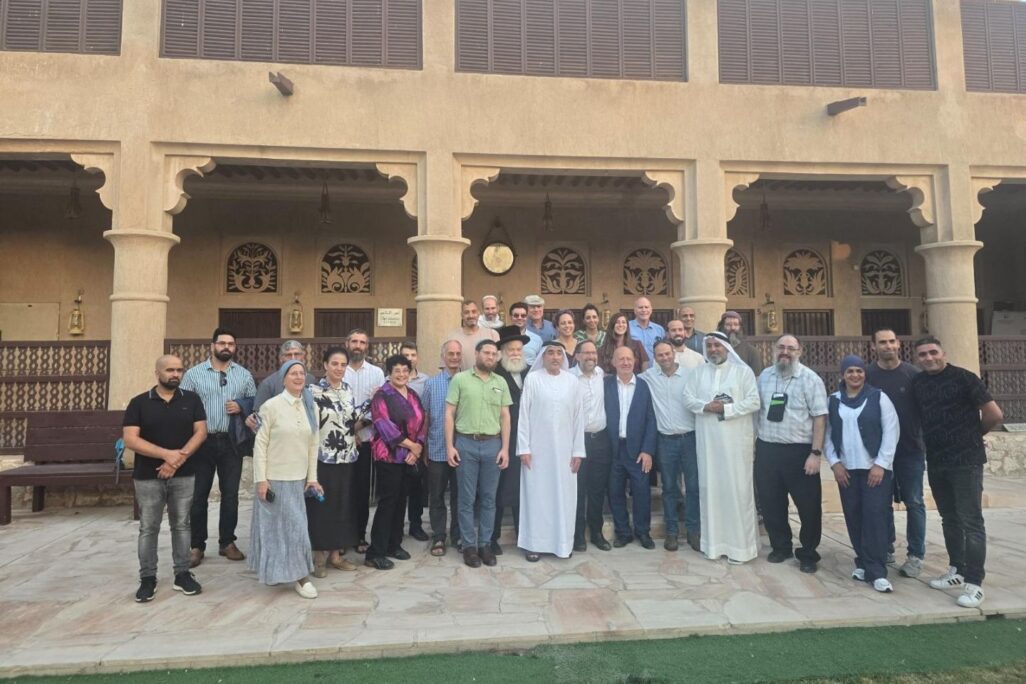
In the midst of a prolonged regional war, and as traditional assumptions about the Middle East are collapsing, a delegation of more than 30 Israeli education and civil society figures traveled last week to the United Arab Emirates.
Members of the delegation, representing more than 20 organizations in the field of interfaith diplomacy in Israel, arrived for a series of high-level meetings and to participate in the third International Conference on Dialogue of Civilizations and Tolerance, held by the Emirates Scholar Center in Abu Dhabi.
“The delegation conveys a clear message at a critical moment: the Abraham Accords are here to stay, and they are the key to stability and prosperity in the Middle East,” said Gilad Shadmon, Director-General of the Ministry for Regional Cooperation, who supported the delegation’s departure.
Rabbi Dr. Yitzhak Nagen, President of the Jerusalem Interfaith Center and leader of the delegation, added: “This unique delegation served as further proof that religion can, and must, be part of the solution. We learned that beyond our shared security interests there is a deeper connection, based on identity, heritage, and shared history.”
“Religion Is Not the Problem, but the Solution”
Rabbi Dr. Aharon Ariel Lavi, Director-General of the Jerusalem Interfaith Center and one of the co-leaders of the delegation, arrived in Abu Dhabi immediately after a conference on antisemitism in Berlin, and was surprised to find that he felt safer in the United Arab Emirates than in Europe.
“In that sense, the Emirati approach is genuine. It’s not just about saying words about tolerance and multifaith coexistence. It is real. Their political stability is built on this,” he said.
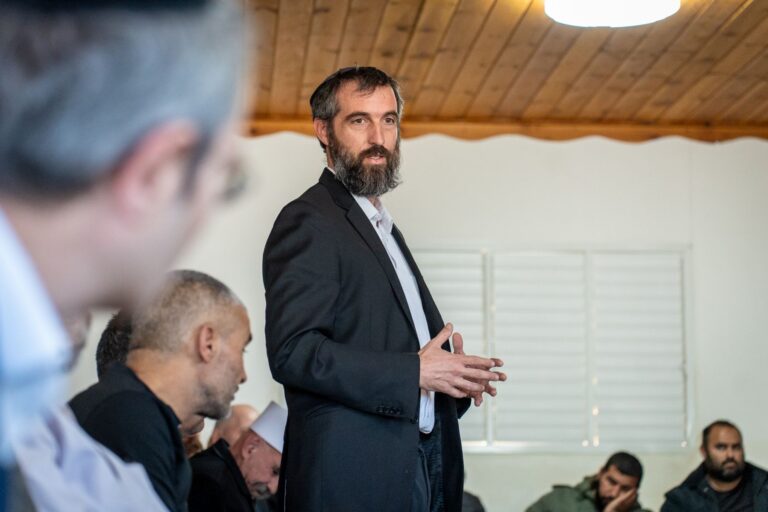
In an interview with Davar, Lavi expands on the insight that engagement between religions is part of the solution, not the problem. According to him, religious extremism seeks to create a new world order: “The goal of the Iranians is to impose Shiism on the modern world. Israel is a significant power in the region. Therefore, they use the Palestinian narrative not out of genuine concern, but in order to gain support and generate chaos in the world. It is a global religious war with a local front, which they are managing.”
In such a situation, he argues, the strategy must change. “If they are in a religious war, our goal is to dismantle the religious component and moderate it,” Lavi says, stressing that a religious war between 15 million Jews and 1.8 billion Muslims is not realistic and would end in destruction.
According to him, dismantling and moderating the religious dimension is done through deconstructing and rebuilding myths and ideas. “In the region where we live, religious ideas have very significant consequences. Many people take ideas, myths, and stories very deeply, in a way that drives them to action. Therefore, one has to engage within the world of myths and imagery.”
Changing the mutual perception of Muslims and Jews is what will enable dialogue, and the Emirati model—a wealthy, developed, pluralistic, and stable Arab state—serves as practical proof that this is possible.
Lavi clarifies that the success of the Emirates is not based solely on natural resources: “The wealth of the Emirates is not just oil. There are other countries with oil, and look at how they look. Countries that are broken apart, like Iraq and Nigeria. Oil is an enabling condition. But you need education for a modern structure in order to grow.”
In order for this model to change relations between peoples, fieldwork and the building of a broad ecosystem of organizations are required. “The Emirates want a security relationship with Israel, but for social and cultural influence, you need to work with grassroots actors. This is what we tried to create within the field of interfaith diplomacy, bringing in organizations with an agenda for cooperation. That is far from obvious. It is also a message to Israeli society: no organization gave up its agenda, but the fact that we managed to bring everyone together is significant.”
Alongside this success, Lavi points to an inherent failure in Israeli society—the lack of knowledge of the Arabic language. “Language is also culture and religion, and it is about understanding the other side,” he notes.
The fact that the conference took place as planned, despite the regional upheaval, surprised even him. “I have friends all over the Middle East. I live in this world, so the existence of peace-seeking Muslims does not surprise me. There is a moderate, peace-seeking Islam. But the fact that the conference was held during a war, and that it was not cancelled, and that senior Emiratis attended, was significant—there were all the reasons to cancel it. We were officially criticized by the Defense Minister. On stage there was a rabbi wearing a kippah openly, and we did not publicize the delegation until we arrived back in Israel.”
“Israeli society is used to direct discourse. In Arab culture, silence is what creates the connection.”
If Lavi’s analysis highlights the strategic urgency of entering the field of myths, Yosef Mahfoud Levi brings the practical toolkit. For Mahfoud Levi, an expert in interpersonal interaction and negotiation in Arab culture, lecturer at Bar-Ilan University and Reichman University, and advisor to diplomats and businesspeople, this is his 13th visit to the United Arab Emirates. He identifies a vast gap between the way Israeli society perceives the Gulf and the reality on the ground.
According to him, Israelis tend to interpret reality in a superficial way and miss the true depth of the Emirati approach. “Culture is an iceberg; what is above the surface is only the tip. But all the decision-making and values are below the waterline, and when you arrive in the field you need to understand the entire cultural world underneath: tradition, religion, family, and general patterns of behavior.”
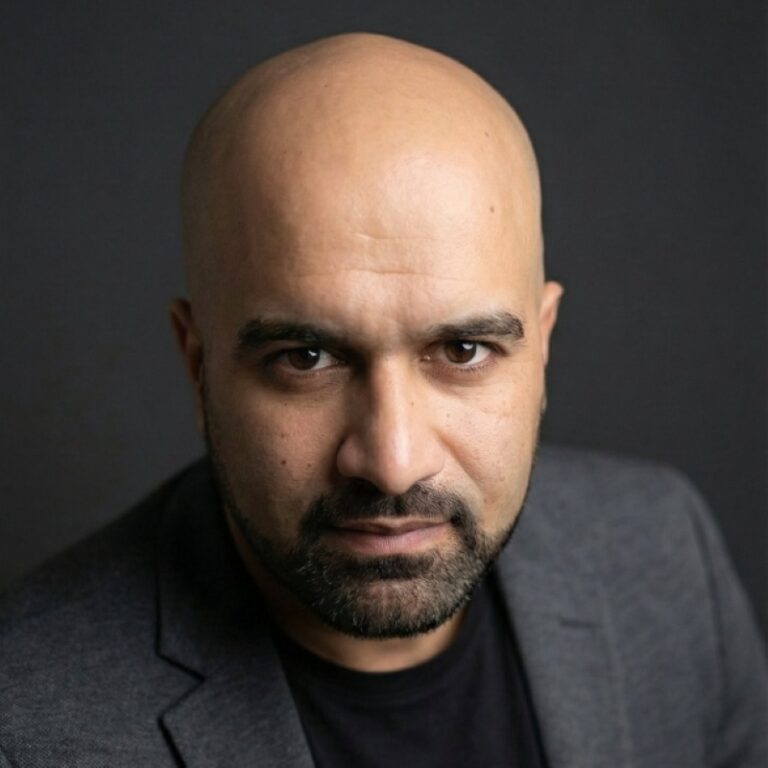
This gap is especially evident in interpersonal and business encounters. The Israeli mentality, which prioritizes efficiency, speed, and immediate solutions, clashes with the cultural codes of the Gulf. “The Israeli public is very accustomed to direct discourse. Even in negotiations, putting everything on the table. Arab culture is an indirect culture,” Mahfoud Levi explains.
“Unlike the Israeli need for sensational headlines and handshake photos, in the Emirates it works differently: “In Arab culture it works differently. Not every relationship needs to be public in order to be meaningful. A picture, a headline, the silence is what actually creates the connection.”
To explain this dynamic, Mahfoud Levi presents the “Three R’s” model (Rules, Risk, Relationships) and shows how reversing the order changes the entire picture. In the West and in the Israeli management style, rules and contracts come first, followed by risk management, and only then is there time to build relationships. In the Gulf, the dynamic is completely reversed: “Relationships come first, they build risk management, and then the rules. That is why building trust is so important in Arab culture, more than in Western culture.”
“When relationships are properly built, a rich inner world is revealed, far removed from stereotypes shaped by limited media mediation. “On my last visit with the people I work with, there was a deep discussion about the future, religion, and technology. There is a deeper discourse in the Emirates about these issues.”
Dialogue Without Compromising Identity
At the core of the Emirati model, and the most important lesson for Israel, lies the interpretation of the concept of tolerance. While in Hebrew and Western thought tolerance is often understood as a passive concept, associated with “suffering” and relinquishing one’s self-definition, in Abu Dhabi it is framed as an active, institutionalized, and strategic value.
Mahfoud Levi illustrates this through the linguistic gap: “The connotation carried by the word ‘tolerance’ in each language conveys the message correctly. In Hebrew it comes from suffering. The Arabic word ‘tasamuh’ comes from generosity, leniency, magnanimity, and not being overly strict about something. Even though the words are translated similarly, they do not carry the same meaning at all, and that is what is interesting in dialogue between civilizations.”
The Emirati “tasamuh” does not seek to blur differences or create a melting pot that erases the uniqueness of the sides; on the contrary, it amplifies them. “We are not necessarily looking for the common denominator, because we understand that we are different. Each side comes with its own tradition and religion, and from that shared space we manage the encounter. Genuine dialogue, according to the Emirati model, does not require giving up identity, but rather recognizing that there is room for someone else. Not dismantling tradition, but working from within it.”
“This type of tolerance does not remain a slogan, but receives strict legal and educational backing from the state. “At this conference we saw how the leadership places interfaith tolerance as a national and strategic value. Everything is also regulated in education and in law. It is a smart process.”
Alongside this, Levi emphasizes that the model is far from naïve. It has clear boundaries and is applied only toward those who accept the most basic rules of the game, the recognition of the other’s right to exist. “Dialogue does not mean naïveté. It means conducting a conversation with someone who is willing to have a conversation with me, someone who recognizes me and I recognize them,” he states. “If a person denies my very existence, then there is no dialogue.”
Ultimately, the strength of the model lies in its ability to isolate political noise and create a stable platform in which identities do not clash but meet. “The moment you introduce politics, you lose the practice,” Levi says, “no matter which side it is.”
Beyond Politics: “A Genuine Human Interest in Another Person”
When moving from broad analysis to the educational and human field, the Emirati model takes on a tangible form. Salwa Abu Kashaf (35) from Rahat, who together with Shadi Zoubi coordinates the Arab youth programs in the “Noar HaOved VeHaLomed” movement and manages a leadership program for ages 18–24 in Kafr Kanna, arrived in Abu Dhabi for the second time. For her, this encounter is an educational tool that must be translated into the daily lives of young people in Israel.
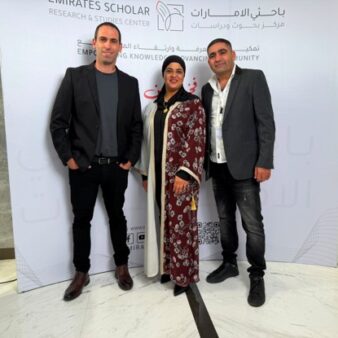
While last year’s visit was mainly a stage of initial acquaintance, this year the dynamic has changed. “Last year we talked about what a youth movement is, because Emiratis don’t know,” she says, adding that returning to the Gulf with a diverse group of Israelis—Jews and Arabs, Haredi and secular participants—generated a deep internal process of rediscovery, precisely through engagement with language.
“Before I thought I was an Arab woman who knows a lot about religion, Islam, and her culture, and it turned out I don’t really know,” she says candidly. “It became an amazing group; everyone in it understands Arabic. There were Haredi participants translating the Quran into English.”
Within the public space of Abu Dhabi and Dubai, where Emiratis are a small minority of the population, Abu Kashaf identified a mode of thinking that is not based on the political baggage familiar from Israel, but rather on seeing the individual as responsible for their society.
“There was an interesting lecture at the conference by Ahmed Al-Mansoori, who is responsible for the Holocaust museum in Dubai. It was interesting for me to see an Arab speaking about the Holocaust of the Jews.”
This perception created in her a surprising experience regarding the genuine interest the hosts show toward their Jewish counterparts, without judgment or accounting for past events: “I never thought there was interest in Jews in Dubai and Abu Dhabi. This is the only group that is interested in Jews in a positive way, real human interest in another person. We don’t talk about what happened and what I did, but about what we can fix in order to build a shared future. These are also my questions.”
From this encounter, she says, “I understood one thing—the Emiratis don’t think like any other people. Their way of thinking is different. They think about personality. It doesn’t matter what the culture or life is. You are a human being and I am a human being, and we can build a shared life. They take this upon themselves as a responsibility.”
The influence of the Emirati model also had a direct impact on the internal dynamics within the Israeli delegation, breaking down early barriers of apprehension between religious, ultra-Orthodox, and Arab participants.
“We talked about everything, politics and culture, about how we can change and build reasonable lives together. It opened up an interesting dialogue. And I was surprised by the religious participants. In the preliminary Zoom call I saw that they were Haredi and religious, and I was afraid of what awaited me, but in the end I enjoyed the group and found it very interesting. I am not a political person and I like hearing Jewish political perspectives.”
Ultimately, the big question accompanying the journey is whether this model can change the bloody reality in the region. For Abu Kashaf, the answer lies in adopting a core principle based on direct listening and creating spaces for open dialogue between leaders and field teams:
“Al-Mansoori said that if you want to build lives, you need eye to eye contact—listening and hearing. To believe that the person in front of you is not coming to kill you, and from there it is possible to reach a shared life. Back in the country after we returned, everyone has a group. Bring our team and yours and we can talk. If the leaders can open a conversation, then the field teams can also open a conversation.”
“The Key to Changing the Middle East Is Education”
One of the central messages that emerged during the visit was the existence of a growing and expanding network of Israeli organizations committed to promoting regional cooperation. These organizations are working together with partners across the Middle East in order to deepen and expand the relationships formed within the framework of the Abraham Accords, and to advance them to the next stage.
Dr. Ali Rashid Al-Nuaimi, Chair of the Committee on Defense, Interior and Foreign Affairs of the Federal National Council of the United Arab Emirates and Chair of the Manara Center for Coexistence and Dialogue, summarizes this strategic vision: “The Abraham Accords are not primarily a security or political agreement. Their purpose is to create connections between people, communities, and nations. Unfortunately, parts of our region have been hijacked by forces promoting narratives of division, hatred, and mistrust. That is why we need peace leaders who will build bridges and speak publicly and clearly about the importance of these relationships. The relationship between the United Arab Emirates and Israel is a strategic one, based not only on shared interests but also on a shared vision for a better future for the region. We must continue to strengthen this partnership for future generations.”
Joining this vision, Dr. Firas Habbal, President of the Emirates Scholar Center, emphasizes the practical dimension: “We understand that the key to changing the Middle East is education, and therefore we have decided to focus on this field strategically and scientifically. We see this partnership as a significant bridge for reconciliation and for long-term impact on the region, in the spirit of tolerance and mutual understanding.”