



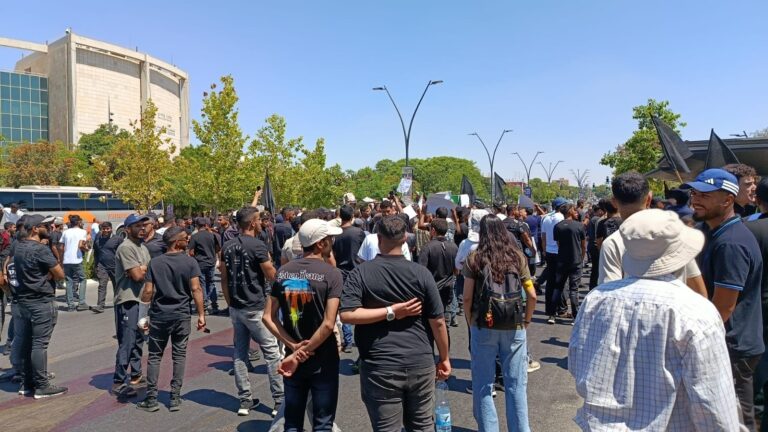
Hundreds of people demonstrated on Thursday last week outside the offices of the Authority for the Regulation of Bedouin Settlement in Be'er Sheva, protesting the state's policy of demolishing Bedouin homes.

Last week, residents of Tel Arad were forced to demolish their homes and spent the night in the local school. At the Local Government Conference, National Security Minister Itamar Ben Gvir referred to the incident, saying: “They told me that the Bedouins whose homes were demolished are sleeping in schools in Arad. They're there because they say, ‘Ben Gvir is demolishing our homes.’ So I tell them to prepare many more schools, because I'm going to demolish many more of their homes.”


The Council of Unrecognized Villages in the Negev said: “The combined area of Tel Aviv and Givatayim is 55 square kilometers, while the area cleared in the Negev is, at most, 2 square kilometers. Most of those affected by the demolitions continue living among the rubble and are not going anywhere. There is no governance here—only the sowing of chaos and the impoverishment of people, at a cumulative cost of 250 million shekels, the direct cost borne by approximately 2,500 families who have lost their homes. If anyone thinks this increases stability, we have a convicted Minister of National Security to sell them. The only solution is governance through construction, development, and the equitable provision of public services.”

Adam Al-Assad, Vice President of Community Affairs at the Stars of the Desert nonprofit and a social activist involved in advancing Bedouin society in the Negev, addressed the minister on social media, writing: “It is very easy to reduce the Bedouin story to a question of ‘illegal construction.’ It is very easy to present yourself as the defender of the law against those who violate it. But that is precisely the problem, you are talking about the outcome while ignoring the story that led to it.
The Bedouins of the Negev are not demonstrating because they are seeking the right to break the law. They are protesting against a planning and settlement policy that is not suited to the reality that has developed here over decades—a reality that the state itself played a central role in shaping.”