


The Ministry of Transport announced this week that the northern section of the Eastern Railway project will begin operating on Sunday, June 28. As part of the new segment, the stations Hadera West, Shomron–Tayibe, and Tira–Kokhav Yair will open. With their inauguration, train stations built within Arab cities will operate in Israel for the first time, including the Shomron–Tayibe station, which is expected to mainly serve residents of the Arab community in the area.
However, alongside the historic moment, a field visit reveals mixed feelings among many residents. Last month, Tayibe Mayor Yahya Haj Yahya boycotted the inauguration ceremony of the railway and station held in his city, in protest of the station’s name. “They made a political move at our expense,” Haj Yahya said at the time. “Is this Samaria (The West Bank)? The station was built on land belonging to our city, and we are residents of the Sharon region.”
")
These sentiments, it turns out, are shared by many residents of the area. “Why call the train ‘Shomron–Tayibe’?” asks Riyad Abd Kadem (50), a resident of Tayibe, raising a question many locals have also voiced. “Call things by their name—Tayibe Station, or Tayibe–Qalansawe–Sha’ar Efraim Station.”
Between Two Cities
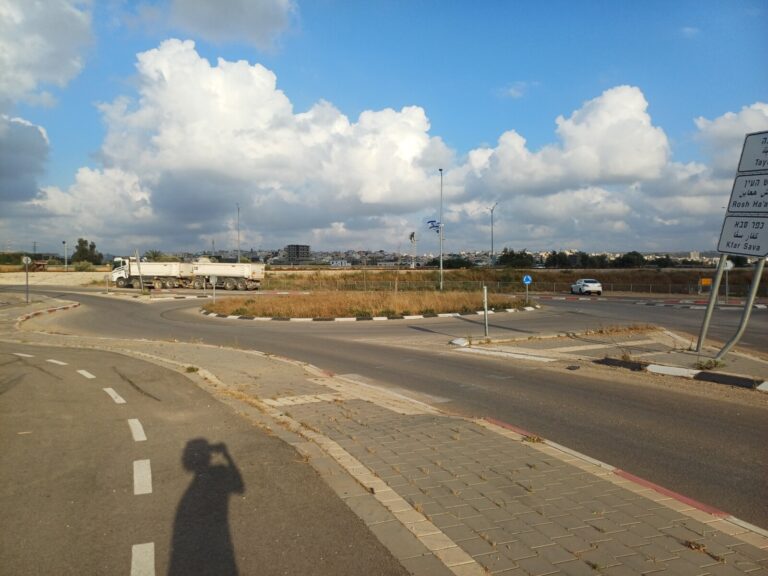
Indeed, the station is not located near Shomron (Sameria), which lies on the eastern side of Tayibe. Instead, the station, a modern, well-designed building with a large adjacent parking area, is situated on the western side of Tayibe, down the slope of the bridge connecting it to the nearby city of Kafr Qasim.
To the north of the station, further along the small valley formed between the two Arab cities, is also the entrance to the Jewish moshav Sha’ar Efraim, with its approximately 2,000 residents.
In that sense, the name “Tayibe” or “Tayibe–Qalansawe” would have been far more fitting for a station located between two Arab cities, among the largest in the Triangle region. In fact, throughout the planning process, this was the station’s official name, from the approval of its plans in 2018 until well into 2025.
Similarly, the Tira–Kokhav Yair station, which will also open as part of the Eastern Railway, was originally named solely after the nearby Arab city of Tira.
In Tayibe, Residents Welcome the Railway, but Not the Name
Tayibe, whose name means “the good” or “pleasant,” is the second-largest city in the Triangle region, with a population of nearly 50,000. The city is built at the point where the steep ascent to the Samarian Hills begins. Viewed from the railway station, Tayibe presents a striking landscape as it stretches gracefully up the hillside.
In Arab tradition, Tayibe has long been regarded as one of the most beautiful towns in the country. Jordan’s King Abdullah I is even credited with saying, “All the tayyibat (good things) in the world come from God—except for the Tayibe of Bani Sa'b,” referring to one of the city's original tribes.
")
Today, however, Abd Kadem believes the railway is far from enough to address the city's problems.
“It’s great that we have a train,” he says, “but you want to talk to me about transportation? Look around. My son leaves the house, do you see sidewalks you can actually walk on? Do you see any crosswalks? And that’s our smallest problem. Our city used to be beautiful, but today there’s no education, no respect for teachers, garbage isn’t being collected, and people park on red-and-white curbs. Tell me, if something like this happened in Kfar Saba, is there any chance the police wouldn’t show up?”
Indeed, crosswalk markings are largely absent throughout Tayibe, and the sidewalks are inconsistent or missing altogether.
According to Abd Kadem, the railway is expected to make a real difference for younger residents. “The first thing I thought about was taking my son on a train ride to see our beautiful country,” he says. “I also understand that for some fathers, it will shorten the trip to Tel Aviv, allowing them to spend two more hours a day with their children—for them, that means the world. But this is only the beginning of addressing our problems. They expect us to applaud because they gave us a glass of water. What we really need is for this to become a pleasant place for our children to grow up.”
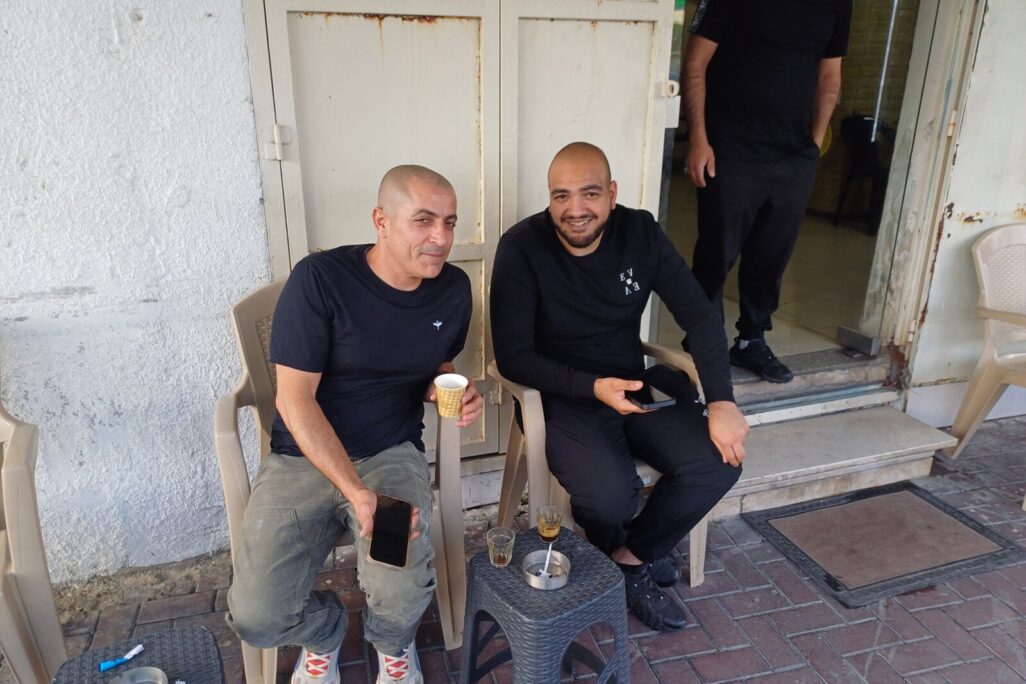
Sitting beside Abd Kadem in what he describes as “the best barbershop in town” are Salem Nur, the shop’s owner, and Saad Aghajeh, who runs a construction business.
“It’s good that we’re getting a train. It doesn’t help us much,” Saad says with a laugh, explaining that most of his business is concentrated in the Sharon region. “But for young people, it’s very important. They travel to Tel Aviv and Haifa to study and work. Tayibe has buses, but they’re not enough. I never imagined we’d have a train, but it’s going to do a lot of good.”
In Qalansawe not everyone heard about it—but those who have are welcoming the news
Just a few minutes’ drive away, on the other side of the station, lies Qalansawe. Unlike Taybeh, which rises on the edge of the hill, Qalansawe is smaller and flatter, with a somewhat more chaotic building style.
In the northern part of the city, on the way to the station, a narrow and constantly congested road runs through the industrial zone. It passes workshops, cafés, and restaurants where many of Qalansawe’s residents work, or meet after work for coffee and a hookah.
“The railway will be good for the area, especially for people coming to visit. That’s important. But the reality is that most people will still need a car,” says Faris Yahya (46), a Tayibe resident who works in Qalansawe, as he works in his window and glass workshop.
“The station is far away. Tayibe now has small minibuses that can take people there, but just look at this narrow road, it’s already packed with traffic. What’s going to happen once the railway opens and everyone starts driving to the station?”
")
According to Faris, in Tayibe and Qalansawe, owning a private car is not a matter of choice.
“If I need to get to the Ministry of Interior by train, I can travel to Haifa, where the office is close to the station,” he says calmly, his fingers skillfully fitting rubber seals into the frames of windows and shutters. “But if my mother needs to go to the Ministry of Interior, it’s better for me to drive her to Netanya, because there isn’t much public transportation there.”
“So the station doesn’t really solve the problem.”
“What can we do? Everyone in the area still needs a car. For example, I know many people who work in the Kfar Saba industrial zone. It’s close, it’s right here. Now there’s a train to Kfar Saba, but once passengers arrive there, they still have to take another bus, and here they also need a bus just to reach the station. So in the end, they’ll just take the car.”
")
There is one more thing that concerns Faris. “As part of the station project, they built a bypass road around Qalansawe that will lead directly to the main highway and the railway, bypassing the industrial zone. On the one hand, it will reduce traffic from outside vehicles here, but on the other, it will also suffocate the industrial area. We’ll still have congestion from local traffic, and at the same time we’ll lose the casual customers who stop by from outside to eat or have a coffee.”
Alongside these concerns, others are far more optimistic. At his food stand in the heart of Qalansawe Owaimeh Zamiro laughs warmly. “Of course I’m happy about the railway!” he declares enthusiastically. “It will help my children, inshallah, and all the young people here who are studying. It’s going to make things better here,” he says while asking one of his customers what kind of meat he would like in his sandwich. “I have three children at university, thank God. They study in Ariel, Tel Aviv, and Herzliya. The railway is going to help us a lot. It will make life even better here in Qalansawe.”
Owaimeh, who turned 51 this year, admits that he never imagined he would see a railway in his lifetime. “As a child, I never dreamed they would build something like this here,” he says. “But from the moment they announced the project was finished, it made me very happy.”
His wife, Kifa, who has just parked nearby, also welcomes the opening of the new station. “I was thinking about applying for a job at the station,” she says with a smile. “I’ve heard it’s a good place to work.”