


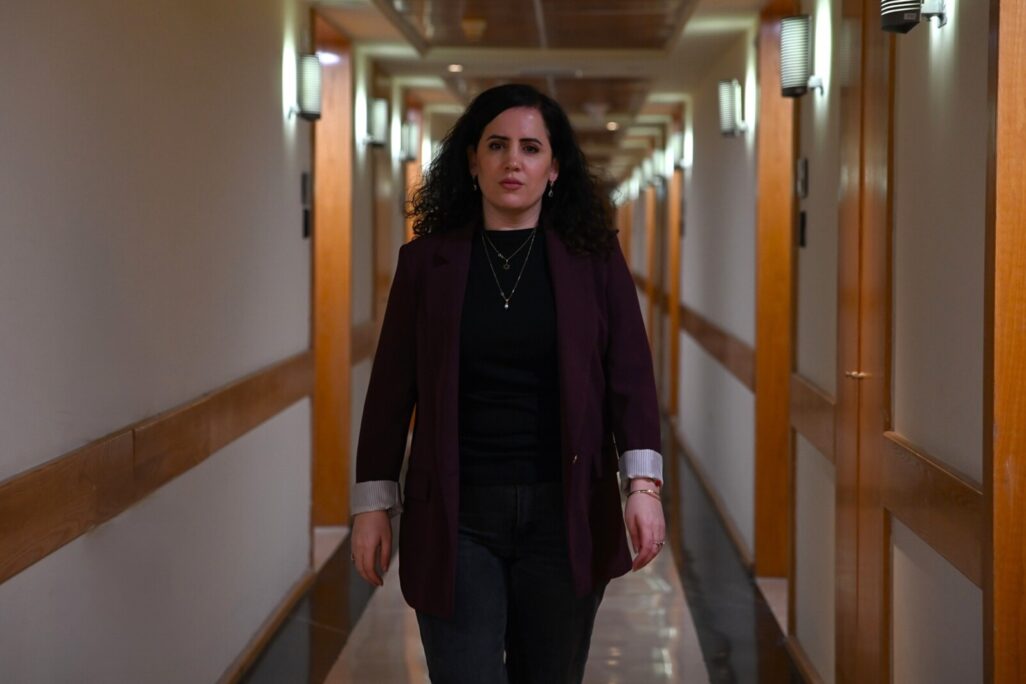
A small public dispute unfolded in recent days between Opposition Leader Yair Lapid, who published a manifesto praising capitalism, and MK Naama Lazimi, one of the leading figures in the Democrats party.
“Socialism simply doesn’t work,” Lapid wrote. “When people tell me everyone should be equal, I ask them two simple questions: Are you willing for your children to receive a mediocre education? And are you willing to guarantee that you will leave them no inheritance?”
Lazimi responded immediately: “Extreme inequality is what makes it possible to erode democracy. Social democracy is the vaccine against tyranny.”
“I advocate for a welfare state, not a sectoral and corrupt welfare-handout policy,” Lazimi tells Davar. While she has made headlines primarily for her participation in protest movements, in the Knesset she is also known for her work on parliamentary committees dealing with socioeconomic issues.
One of my conversations with Lazimi took place on a rare occasion: a Monday morning when she was not at the Knesset. Her speaking rights in Knesset committees had been suspended for two days by the Knesset Ethics Committee because of her participation in protests calling for the return of the hostages that had spiraled out of control.
According to Lazimi, colleagues in the opposition told her she had been suspended “to create the appearance of symmetry,” after MK Nissim Vaturi of the Likud had also been suspended. “I was so furious about that,” she says, her frustration unmistakable. “I have no words.”
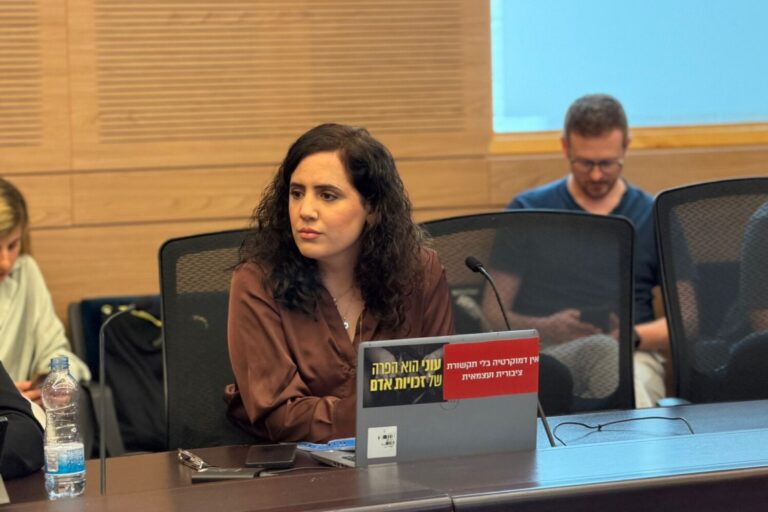
Later that day, she came to the Knesset and sat silently in the Special Committee on the Communications Law, her laptop open in front of her. The sticker affixed to it—“There is no democracy without independent public media”—served as her quiet form of protest.
Someone unfamiliar with your work in the Knesset might think that your main activity is setting bonfires on the Ayalon Highway.
“By the way, there was never a bonfire on the Ayalon. It was in an enclosed area that the police had approved. But that’s how the poison machine’s narrative works. I decided not to waste my energy fighting it. Whenever anyone asks me, I tell them that if the families of the hostages had asked me, I would have done much more for them. So I have absolutely no intention of apologizing for it.”
Lazimi is finishing her fifth year as a member of the Knesset.
In an interview with Davar conducted a year after she first entered office, it was evident that she was still searching for her place in parliament. She was photographed sitting with tense shoulders in the fourth-floor corridor, with portraits of Knesset members who had received the Israel Prize behind her.
Now we meet in her bustling office, filled with volunteers, aides, letters, certificates, stickers, and stacks of papers. During the photo shoot, she uses every spare moment to revise a speech she is preparing.
Last week, Lazimi set herself a new goal: to be the one presenting the Israel Prize, as Israel’s Minister of Education.
Winning Public Trust in Order to Support Taxation
Lazimi has long been identified with the struggle for social justice. In recent months she published a policy document titled “A New Deal for Israel,” which outlines her socio-economic principles while addressing Israel’s current reality.
For Lazimi, education is a central part of the social services the state must provide to its citizens—something that is not a given in a Knesset largely characterized by economic right-wing positions. The path toward this, she tells Davar, runs through shifting budgets away from sectoral mechanisms toward state-wide, transparent funding.
Regarding the method of budget allocation, Lazimi criticizes the current system, which increasingly relies on coalition funds, and proposes a new approach to state budgeting.
She speaks of abolishing what she calls “sectocracy,” a term she may have adopted from the social-democratic historian Prof. Dani Gutwein, under whom she previously studied. She calls for ending mechanisms through which public funds are directed to specific groups via political agreements and coalition-based allocations.
")
“I am proposing universal welfare policy, not a sectoral and corrupt handout policy,” Lazimi says. “Social democracy cannot exist in a crisis of trust, because ultimately the goal is to create budget expansion for the benefit of citizens, and we do that through taxation.
“If there is no trust, you see in the polls that people don’t want to pay taxes, because they say it doesn’t come back to them. ‘If it goes to healthcare and education I’m willing, but if it goes to the corrupt I don’t want to pay.’
“If I say no to sectoralism and no to corrupt welfare arrangements, then the person on the street will say: ‘Okay, she doesn’t want to exploit me.’”
As an example of the lack of long-term thinking, Lazimi points to the decision to abolish the Knesset’s Future Generations Commission, a role that existed only between 2002 and 2006.
“This was a groundbreaking function that came from a social-democratic perspective—planting seeds so that they will grow, the opposite of an emphasis on immediate results. I look at reforms in the Arrangements Law and see that they are destructive to future generations, even if they help the Budget Department close some short-term gap.
“Thinking about the long term is also relevant when it comes to evacuating Haifa Bay, investing in renewable energy, and rebuilding early childhood education. It’s not because I’m naive or disconnected—it’s because I’m looking ahead. And by the way, the sectoral enclaves created here under neoliberalism cost the Israeli economy far more.”

Lazimi is determined to lead sweeping economic and social reforms if the political camp opposing Benjamin Netanyahu returns to power.
“In four years of government, you can bring about a revolution. Take the Rabin government, it served for only three years. It established the public college system, passed the National Health Insurance Law, created 100 mother-and-child health clinics, launched the construction of Highway 6, reduced school dropout rates by 40%, increased matriculation eligibility by 18%, made massive investments in Arab society, and raised teachers’ salaries without a labor dispute. Those were extraordinary achievements. People remember Rabin only for the peace process, and that’s a shame.”
State Haredi Education at the Top of the Agenda
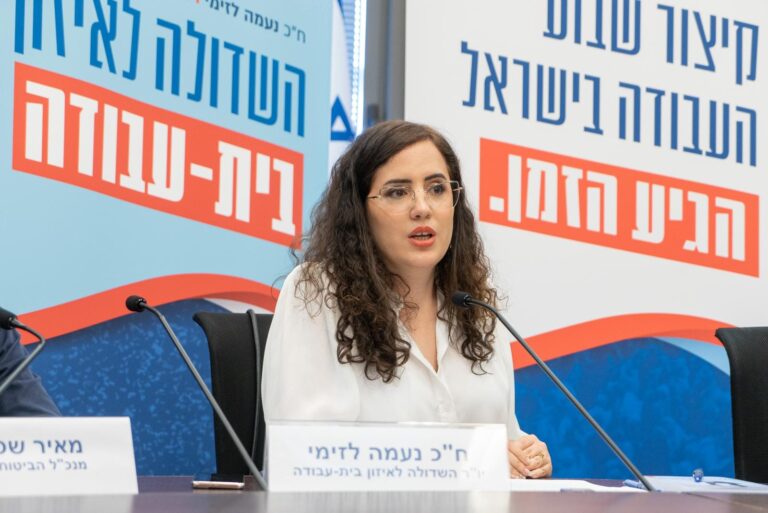
Last week, Lazimi presented her education plan at a special conference in the Knesset. She speaks of promoting “education in the spirit of the Declaration of Independence,” arguing that “schools are afraid to talk about those values.”
Like Gadi Eisenkot, Naftali Bennett, and Benny Gantz, she supports equal funding for educational institutions that teach the core curriculum, while reducing funding for those that do not. However, she insists that her proposals differ significantly from theirs.
She draws a direct connection between quality education, equality, and democracy—or, to use one of the few terms still heard from her in the Knesset, social democracy.

“The issue of school funding, which should be equitable and based on fair, uniform criteria, is a responsibility that falls on us,” Lazimi says. “I’m not sure everyone is willing to tackle it. The Arab state school system is at the bottom, which only deepens inequality for a community that is already chronically underfunded.”
“Our campaign against funding schools that do not teach the core curriculum has already doubled the number of state Haredi schools. The Belz network joined the State Haredi system, and that happened because of the defensive struggle we waged. Just imagine what could be achieved through constructive policymaking. Today, for the sake of political alliances, Knesset members are willing to deny Haredi children the opportunity for employment and education that they could receive in the state Haredi system.”
“Some in the Haredi community, or in the broader religious public, might say, ‘She wants to harm us.’ I don’t deal in narratives; I deal in reality. If someone wants to believe that by advocating better employment services, a core curriculum, and a growing economy I’m trying to harm them, I’m not going to argue with them, because I know it simply isn’t true.
“I want to lift people out of poverty, not preserve it. I’m not trying to undermine Haredi identity. I want a State Haredi education system, which enjoys majority support within the Haredi public. Because of political conservatism, people are reluctant to move in that direction, even though there is demand for it.”
“Today, we are the Knesset members working in favor of core curriculum education and ending funding for studies without a core curriculum in partisan networks, we are acting for the benefit of the Haredi society more than their own representatives in the Knesset. We must recognize state Haredi education within the State Education Law. I also support massive investment in infrastructure in order to stabilize and build state Haredi schools. To me, this is an investment in future generations.”
According to her, an equal military conscription law would also help integrate Haredim into the labor market, and in that sense it is an “investment in citizens, who will return it through taxes.”
Strengthening Teachers, Including Veteran Educators
The challenge facing education and finance ministers in recent years has been the restoration of the teaching profession’s status. “Yes. This decline in the status of teachers, which is the most important profession there is, this kind of moral and intellectual erosion, is a disaster.”
There are many claims about the wage gap between new teachers and veteran teachers, which makes it harder for new teachers to enter the profession and pushes experienced, exhausted teachers to leave the system.
“First of all, I want us to view teaching as a lifelong profession, which means we also need anchors that prevent burnout among veteran teachers. Raising salaries for young teachers is essential, simply because their purchasing power is truly shrinking in the face of the cost of living. I see it at home.”
“I’m married to a teacher,” Lazimi says of her partner, Avi Motadeh. “He loves being a teacher, but teachers are leaving because they can’t support themselves on 6,700–7,000 shekels, especially when the conditions and work environment are not good.
“When we moved to Holon, the first thing he said to me was, ‘How nice that I don’t have to bring coffee from home anymore; there’s a proper coffee station.’ It sounds trivial, but these small things reflect respect for the profession.”
And regarding veteran, exhausted teachers?
“We need to create a real program. Not a committee that just ticks a box. To build a genuine career horizon, with variety in the role, and the ability to refresh yourself by moving between different areas within the profession. Part of the burnout comes from the fact that there are no meaningful additions to highly important roles. People don’t choose to be homeroom teachers, because it requires so much investment and the extra pay is negligible, and that’s terrible.”
Many people who advocate for change in education talk about decentralization of authority. How do you see that?
“When pedagogical autonomy is taken away, it doesn’t allow for uniqueness,” Lazimi agrees, referring to her father, Avi Lazimi, who worked as a school principal in Migdal HaEmek.
“My father made far-reaching changes in the school he ran. He turned it into an arts-focused school, with chess awards, collaboration with the Mayumana dance group, and engagement in entrepreneurship and high-tech studies. The over-centralization in the Ministry of Education is not right.”
“The ministry needs to define a clear and strict standard if we want equality of opportunity. But when a school principal wants, for example, to develop an agricultural track, or a civics and leadership track, and to create something unique within the public state education system, it should be possible to enable that and also reward it.”
What does this division of authority between the Ministry of Education and schools look like?
“I think there should ultimately be an orderly committee that defines the mix, and we will implement its conclusions. I’m not interested in eliminating all responsibility and oversight, but rather in ensuring that what is under the ministry’s authority is clear and unequivocal, while also allowing space for pedagogical autonomy. I’m not setting rigid boundaries here; this requires serious staff work, because it’s something everyone agrees needs to change.”
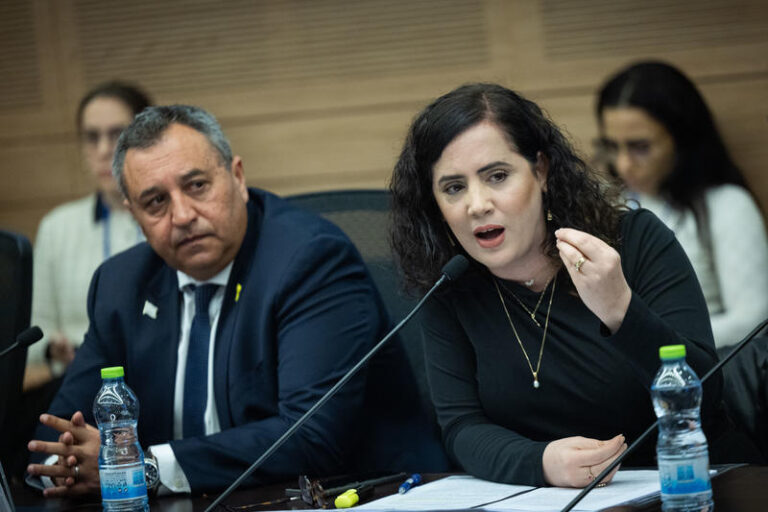
Lazimi speaks about uniform state funding based on core curriculum studies and the values of state education. She points to a direct link between government policy and harm to education budgets.
“During the teachers’ struggle against wage cuts, which I supported completely, what shocked me was that the cut was almost identical to the budgetary reserve that was then held for Haredi education networks, which stood at 1.2 billion shekels. It was very extreme. In other words, workers are funding exemption from responsibility. It’s unbelievable.”
If we return to Lazimi’s recent debates with her partners in the “change bloc,” one of the central ones is with the two leaders of the “Together” party, former prime ministers Naftali Bennett and Yair Lapid, who entered politics after the social protest movement but advanced an economic approach opposite to Lazimi’s.
“How will you advance all these goals in a coalition led by Bennett and Lapid, who are not exactly major social democrats? If the election were about economics, you and Bennett would likely be at opposite ends of the spectrum.”
“We learned from last time. We come prepared, and we will ensure our values are given significant weight in the coalition agreements of a ‘government of repair.’ In the end, we are demanding something very clear: after four years of failure and decades of neglect and erosion alongside political decay, it is time for the state to take responsibility for its citizens. We don’t have the privilege of being a detached state.”
However, Lazimi emphasizes: “I will be in any government that does not include the Kahanists and the corrupt people who are currently in it.”
I recently asked Bennett about his enthusiasm for DOGE, Elon Musk’s so-called “Department of Government Efficiency.” Bennett replied that he would come with a machete to cut what he describes as excessive regulation and bureaucracy, in a very aggressive way. What do you think?
“I don’t understand how, after October 7, someone wants to cut the state down and leave us so exposed, not only in routine times but also in emergencies. The same state that failed after being weakened, cut, and stripped of everything in the social services system. If there is one clear lesson, and Lapid also agreed after October 7, it is that the public sector and social services are an inherent part of national resilience.”
“I am not afraid to talk about efficiency and reducing bureaucracy, but the public service needs to be as efficient, technological, and as well-staffed with high-quality human capital as possible. I want a state that takes responsibility, not just one that regulates.
“Even to all the high-tech entrepreneurs, I want to remind them that without the state this would not have happened. From the technological units, through R&D grants and all the public investment, alongside remarkable human entrepreneurship—that is what built this engine of growth. Anyone who wants to dismantle that is undermining our ability to thrive and succeed.”