
“Loss does not have to be traumatic, but studies show that people with intellectual disabilities are three times more likely to experience trauma. When bad news is delivered with appropriate support and mediation, the cycle of trauma can be broken rather than becoming lifelong,” social worker Hila Tamar Adri told Davar.
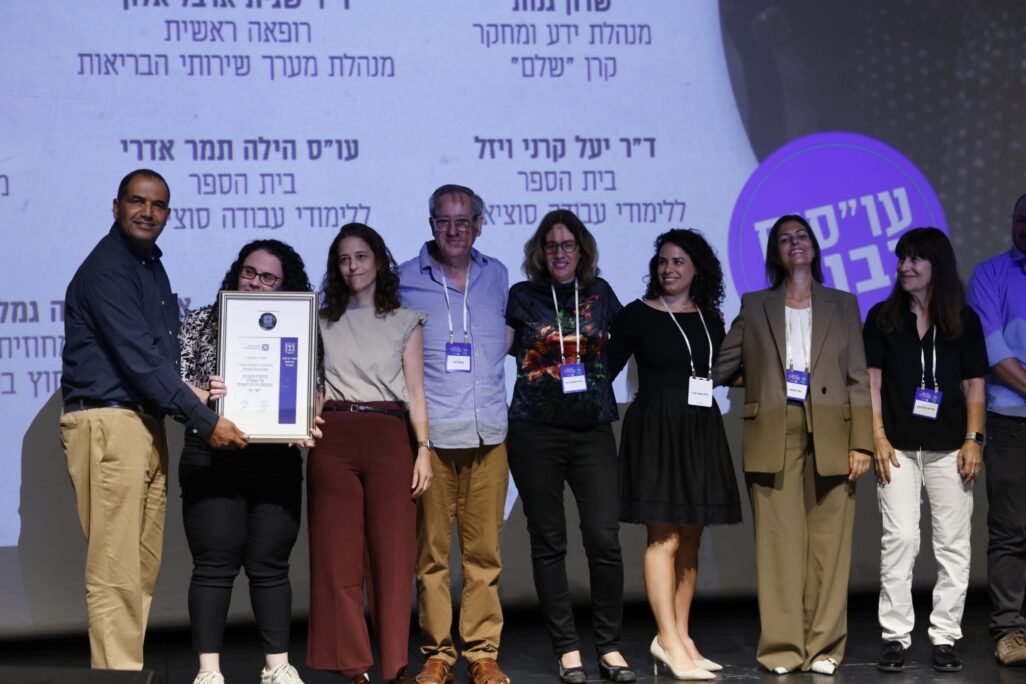
Last week Adri and her partners from the Disabilities Administration at the Ministry of Welfare and the Shalem Fund received a commendation for the initiative “Delivering Bad News to People with Intellectual Disabilities.” The award was presented at a ceremony dedicated to the work of social workers.
On the night of October 7, Tamar Adri realized that the research she had been working on regarding how professionals deliver news of a loved one’s death to a person with an intellectual disability would now be especially relevant.
In rapid and unusually close cooperation, the Disabilities Administration at the Ministry of Welfare and the Shalem Fund worked together to draft a procedure tailored to people with intellectual disabilities.
“Out of a desire to protect, for example, a social worker delivering bad news may not know whether to inform a sibling with a disability about the death of his brother or sister, but in doing so she denies him the opportunity to encounter grief,” says Tamar Adri. “But the research shows that they are able to process the news.”
“On October 7, everyone encountered loss and grief across every circle,” says Naama Shavit from the Ministry of Welfare, who accompanies the project. “Our goal was to ensure that a person with a disability is part of society, part of the Israeli narrative, for better and for worse.”
“Funerals and shiva are essential for processing trauma”
On the project page on the Shalem Fund website, therapists can find a protocol adapted into Hebrew, Arabic, and Russian; a video for professionals; another video explaining what a funeral is for people with intellectual disabilities; and an additional video on how to properly deliver bad news.
“The establishment of the project happened in the week after October 7,” says Sharon Gannot from the Shalem Fund. “We were in a national event, and we did what was necessary to ensure that people with intellectual disabilities were part of it. Everything is adapted into very simple language, what is a hostage, what is war.”
According to Shavit, “There is something even more difficult in it, when the crazy reality we experienced is described in simple words without sugarcoating it.”
Tamar Adri is convinced that funerals and the following week of sitting shiva are essential for processing trauma for every person, and certainly for a person with an intellectual disability.
She describes how, as a young social worker, she encountered a case of a woman with an intellectual disability who used to wait for her mother, who had died twenty years earlier—“apparently because her death had not been properly mediated to her.”
“It does not have to be this way. When a family member with an intellectual disability experiences loss, not only war or October 7, every effort is directed toward supporting them. If the news is communicated properly, both the parents and siblings, as well as the family member with the intellectual disability, have the opportunity to process the tragedy, to attend the funeral, to honor the deceased, and to sanctify life.”