
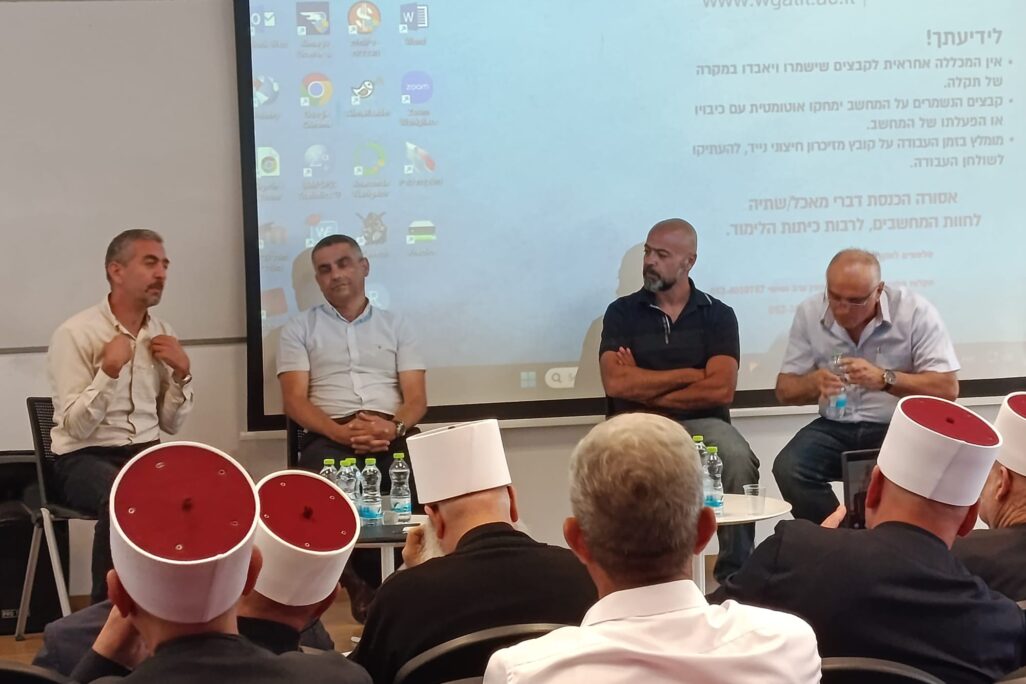
“The internal existential threat concerns me greatly. I know what the Druze identity of my children will be, but what will it be for my grandchildren?” wondered Alaa Abu Roken, a Middle East expert, at the conference “The Druze in the Middle East – Between Despair and Hope,” held last week at the Western Galilee College. “Our situation today is relatively good compared to other Druze communities. But we must identify the dangers as well as the sources of our resilience.”
Abu Roken identified three challenges facing Israel’s Druze community today: the identity conflict, the connection to roots, and modernization. According to him, the individualism among young people is weakening their connection and commitment to the community, alongside the growing trend of complete secularization among young Druze.
He said the situation is even more complex because there is a conflict between the community’s sources of strength: “There is a conflict between statism and sectoral interests, between the community’s ability to be part of the state while maintaining a balance of interests.”
“Dysfunctional Institutions”
Dr. Salim Barik, an expert in political science and a researcher of Israeli-Palestinian relations, local government, and the politics of Israel’s Druze community, disagreed with Abu Roken: “There is a problem, but the problem is not individualism; it is the process of fragmentation. This is connected to local authorities, clans, and dysfunctional institutions.”
According to him, instead of functioning as a unified community, local authorities operate separately and suffer from dysfunction and corruption. “We make up 1.4% of the population; we do not have significant political power. We need to rely on a larger force. We need to be pluralistic but united, and manage our institutions in an efficient and effective manner.”
He added that “today, crime is rampant within the community,” and emphasized the importance of religious authority in addressing the phenomenon. Sheikh Mowafaq Tarif, the spiritual leader of Israel’s Druze community, said: “Religious leaders are doing a great deal regarding crime. Personal security is the responsibility of the state and the police. They are doing nothing.”
Dr. Jinan Fallah, a researcher of Druze society, argued that the solution lies in education: “It is important to invest in early childhood education and in the family. We can preserve ourselves if we educate correctly.”
The discussion also focused in part on the Druze villages in the Golan Heights. Dr. Barik called them “border minorities” who face suspicion from both sides. According to him, within ten years all Druze residents of the Golan should serve and become citizens. “The Druze of the Carmel, the Galilee, and the Golan should be one community,” he emphasized.
William Abu Awad, head of the Buq’ata Local Council, responded: “There will not be large-scale conscription, because we see the treatment of our brothers in the Galilee. They are equal when it comes to obligations, but not when it comes to rights.”