
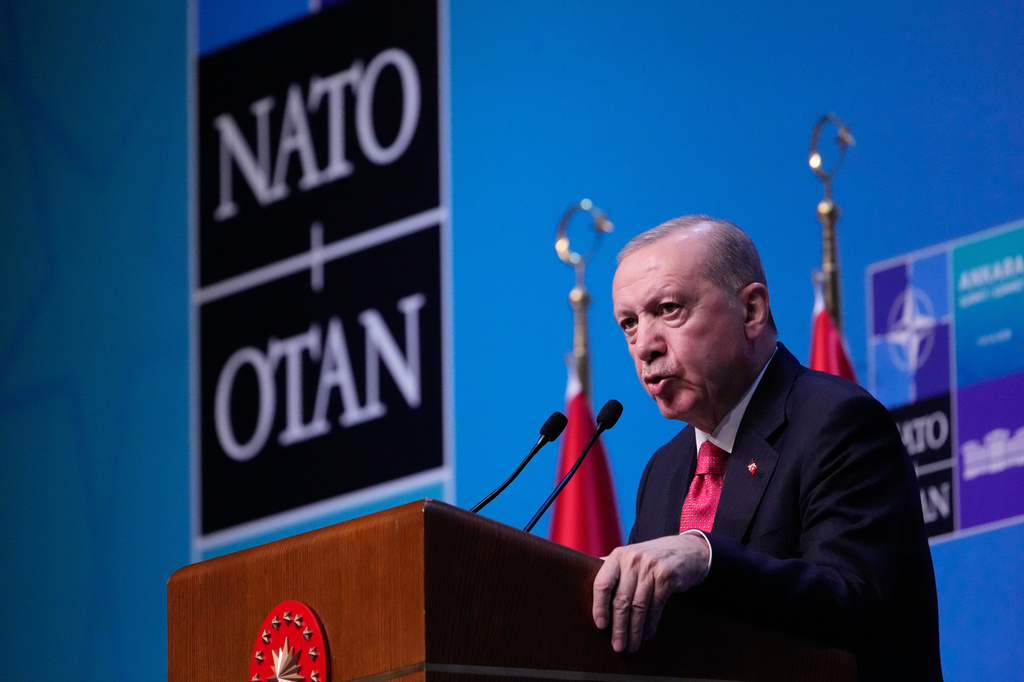
Last week's NATO summit in Ankara reveals Turkey's rising status within the alliance, driven by European fears of Russia, the weakening of American involvement in Europe, and Turkey's expansion in Syria. In an interview with Davar, Dr. Hay Eytan Cohen Yanarocak, a Turkey expert at the Dayan Center at Tel Aviv University, explains how Turkish President Recep Tayyip Erdoğan is using this situation to expand his influence both externally and domestically.
What does the current NATO summit reveal about Turkey's position?
"The current summit reveals Turkey's strength within NATO today. Erdoğan is able to do this because of Europe's fear of Russia. The Europeans need Turkey as a supplier for the defense industry, especially considering the fact that the United States has significantly reduced its involvement in the NATO alliance. As a result, the Turkish share of the contribution is becoming much more important."
"This is also the reason Europe does not dare say a word about the erosion of Turkish democracy. Erdoğan imprisoned the main threat to his rule, Ekrem İmamoğlu, the mayor of Istanbul, and he has been in prison for more than a year, in a way that leaves him facing a weak and divided opposition."
")
According to Cohen Yanarocak, another reason for Turkey's strengthening is Syria. "The entire American foothold in Syria is thanks to Turkey. After all, until today we have not seen the United States truly succeed in operating there. But after the fall of Assad, and thanks to Turkish penetration into Syria, we are seeing that the Americans have also managed to enter Syria, take a cut from the oil, and contribute to the reconstruction of the country."
Is this the reason Trump is showering Erdoğan with praise?
"Yes, he is also giving him public legitimacy. He is once again promising him the F-35 aircraft, but in my assessment this is a maneuver, because the only one who can approve the sale of such aircraft is Congress."
According to Cohen Yanarocak, this combination of the strengthening of Turkey's status and the expansion of its influence into Syria has awakened the neo-Ottoman specter: the longing to return to the borders and mentality of the former Muslim empire. A prominent example was the statement made by Turkish Interior Minister Mustafa Çiftçi in a speech at the beginning of June:
"Just as we witnessed the liberation of Damascus, Aleppo and Karabakh, with God's help, one day we will also see the liberation of Jerusalem."
Externally, Turkey's attempt to increase its influence in the Arab sphere is different. "The Turks do not like to use the term neo-Ottomanism. When they speak to the Arab world, they rely much more on the language of the Muslim Brotherhood. The spirit that Erdoğan brings is a kind of combination of neo-Ottomanism and the Muslim Brotherhood."
According to Cohen Yanarocak, criticism of Israel is a central tool for uniting Turkish society around Erdoğan, and externally it also contributes to Turkey's standing vis-à-vis the Arab world.
What are the expressions of hostility toward Israel?
"We are seeing an increase in expressions of anti-Zionism and antisemitism in the country. For a long period during the war, they have led the accusation that Israel is committing genocide and joined South Africa's lawsuit, and they are also taking legal action against IDF soldiers who hold Turkish passports."
Cohen Yanarocak adds the suspension of exports and imports to Israel in 2024, a step with heavy costs for Turkey itself as well, "so there is an ideological choice here and political support for Hamas."
Despite this, Cohen Yanarocak notes that he does not see Erdoğan declaring war on Israel, leaving Israel to contend with someone who is increasingly becoming clear as a rival but an "enemy," as Prime Minister Benjamin Netanyahu recently described him.