
The government intends to cut 567.8 million shekels from the budget of Decision 550, which is designated for the fight against crime in Arab society, according to a letter sent by Government Secretary Yossi Fuchs to government ministries. The money will be transferred to the police and the Shin Bet, which recently announced that it would join the fight against criminal organizations.
According to Fuchs, the available budget of Decision 550 for 2026 stands at 1.33 billion shekels. The budget that will not be cut will be allocated to the Ministry of Housing – 337 million shekels; the Ministry of Education – 184.5 million shekels; the Ministry of Transportation – 79.5 million shekels; the Ministry of Welfare – 70.6 million shekels; the Ministry of Health – 43.1 million shekels; the Council for Higher Education – 9 million shekels; and the Ministry of Interior – 3.4 million shekels.
Professional officials believe that the cut will severely harm the program to reduce disparities in Arab society. They point out that employment guidance centers and innovation centers will be closed, as well as the "Circles of Employment" program, which assists people in exiting prolonged unemployment. The planning and development of industrial zones will be halted, and the advancement of master plans will be harmed. The development of Arab local authorities will also be affected, and dozens of employees will be laid off.
Ofer Dagan, co-CEO of Sikkuy-Aufoq, a shared Jewish Arab nonprofit that works to advance equality and partnership between Arab-Palestinians citizens of Israel, points out that since the 2009 Director-General Committee report, the rationale for combating crime has included several components. "Police force alone is not enough. There needs to be coordination and synchronization between the various enforcement bodies, and enforcement alone is not sufficient. There is also a need to address the social, economic, and infrastructural roots of crime."
The National Security Minister seeks to change policy and strengthen enforcement
"In a democracy, decision-making processes are carried out not only according to the whims of politicians and ministers," says Dagan, "but rather according to orderly policy work involving professional experts."
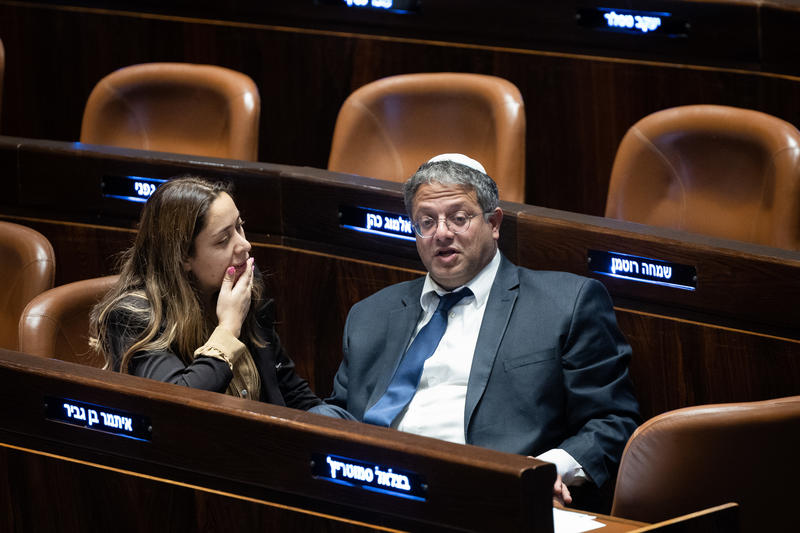
Last March, representatives of National Security Minister Itamar Ben-Gvir and Minister for Social Equality May Golan approached the Prime Minister's Office requesting a cut to the 2026 budget of Decision 550, claiming that the funds were not being utilized. Following this request, Acting Director-General of the Prime Minister's Office Drorit Steinmetz asked government ministries to assess how much could be cut from their budgets. The majority of government ministries opposed the cut.
")
On June 14, Steinmetz announced that the cut had been postponed and would be reconsidered in the final quarter of the year, in accordance with the unused balances. She urged government ministries to utilize the budget of Decision 550.
Dagan points out that the funds were never transferred from the Ministry of Finance to the government ministries, and therefore could not be utilized. He notes that the amount that will be cut will be transferred to the police and the Shin Bet, but the budgets of the program to combat crime (Decision 549) have not been fully utilized.
Following the publication of the letter, Salem Abbasi, coordinator of the socio-economic unit at the Mossawa Center, appealed to the Prime Minister demanding that the move be cancelled. "Diverting budgets that were intended to close gaps created by ongoing discrimination to the Shin Bet seriously harms the principle of equality, the binding status of Government Decision 550, and the social and economic objectives at its foundation. This is a move with profound and long-term wide-ranging consequences for the economic system, which could even lead to an outcome opposite to the one declared."