
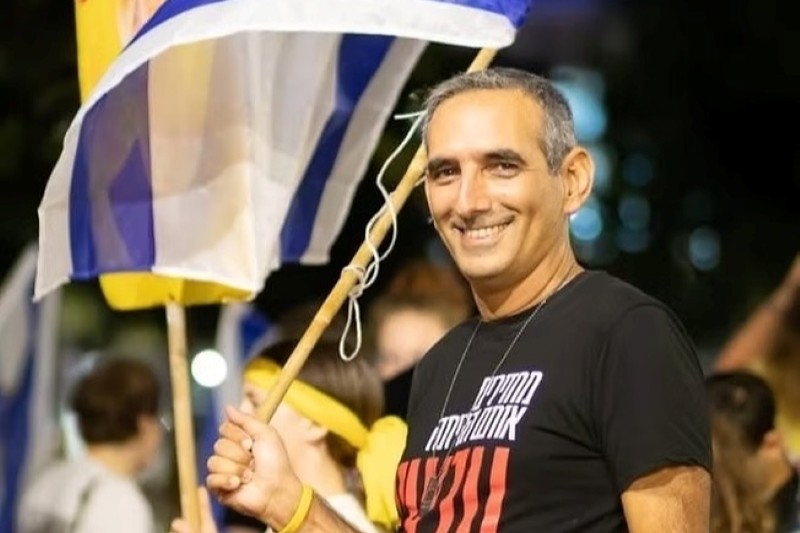
Avi Dabush is confident that The Democrats can become a governing party. It will not happen in the next election, he says, and it requires a fundamental transformation within the party. “If this time we manage to bring in between ten and fifteen seats, then next time we can reach thirty-plus,” says the candidate for the party’s list, who grew up in Ashkelon and currently lives in the Gaza border communities. “To do that, we must reach much more deeply into Arab society, the periphery, Russian-speaking communities, Ethiopian Israelis, and others. We need to change.”
In a conversation with Davar, he discusses how his views have changed since experiencing the events of October 7 firsthand, what The Democrats should learn from the historic right wing-nationalist political movement founded by Menachem Begin, Herut movement, and why genuine security is the opposite of the current government’s policy:
“We need to return the conversation about peace to the realm of security—that is part of the role of leadership.”
You argued that the left needs to reach new audiences—more peripheral and traditional communities. Do you think The Democrats can break through in this area?
“Voting patterns in Israel are very class-based. Lower socioeconomic groups tend to vote for Arab and Haredi parties, middle groups mainly vote for the Likud and the right, and higher socioeconomic groups primarily vote for the left and the center.
“Do I see potential for breaking this pattern? Absolutely. Will it happen in the upcoming election cycle? I guess not. This is a task that will take at least a decade. I would love to see change already in the next election, but without patience and long-term commitment there is no point in pursuing it. It requires greater imagination, flexibility, and openness.”
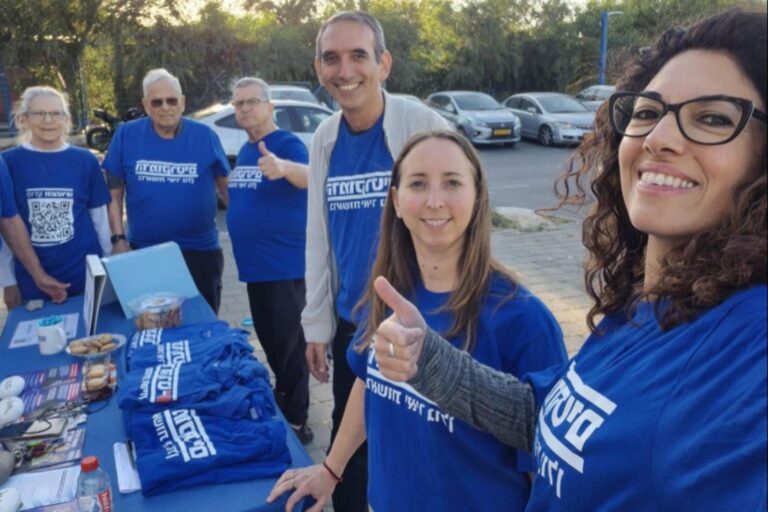
“We are at a point with a lot of potential. The Democratic Party has only just been established. If it maintains the image of being only a party of secular centrists closely associated with the protest movement, we will have a problem. That is an important constituency, without a doubt—but we need to think about where Mizrahi Jews, Russian speakers, Ethiopian Israelis, and Arab citizens fit in. Not only electorally, but also in terms of how they become part of the leadership of this movement.”
What needs to happen for that to occur?
“It requires going out into the field, but also coming with policy proposals. It requires opening the door to people from the periphery, as Herut did in the past when it transformed into Likud. We need to strengthen local activists and give them support.
“There is a big difference between showing up for a one-time demonstration in Beersheba or the Hatikva neighborhood and being insulted once or twice, versus living there all year. People who live there deal with criticism from their neighbors, their families, their local grocery stores, and their communities. That is why we need to stand behind them.”
“The first thing I did after the formation of The Democrats was establish the Periphery Forum together with Naama Lazimi. It is important to invite people from the periphery not only to participate in local activities, but also to lead and take part in the party’s leadership and decision-making processes.
“Representation also matters. Meir Sheetrit and David Levy, who became symbols of the Likud, first came to Mapai, but the door was not opened to them.
“That is why I am also glad to see many veteran activists from parties in the periphery, people who left political activity in recent years, returning now to party involvement.
“Our goal is to double our support in around 40 municipalities we have identified. If Ofakim currently has around 200 voters, we want to reach 400. If Sderot has around 300, we want to reach 600. Those are the targets.”
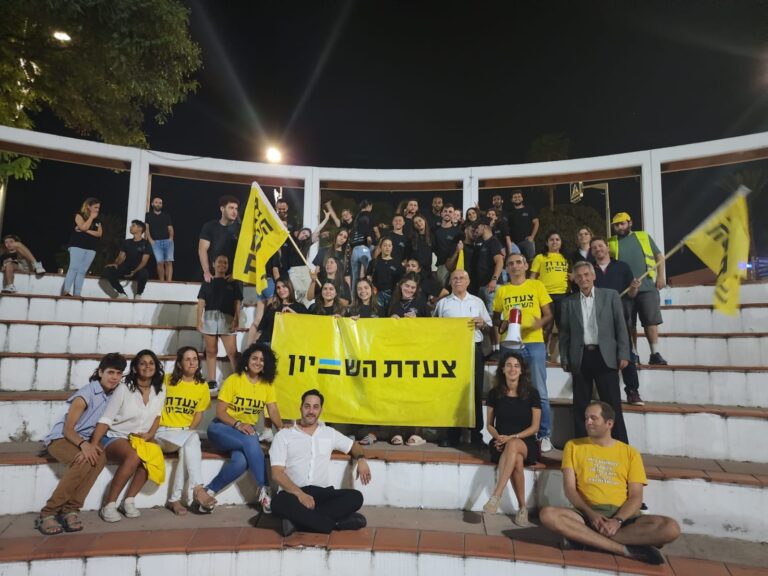
“There is a real crack in the right wing today, and whether we manage to step into it is up to us—especially if we are part of the next government. The question is whether we will know not only how to present ideas, but also how to advance policies accordingly.
“We travel through the periphery and hear genuine nostalgia for the Rabin government of 1992 and the social investments it made, not only in Arab society, but also in Sderot and Ofakim.
“That should be our political mission: to create genuine equality of opportunity for children in the periphery, both Arab and Jewish, and for children in the center. To rebuild a welfare state, public housing, and public infrastructure.”
From Bnei Akiva to Rabbis for Human Rights
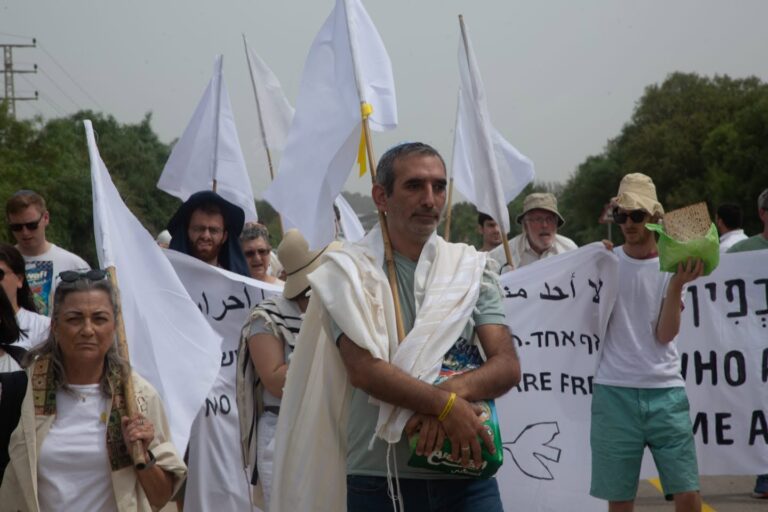
Dabush grew up in Ashkelon in a right-wing, traditional family. He studied at the yeshiva of Rabbi Drukman and served as a counselor in the Bnei Akiva youth movement. In 1993, at the age of 17, he participated in protests against the Oslo Accords—and that was when he began questioning the political worldview in which he had been raised.
“Ashkelon was a small city, and Gaza was ‘the big city’ that people went to for the market, the dentist, or the mechanic. My father was a career military officer who served there, and we used to travel there often. During the protests against the Oslo Accords, a question began to emerge for me: So what exactly are we offering?”
He entered left-wing organizations through leading an environmental campaign against the coal-fired power station in Ashkelon, and since 2002 has been deeply involved in civil society.
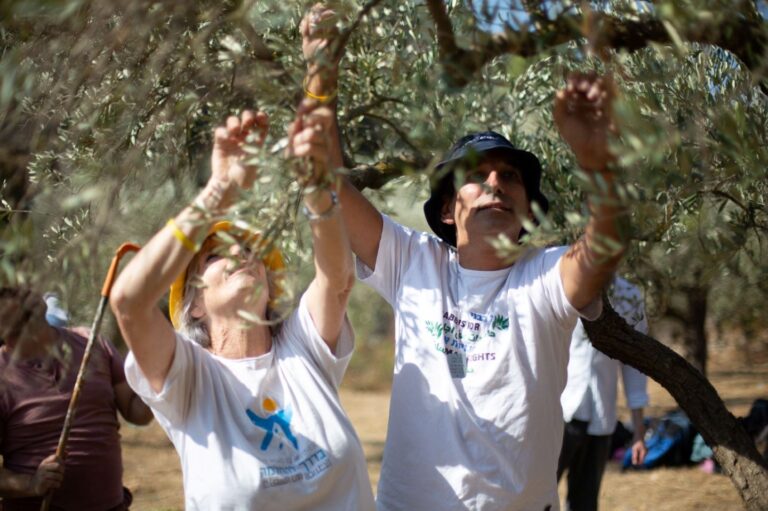
For the past seven years, he has served as CEO of Rabbis for Human Rights, an organization that is active extensively in the West Bank, including through protective presence and assistance to Palestinian farmers during olive harvests, in response to attacks by Jewish settlers from the hilltop communities.
Alongside this, since 2008 he has lived with his family in the Gaza border communities. On the morning of October 7, 2023, he sheltered with his partner Anat and her two children in the apartment’s safe room in Kibbutz Nirim. He gripped the handle of the safe room door tightly while hearing the attackers speaking Arabic outside the window.
“About five minutes after the first Red Alert, I started hearing gunfire. It wasn’t clear what was happening, but I ran out of the safe room to close all the shutters and get the phones. After another five minutes, we were already hearing commands in Arabic—they were here on the grass.”
They remained inside for eight hours until the army arrived, and were evacuated under fire to Eilat on the morning of October 8.
Has your political outlook changed since then?
“Yes. In the past, I thought that in a scenario where the Palestinian Authority would govern alongside Hamas, it might be possible to contain Hamas and moderate it. Today, it is clear to me that this would not work.
“To my credit, this was during the years when the right-wing government was the one that strengthened Hamas and maintained constant dialogue with it—and let it be clear: the people who live here were never naïve. Vivian Silver, Chaim Peri, Oded Lifshitz—all of them knew exactly what Hamas was, because since 2001 there have been attempts to murder our children. The question remained: ‘What do we do? How do we move forward?’
“Today it is clear to me that Hamas is outside the equation. I also have to say that I see once again how the right is strengthening it and blocking any alternative possibility. We need to create some kind of new governing authority there, and of course it will involve the Palestinian Authority. We need to say this openly, there is no other viable arrangement.
“All kinds of fantasies about militias or clans—what clan is suddenly going to take control over two million people? That will not happen. We need international cooperation here. In my view, Egypt needs to play a significant role.”
“In terms of values and vision, since October 7 my commitment to peace and my belief in the importance of diplomatic agreements have only deepened. I completely see that there is no other way to achieve stability and security.
“I feel that over the past thousand days, people have been trying to sell us the idea that war equals security and security equals war. Meaning that as long as there is war, as long as we have bombed them, as long as our soldiers are deep inside Gaza, inside Syria, and inside Lebanon, and reach Iran whenever they want—that this is security.
“It is the complete opposite. Security means that we are not constantly running to shelters. That 2,200 soldiers and civilians do not die, that the economy can thrive, that we can travel, and many other things.
“For me, it is obvious that security means peace and diplomatic arrangements, and we need to pursue that direction with full force. It requires hard work and great effort—it is complex and demands a great deal of wisdom, understanding, and caution—but that is where we will find security.”
Can this position be sold to the Israeli public in general, and to your friends and partners in Sderot and Ofakim in particular?
“In the 1990s, there was a kind of discourse that separated peace from security. We need to bring the discussion about peace back into the realm of security, of serious professionals sitting down and asking what can contribute to our security and to the security of the Palestinians, what can contribute to the economy, water management, the climate crisis, and so on. This needs to be a highly professional effort.
“In the Future of the Western Negev movement that we established during Operation Protective Edge, there was a crack in that barrier. We managed to bring in people from the Likud Central Committee, mainly mothers from Sderot, Ofakim, and Ashkelon—because there was an understanding, as parents, that this was in the interest of our children, rather than this endless cycle of war.
“In my view, the movement ultimately faded away precisely because some people on the left were afraid to speak clearly about advancing a diplomatic arrangement, rather than only speaking generally about the need for solutions.
“It is true that trust between us and the Palestinians is at its lowest point, from both directions. But I read the surveys from AChord and see that there is very strong support among the Israeli public for a regional agreement. When you bring Saudi Arabia, Egypt, and American backing into the equation, Israelis relax a little and say, ‘I am willing to pursue this,’ including understanding that this means a Palestinian state.”
“In my view, this is also part of the role of leadership—to honestly tell the public: between the river and the sea, there are 15 million of us, half Jewish and half Arab. We need to find a way to live together.
“That does not mean that we do not love the entire land. I too feel deeply connected to Bethlehem, Nablus, and Hebron. That is also why my family came here from Libya and Syria, but this land will need to be divided so that we can thrive in it.
“Israelis are very skeptical about this, and that skepticism is healthy. It is important to them that this happens while maintaining security. But I do believe that, ultimately, this is what Israelis want.”
“We need a governing alternative”
According to Dabush, the party’s agenda should be shaped for the coming decade. “This means sharpening our positions and not being afraid to talk about the occupation, Jewish terrorism, a Palestinian state, social democracy, increasing public investment, what kind of reform is actually needed in the judicial system, and so on.
“We need to build a governing alternative that offers something different from Netanyahu. Not one that says if Netanyahu bombed the Dahiya once, we will bomb it twice; and if Bibi creates a deficit, we will cut social services and avoid running a deficit ourselves.”
Who, in your view, should be your partners in advancing this agenda in the next government?
“Regarding the upcoming election, Yair Golan said, and I agree with him, even from the most personal place as a resident of the Western Negev, that we will not sit with parties that were part of the current coalition. So the spectrum is clear to us: at the moment, it ranges from Lieberman to the Arab parties.
“I do think that Ra’am should definitely enter the coalition, and I emphasize—not could, but should. I would also be happy to see some kind of agreement with Hadash and Ta’al, along the lines of what the Rabin government did at the time.”
Do you think that with Lapid–Bennett, Lieberman, and Eisenkot it would be possible to advance the social democratic policies you are talking about?
“In the longer term, I definitely think that the partners in this coalition are not necessarily the partners we will have in future coalitions. We need to look at ourselves and build ourselves as the next governing party. If this time we manage to bring in between ten and fifteen seats, then next time we can reach thirty-plus.
“To do that, we must reach much further into Arab society, the periphery, Russian-speaking communities, Ethiopian Israelis, and others. We have to bring in a new electorate. We need to change.”
“Our ability to influence socioeconomic policy in the next government will ultimately depend on how many seats we win, and also on what the party’s top ten looks like. I think it is important that the top leadership be strongly social democratic if we want to present ourselves as an alternative.
“In my view, the ultimate role the party should aim for is the Finance Ministry. It may seem far away at the moment, but that is what we should aspire to—taking the Finance Ministry, either in this round or the next, in order to create genuine equality of opportunity.
“To rebuild a welfare state and real social safety nets: to renew public housing, which currently barely exists; restore eroded welfare benefits; ensure food security; and repair public infrastructure.”
If Eisenkot forms a unity government with Likud, should The Democrats be inside or outside?
“If it means being the fifth wheel in such a government, or building the alternative from the left, I would rather build the alternative from the left.
“In the longer term, I can definitely see a partnership with Shas or United Torah Judaism. With Likud, it is difficult for me to see that today because, unfortunately, it is so deeply rotten and corrupt at its core. Perhaps if there were a dramatic change there.”
“It is important that the liberal left also talk about Judaism”
How do you view the conflict with the Haredi community?
“The Haredi community will have to change, and we need to find a way to help them do that, including by setting boundaries. What has happened in recent years is complete abandonment—a political electorate being purchased through bribery. This means that in the next government, we should strongly support state Haredi education, for example, and initiatives to expand it. We should also support it with resources, without embarrassment.”
“This requires a long and deep process, while at the same time the army currently needs thousands of combat soldiers, something that, at this point, can only be achieved through recruitment from the Haredi community.
“That also carries risks, by the way—we are seeing what is happening in these units in terms of moral and values-related issues, and there is also the impact this has on gender separation within the IDF.
“I think the army should be allowed to refine, clarify, and improve its tools for recruiting combat soldiers from the Haredi community. At the same time, there need to be alternatives through national service, civilian and community service, and additional solutions. The most important thing is to begin an educational revolution, so that in 10–15 years graduates of Haredi education will genuinely be in a different place.”
Two years ago, you completed your studies in “Israeli Rabbinate.” Today, some are trying to promote The Democrats as a platform for secular-atheist politics. How do you see that?
“I came to rabbinical studies, of course, through my work as CEO of Rabbis for Human Rights. I am surrounded by many rabbis, men and women, who are people of the left, from all streams.
“I considered studying through the Reform and Conservative movements, but ultimately decided to study at the Israeli Rabbinate Beit Midrash, which is something of a cross-denominational movement. The approach there is that rabbinate today means being a leader within Jewish society, in Israel and beyond, and that such leadership is also connected to public and political action, and to the ability to make courageous statements.
“I think of Rabbi Abraham Joshua Heschel, who marched with Martin Luther King Jr. and fought against the Vietnam War, as a model.”
“On the other hand, many people often imagine that I wear a kippah, and that is not true. I am dati leshe’avar (formerly religious), and I do not live a religious lifestyle. But I do think it is important that those of us in the liberal left also say something meaningful about Judaism—about what it means to be a ‘Jewish and democratic’ state.
“Let’s talk about a social and economic Judaism: about the remission of debts and land, laws protecting workers, charity for the poor, and concern for the orphan and the widow. About ‘love the stranger,’ which appears 36 times in the Torah.”
As part of your role at Rabbis for Human Rights, you are heavily involved in protective presence against Jewish terrorism. What is required to put an end to this phenomenon?
“Protective presence helps prevent some of the processes of displacement affecting Palestinian communities that are targeted by Jewish terrorism. But it cannot stand on its own, certainly not when Jewish terrorism is supported so strongly by the government through funding, infrastructure, weapons, vehicles, and, at best, the military turning a blind eye, and at worst, soldiers participating.
“This is deeply painful for me, also as the father of a soldier. I would like to see, and unfortunately it will be very difficult to achieve even under the alternative government we imagine, the dismantling of the infrastructures that enable terrorism.
“That means, of course, reversing the decisions regarding the establishment of 34 new communities in Areas A and B, and returning the army, police, and Shin Bet to carrying out their responsibilities.”