
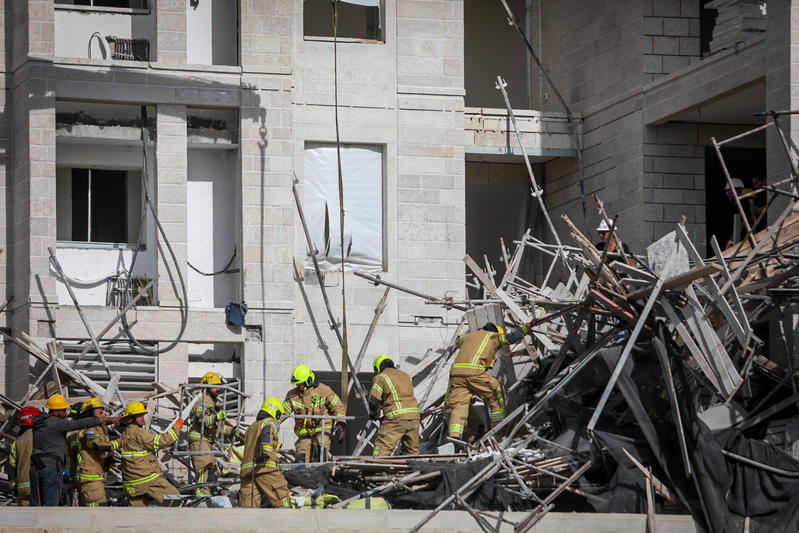
The number of people killed in workplace accidents during the first half of 2026 stood at 39 people, while 306 workers were moderately and severely injured, according to a report by the Workers Hotline (Kav LaOved) organization published on Monday. The number of fatalities is the highest since the first half of 2023, when 44 people were killed.
Similar to previous years, half of those killed (20 people) were from the construction sector, which employs only 11% of the total number of workers in the economy. The number of fatalities in the construction sector during the first half of 2026 doubled compared to the first half of 2025 — from six to 11.
The Worker’s Hotline (Kav LaOved) report is based on data collected throughout the year from various emergency and rescue bodies. The identities of ten of those killed are unknown to Kav LaOved; 11 were migrant workers. This is compared to the first half of 2025, when seven migrant workers were killed — a trend that reflects the increase in the number of migrant workers in Israel following the halt in the entry of Palestinian workers, and the growth of their proportion among workers in the economy in general, and in dangerous sectors in particular. Half of those killed in the construction sector were migrant workers.
Nine of those killed in the first half of 2026 were Arab citizens of Israel (31%); three were Palestinians and six were Jewish.
Where in the past falls from height were the most common cause of death in workplace accidents, in the first half of 2026, 31% were killed by being struck by a heavy object and 23% were killed in falls from height. Twenty percent of fatal accidents were caused by being run over during work or by being struck by a work vehicle or forklift; 8% were due to being trapped in machinery and 8% due to collapses. In the construction sector, 40% of fatal accidents were caused by falls from height and 40% by being struck by a heavy object.
The number of workers seriously injured in the first half of 2026 was 63, compared to 61 in the first half of 2023 — the deadliest year recorded prior to the war.
Continued decline in the number of orders issued to employers
According to data processing from the website of the Safety and Health Administration at the Ministry of Labor, during the first half of the year, 1,139 safety orders were issued by inspectors from the administration, of which 844 were in the construction sector (74%). This compares to 1,380 in the first half of 2025, of which 986 were in the construction sector. This continues the downward trend in the number of orders issued to employers since 2020, when 3,057 orders were recorded.
Kav LaOved noted that the most common violations leading to the issuance of safety orders were the absence of inspections by certified examiners for heavy equipment and boilers (72 orders), defects in elevators (37 orders), and failure to comply with the requirements of the Electricity Law (32 orders) — data similar to previous years.
In 627 of the orders, which constitute 55% of the orders issued during the first half of 2026, it was not recorded at all which legal provision the safety order was issued under. In some cases, it was stated that the order was issued due to "multiple deficiencies." In 315 orders (28%), it was not specified who was the person carrying out the work against whom the safety order was issued.
Kav LaOved emphasized that despite the increase in the number of accidents, there are only around 80 Safety Administration inspectors across the entire country, compared with 70 a decade ago.
Kav LaOved stated "The field is waiting for dramatic decisions: a full-time Minister of Labor is needed (since Yoav Ben Tzur’s resignation in 2025, Yariv Levin has held these responsibilities alongside many other responsibilities); the establishment of the National Authority for Occupational Safety and Health; the entry into force of safety regulations in October 2026; an examination of the effects of private recruitment of migrant workers in construction on the sector as a whole and on workplace accidents in particular; legislative changes regarding the obligation to install safety nets; increased deterrence and enforcement; increasing the number of inspectors and investigators and improving their employment conditions; and promoting changes in workplace culture."