
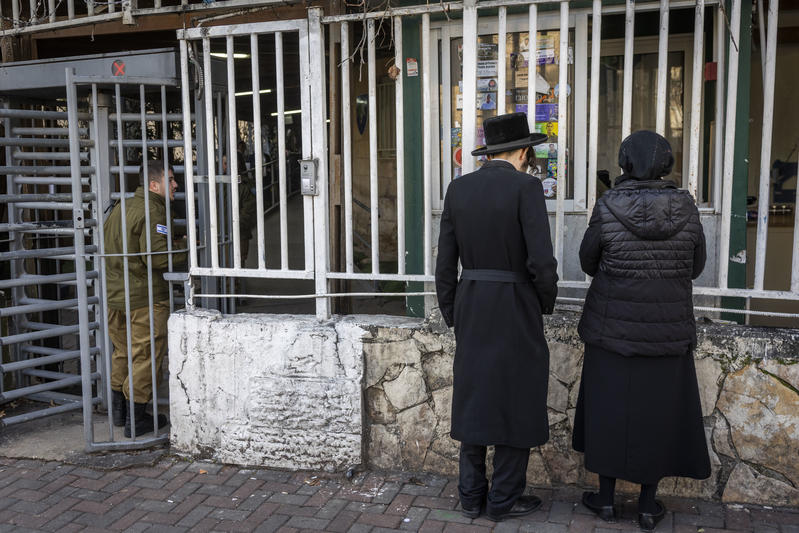
On WednesdayThe Knesset approved the law freezing the arrest of yeshiva students, following a heated debate. "In recognition of the importance of Torah study," the law states, "a special arrangement is hereby established, as a temporary order, for the suspension of the arrest of yeshiva students for whom Torah study is their full-time occupation."
The law applies to yeshiva students whose date for reporting to the military enlistment process fell between July 1, 2023, and the date on which the temporary order comes into effect. They will be exempt not only from arrest, but from any investigation or enforcement proceedings relating to the offenses of insubordination, desertion, or unauthorized absence from military service under the Military Service Law.
How long will the law remain in effect?
The law states that it will remain in effect until November 30, 2026—four and a half months from today, and approximately one month after the upcoming Knesset elections. In practice, however, it is expected to remain in force for a longer period. Once elections are officially declared, the existing legal framework in all areas is automatically extended through the first three months of the next Knesset's term. As a result, the temporary order is expected to remain in effect until January 2027.
Who is defined as a yeshiva student under the law?
According to the temporary order, a yeshiva student is defined as someone who studies Torah on a regular basis for at least 45 hours per week, or 40 hours per week if enrolled in a kollel (an institute for advanced Torah study, typically for married students). The student may not engage in any occupation in addition to his yeshiva studies, and the head of the yeshiva where he studies is required to notify the IDF each month if the student has stopped studying.
Who will decide who is eligible for recognition?
The Minister of Defense will formulate the list of yeshivot recognized under the law, and the list will be published online. A yeshiva will be included on the list if the head of the yeshiva, or a person authorized on the head's behalf, declares that regular Torah study takes place there. The minister will also establish the criteria for removing a yeshiva from the list, subject to the approval of the Knesset Foreign Affairs and Defense Committee, and will issue regulations governing how students of a yeshiva that has been removed from the list are to be treated.
Responsibility for examining individual yeshiva students will rest with the IDF. Under the temporary order, a committee will be established consisting of three members: an officer holding the rank of Colonel or above, who will chair the committee and will be appointed by the Military Advocate General (MAG), and two officers holding the rank of Lieutenant Colonel or above, who will be appointed by the Head of the IDF Personnel Directorate. The Military Advocate General will determine the procedures for submitting applications to the committee and the manner in which the committee will examine those applications.
This aspect of the bill drew sharp criticism from IDF Chief of Staff Eyal Zamir. In a letter he to Prime Minister Benjamin Netanyahu, he said that the IDF has no "comparative advantage, tools, or expertise" to assess the exemption criteria defined in the proposed law. He argued that the committee of officers established under the bill would undermine the legitimacy of and trust among those serving in the military, and would divert attention and resources away from operational missions.
Who is responsible for overseeing whether yeshivot comply with the law?
Under the law, the Minister of Defense is responsible for authorizing inspectors. The minister may make use of the Ministry of Education's inspection mechanism. If an inspector finds that 20% or more of the students at a particular yeshiva are repeatedly absent, the inspector will issue a warning to the head of the yeshiva. If this pattern continues, the yeshiva will be removed from the list of recognized yeshivot, and its students will be given the opportunity to enroll in another yeshiva.
What legal difficulties does the law raise?
The legal team of the Knesset Foreign Affairs and Defense Committee published a critical opinion regarding the law on Sunday, arguing that it discriminates against the non-ultra-Orthodox public. "This arrangement prevents legal proceedings and grants immunity from criminal sanctions to yeshiva students due to their failure to fulfill their obligation to report [for enlistment], while these sanctions remain in place for the general public," the opinion stated.
The legal opinion states that a combination of freezing criminal proceedings alongside economic sanctions may have eased the legal difficulty. However, in practice, it argues that this constitutes a "sectoral exemption from the obligations of the Defense Service Law, without placing a balancing counterweight on the other side of the equation."
Petitions were submitted today against the law to the High Court of Justice by the Yesh Atid and Yisrael Beiteinu parties, as well as civil society organizations.