
Historian Moshe Zuckermann devoted an entire book to the way the narrative surrounding the French Revolution has been repeatedly reshaped over the centuries since it took place. The question of whether it was "an assault on history," as the English conservative Edmund Burke described it, or a "great and magnificent event," as the French socialist Jean Jaurès argued, illustrates how historical events are continually reinterpreted through the lens of contemporary ways of thinking and value judgments.
His analysis is equally relevant to the 2011 social protest movement, which this week marked 15 years since its beginning.
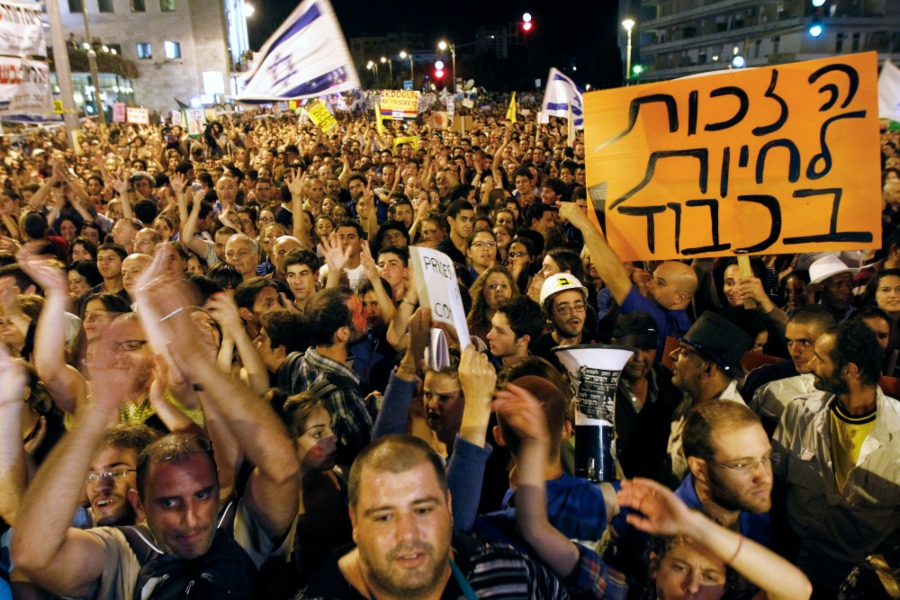
On July 14, 2011, Daphni Leef called on young people to join her in protesting soaring housing prices on Rothschild Boulevard in Tel Aviv. Her call was answered first by dozens, then hundreds, and eventually hundreds of thousands, who spent the summer in tent encampments established across the country. The slogan, "The people demand social justice," expressed a deep and widespread sense of dissatisfaction with Israeli society.
In response to the protests, the government established the Trajtenberg Committee, whose most significant legacy was lowering the age for free compulsory education from five to three. At the end of the summer, following a mass demonstration at Kikar HaMedina in Tel Aviv, the largest social protest in Israel's history came to an end.
Those are the facts. But the 2011 protest did not truly end. Like other major historical events, it has continued to evolve—taking on new meanings over the years, acquiring new contexts, and being continually reinterpreted and rewritten.
The Message That United Right and Left, Center and Periphery
The tendency to force the protest into existing political categories began while it was still unfolding, with the infamous "sushi and hookahs" remark and attempts to portray it as a left-wing protest. Even within the movement's leadership, there was an ongoing debate over how explicitly political it should become. But at the time, that was not the dominant narrative.
After 15 years marked by major events, disasters, and waves of protest, things look different. Viewed through the polarized and anxiety-ridden lens of Israel in 2026, it is difficult not to place the 2011 social protest in the same category as the protest movements against Benjamin Netanyahu's government, which later expanded into demonstrations against proposed changes to Israel's system of government and judiciary.
On the surface, the logic behind this classification is understandable. The protest was indeed centered on Rothschild Boulevard, in the heart of secular, liberal Tel Aviv. Its leaders were largely young people from the upper-middle class, and some later went on to join left-wing political parties. The demonstrations were also directed against Netanyahu, who was prime minister then, just as he is today.
Nevertheless, some facts do not fit neatly into this interpretation. For example, a large number of the tent encampments were established in the periphery. While the protest’s epicenter was in central Tel Aviv, its participants included residents of Hatikva neighborhood, Kiryat Gat, Sderot, and Kiryat Shmona. A study by Dr. Azi Lev-On found that the protest also received sympathetic coverage in local media outlets in peripheral communities.
Real-time public opinion polls showed that 80–90% of Israelis supported the protest, while fewer than 5% expressed strong opposition. The Religious Zionist community responded with suspicion toward the movement, but did not reject it outright; articles expressing support could also be found in sector-specific media.
Even if the protest’s center of gravity was in liberal Tel Aviv, its messages resonated widely. Singer Margol, who had criticized the movement as a protest of "northerners" (a derogatory term for affluent Tel Aviv residents), later changed her position and performed at the protest encampment in Beersheba. Even Prime Minister Benjamin Netanyahu, who attempted to frame and categorize the protest, was ultimately forced to establish a committee aimed at reducing the cost of living.
A Protest About Life Itself
Beyond that, however, the agenda brought forward by the protest focused on issues of everyday life. The call for social justice was not engineered in the offices of strategic consultants (as some attempted to claim), nor was it a scheme designed to elevate a new political leader. Rather, it emerged from an authentic gut feeling shared by many Israelis: that something within the system was not working properly. That there was a gap between the Israel they wanted and the one they were actually experiencing.
It was a profound existential experience that succeeded, at least temporarily, in softening identity-based divisions and social tensions. The protest sought, even if it ultimately failed, to reshape the relationship between the state and its citizens.
In terms of substance, the protest’s message was fundamentally positive and optimistic: a demand to build a better future, unlike the protests of recent years, which have largely been driven by fears of collapse or destruction. It was progressive rather than conservative—seeking to change the future rather than defend the past.
The indirect effects of the 2011 protest run deeper than what is immediately visible. Its echoes can be seen in the development of critical public discourse, the wave of labor organizing across the economy, and the renewed prominence of the concept of the welfare state.
But in terms of direct impact, after 15 years the sobering truth is that the 2011 protest is not the guiding star of any political movement. It was a transformative event that ultimately transformed very little. The popular and public momentum that emerged from it fragmented, dispersed, and faded away. The people are still here, and the ideas still exist, but the unique sense of possibility and the energy that accompanied the movement have disappeared.
It is impossible to travel back in time, revive ideas and movements that have faded away, or reverse changes in public discourse and opinion. Nevertheless, it is worth trying to remember the summer of 2011 protest as much as possible for what it was: an opportunity that remains unrealized.