
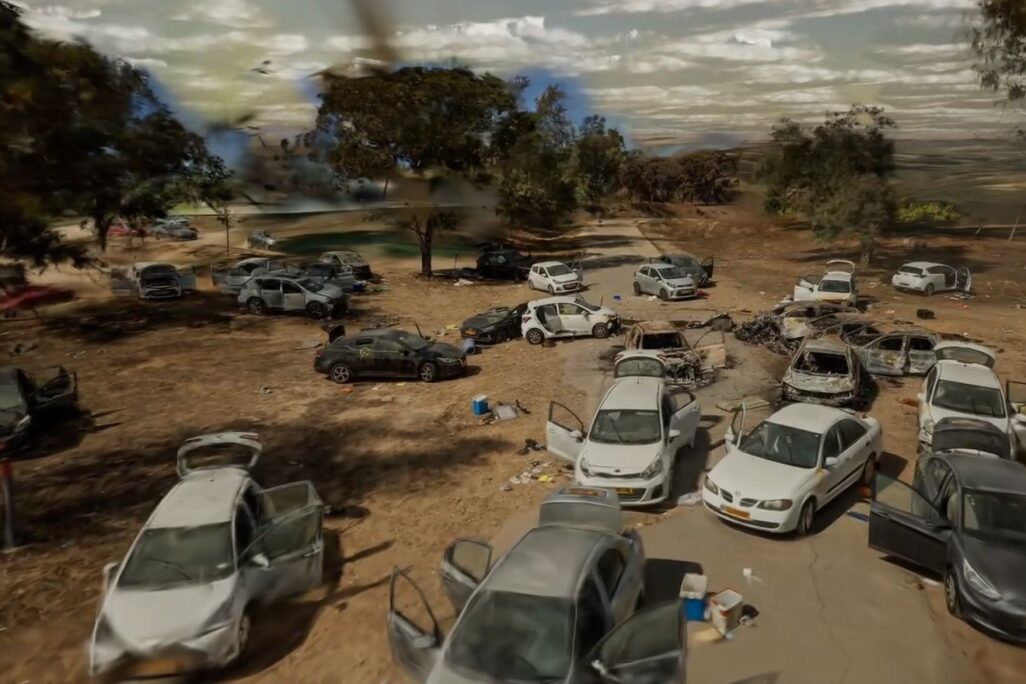
Survivors of the Nova music festival are facing a massive wave of online harassment and abuse from coordinated bot networks, according to a comprehensive report published by the Fighting Online Antisemitism (FOA) movement.
The study found that festival survivors and Israeli hostages who were held in Gaza are targets of a "continuous and multi-layered digital campaign" operated by thousands of fake accounts and bot networks with direct links to the Iranian regime.
The organization describes the attack as "the war after the war", emphasizing that survivors are being harmed a second time. The documented harassment is not an abstract phenomenon: specific individuals, identified by name, including hostage survivors and their family members, have been subjected to prolonged smear campaigns that further intensify the trauma of October 7.
The alarming statistic: Surge in PTSD among survivors
An academic study examining 392 Nova festival survivors found that one year after the trauma, 54.6% of survivors were experiencing PTSD symptoms, defined as consistently high symptoms or symptoms that are worsening over time, compared with only around 20% of the general population exposed to a traumatic event.
The researchers said these rates are "exceptionally high", pointing to repeated exposure to distressing trauma-related content online, alongside the broader "socio-political climate," as factors that may uniquely contribute to the worsening of symptoms among survivors.
Methods of operation: From conspiracy theories to victim blaming
According to the FOA report, the campaign is driven by bot networks linked to state actors, primarily Iran. It represents a continuation of Iran’s long-term efforts to spread disinformation and conduct influence and cyber operations. The broader goal is to deepen social divisions and undermine citizens’ sense of security in Israel, the United States, and other Western countries.
The report’s data was collected between October 2023 and April 2026 across major online platforms, including X (formerly Twitter), Instagram, TikTok, Reddit, and Telegram. The campaign consists of several types of harmful content:
- Denial of the massacre: Claims that the event was staged, involving "crisis actors" and fake blood.
- Conspiracy theories: False claims that the IDF was responsible for the deaths, alleging that military helicopters fired on festival-goers in order to create a pretext for war.
- Victim blaming: Portraying the festival as a provocation and claiming that attendees "brought it upon themselves" because they chose to dance on "stolen land" near the Gaza Strip.
- Targeted personal harassment: Personal smear campaigns against named survivors, using severe slurs (such as "terrorist" and "whore") and systematically mocking testimonies of sexual violence. Those personally targeted include Noa Argamani, Romi Gonen and her mother Meirav Leshem-Gonen, Omri Sasi, and Avinatan Or.
"The eighth front": Social media platforms are failing to filter content
The Fighting Online Antisemitism (FOA) movement is an Israeli non-profit organization founded in 2020 by Tomer Aldubi and Nir Kaplan. It operates a network of more than 5,000 volunteers who monitor and report harmful content online.
Aldubi told the British Telegraph: "Antisemitism and extreme hatred against Jews, Zionists, and Israelis have spread around the world at a staggering pace since October 7."
According to the organization’s data, there are significant differences in the effectiveness of social media platforms in removing reported antisemitic content:
- TikTok: Removed more than 80% of content reported as antisemitic.
- X: Removed fewer than 50% of reported posts.
- YouTube and Meta (Facebook and Instagram): Removed fewer than 40%.
During a comprehensive discussion held by the Knesset’s Subcommittee on Artificial Intelligence and Advanced Technology, committee chair MK Orit Farkash-Hacohen (Blue and White) described the online sphere as "Israel’s eighth front."
Meirav Bender Sapedia, FOA’s director of partnerships, warned during the discussion about the long-term impact of online misinformation: "These contents are contaminating all the trust databases of artificial intelligence." According to her, AI models are trained on information currently available online, meaning that these falsehoods could influence global knowledge for years to come.
A call for strategic change and an institutionalized response
Although the organization’s professional team has achieved relatively high removal rates (around 64% of its direct reports are accepted, with approximately 150,000 posts removed since 2020), the scale of the challenge remains enormous. The organization’s thousands of volunteers independently report harmful content, but only 27% of reported posts are ultimately removed.
"It is unfortunate that in this arena, the people doing the work are volunteers," MK Farkash-Hacohen criticized, calling for government action on a strategic scale. She emphasized that the Foreign Ministry has hundreds of millions of shekels allocated to combating antisemitism, and argued that these funds should be used to establish a dedicated government task force focused on the issue.
"I invite anyone who thinks it isn’t real to come and see"
One person who feels the damage of this digital war on a daily basis is Omri Sasi, one of the producers of the Nova festival and a survivor of the massacre, who lost many family members during the attack. In a painful interview with The Telegraph, Sasi spoke about the heavy personal toll:
"The abuse that survivors have faced ever since, along with the amount of denial and misinformation online, have dramatically worsened my trauma. I organized the festival, and I lost the people closest to me there. I invite anyone who thinks what happened was not real to come, look me in the eyes, and see how wrong they are."