

On Haifa’s southern edge, along the waterfront, stands the Atallah family home. It is packed from end to end with clay works, concrete sculptures, historic vessels and family mementos. Ceramics workshops are held here, but the place bears little resemblance to the fashionable galleries and contemporary studios that have become increasingly common.
Amid the crowded shelves, distinctive jars and thermoses sits Raja Atallah, who will turn 81 this month. His gaze is warm and intent as he moves between memories of his own rich past and that of his family, and his desire to pass on the knowledge he has accumulated.
“I don’t want money, I just want everyone to benefit,” he says as he leads me between the shelves, pointing out pieces he is not currently willing to sell. “We’ve been making pottery for 400 years. Instead of letting the secrets of the family and the craft go with me to the grave, I want every potter in the country to benefit from them.”
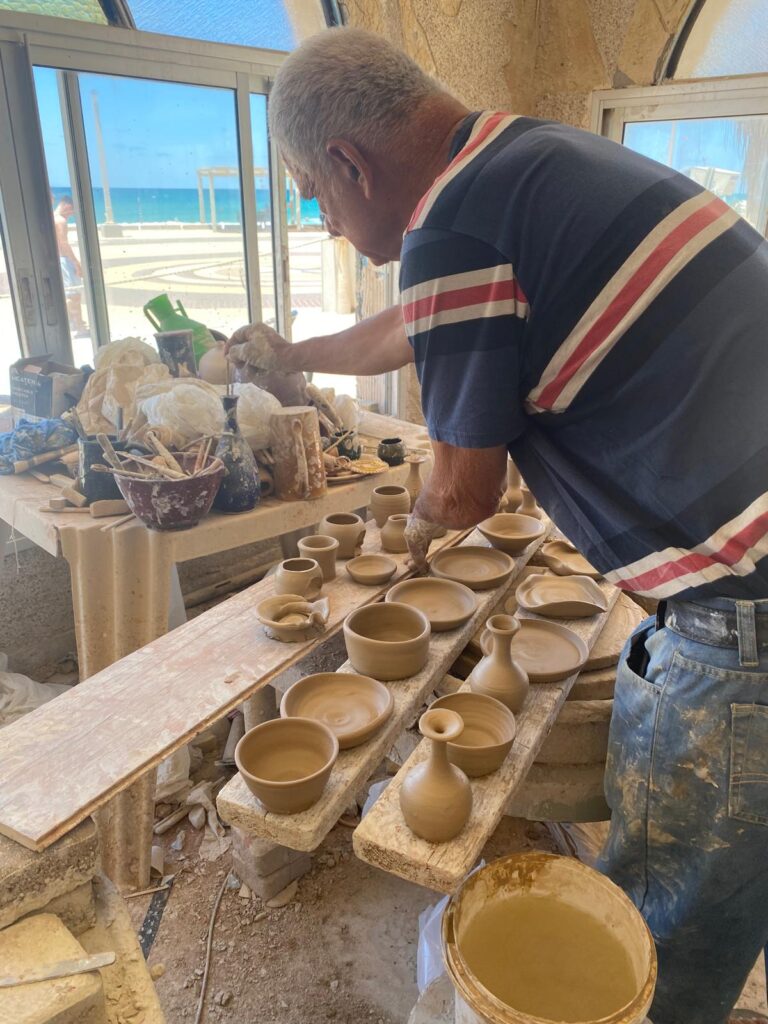
A film and exhibition about the family and its craft are now being planned, he says. “All those potters who have been in the field for 30, 40 or 50 years — they’re not real potters. Their methods start at H and I, not A and B. In the film and the exhibition, I want to show how you make large pieces, intricate designs and new forms. I want everyone to see and learn what real pottery is.”
“We Had Clay and Sand for Free”
The Atallah family’s history has been intertwined with clay for generations. “Four hundred years ago, everything was made of clay,” he says. “The vessels people drank water from, cooking pots, plates, jars for storing wine and oil. Lebanon asked Greece for potters, and our ancestors agreed to go and moved to Lebanon. In 1860, war broke out in Lebanon and Christians fled to Haifa. We’ve been Haifans ever since.”
Alongside his family’s deep ties to Haifa, Atallah’s history also connects him to Acre through the Fakhouri family, the family of his paternal grandmother. “All the historic potters in Acre, the members of the Fakhouri family, are our relatives — our uncles and extended family. There were still working potters there until the Six-Day War, and the connection to Acre and to the roots of the craft there is an inseparable part of who we are.”

In 1924, the Haifa branch of the family settled on the very spot where he lives today. Atallah’s father chose the location with the craft in mind. “My father examined the soil beneath the sand and saw that it was perfectly suited to pottery. We took the clay from right here and mixed in 20 to 25 percent clean sand from the sea. That way, we had our clay and sand for free. My father bought the land, and we’ve been here ever since.”
Shade and Well Water
According to Atallah, the location of the family home also proved historically and geographically significant. “Anyone traveling between Acre, Haifa, Jaffa and Jerusalem had to pass right by our house,” he says. “There was no other road in those days. We had a khan here for horses and camels, with two freshwater wells. Travelers would stop to draw water, give their pack animals a drink, rest or spend the night, and then continue on their way. Traveling from the north of the country to the south couldn’t be done in three hours like it can today. Our stop was unavoidable.”
A reminder of the khan remains on display to this day. “There were always hot coals burning here, with kettles of tea and coffee ready for anyone who came in. That’s why, next to the photographs of my mother and father hanging on the wall, I always keep two kettles, they remind me of the open house my parents kept.”
Atallah has preserved that tradition of hospitality. At the entrance to the family compound, a steaming pot of tea and cups are always waiting for whoever happens to arrive. Raja pours fragrant herbal tea, made with herbs sent to him by Druze friends from Daliyat al-Karmel and Isfiya, and makes clear that everyone is welcome. “I have Druze friends, Muslim friends, friends from every community. We’re with everyone. We’re at peace.”
The Sea Is in His Blood
For decades, pottery brought the family considerable prosperity. “We made money back then,” he recalls. “We were the only ones selling vessels for storing and drinking water. There were no refrigerators in the country, so our jars and water flasks were the refrigerators people had in their homes.”
Then came 1967. The Six-Day War and the opening of markets transformed the trade. “From ’67 onward, everything stopped,” he says. “They started bringing in pottery from Gaza and the West Bank for next to nothing. A vessel that had once sold for a respectable price was suddenly worth a fraction of a penny. You couldn’t make a living from it anymore. The potters in Haifa and Acre stopped working and went elsewhere to earn a living. People had to survive.”
Economic necessity also pushed the next generation toward the sea. Raja made sure to teach his children the fundamentals of pottery at the end of each workday, preserving the family tradition, but they began earning their living as lifeguards on Haifa’s beaches. He says the family’s presence on the shore helped save people from drowning on many occasions and often extended beyond their formal duties. Family members were on the beaches even in the years before organized lifeguard services were in place, as well as in the early morning hours and after the lifeguard stations had closed.
The sea is part of Atallah’s identity. “I’ve been a fisherman since I was 13,” he says. “It’s in my blood. But in my entire life, I’ve never sold a single fish. I ate them and gave them to friends. Fishing isn’t a business for me — it’s a hobby. They used to call me the Elvis of the sea. Now it’s Elvis alte zachen.” (alte zachen means old stuff/things in Yiddish, a joke on his age)
His bond with the sea has also found expression in his art. In the courtyard are sculptures he fashioned from cement and stone. He crushed old roof tiles into powder, mixed it with sea sand and used the mixture to sculpt figures. “Every morning at five, I sit and drink my tea with my friend — the sea. I can’t live without swimming, just as I can’t live without fishing, and just as I can’t live without making pottery.”


A Late-Night Idea
Now in his 80s, Atallah continues to create and plan for the future. He works alongside his brother, Boulos Atallah, and collaborates with another brother, Munir, who studied ceramic glazing in the Netherlands. Raja Atallah describes the methods he uses to make different vessels and takes pride in what makes them unique. Inspiration continues to strike even today: “Even at night, when I’m lying in bed, sometimes an idea for a new design suddenly comes to me. So I get up and go make it in clay.”