
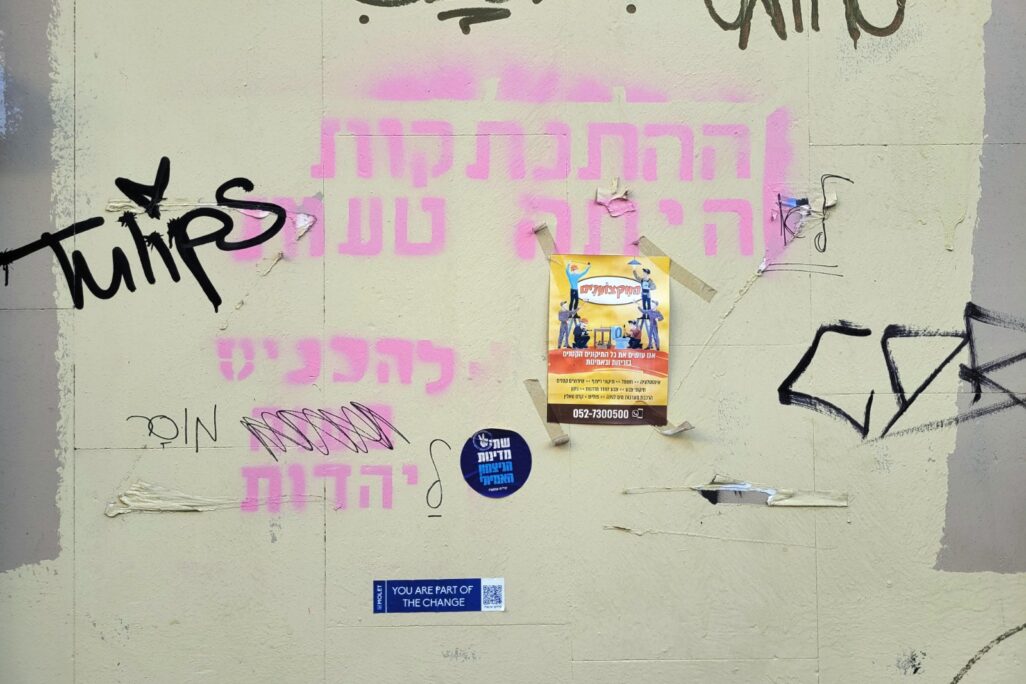
Amid images of the burned walls of the communities near Gaza and the crumbling walls of Gaza itself, Zipa Kempinski continued, even after October 7, to photograph the walls she knows intimately—the walls of Florentin, a neighborhood she has been photographing, documenting and cataloguing for more than a decade.
Florentin could have been part of Tel Aviv’s “White City.” It is filled with buildings that tell the story of the city’s development and Bauhaus balconies that, if they were better maintained, could easily be mistaken for those in the city center. But Florentin’s peeling walls have become the canvas of the “creative class”—edgy, bohemian, anarchist and political.
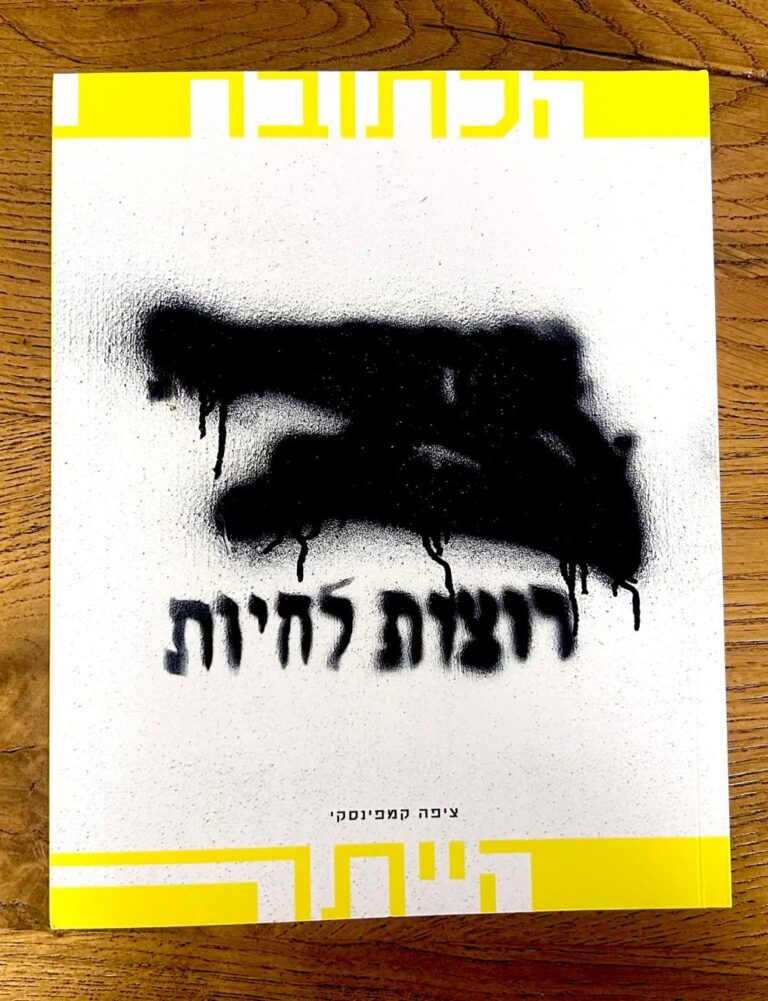
Kempinski’s new book, The Address Was (published by “What Was Here Before,” Florentin), documents the internal Israeli fault line as reflected on the neighborhood’s walls. Messages calling for peace and revenge replace one another on the same wall. Calls for accountability are plastered over. At times, the suffering of Gaza’s children is silenced; at others, so is the suffering of the hostages languishing in Hamas tunnels. One message asks, “Grandma, what did you do during the genocide in Gaza?” Another responds in marker: “I buried my dead! I sat shiva! I cried for the hostages.” Someone responded to the words “Together we will win” with the question, “Where is the victory?” And a bereaved woman protests on the wall: “You’ve gotten used to it.”
In the wake of the horrific massacre, the hostages and the war, the gray city became filled with grief, rage, pain and indifference—all smeared across layers of spray paint, paint and stickers. They overlap one another, respond to one another, and for the most part, certainly not politely.
Kempinski’s project recalls what David Grossman did in the early 2000s with Sticker Song, recorded by the Israeli hip-hop group Hadag Nahash. The clashing slogans weave together the story of a society in trauma. The medium of stickers has also made a comeback, this time carrying quotes and words of wisdom from young men and women who will forever remain 20 years old.
Unlike social media, graffiti does not allow people to retreat into echo chambers. The public wall, unlike the private wall of social media, is open to everyone. But is what emerges on these walls a conversation? An argument? A debate?
“There are quite a few events in life that we would prefer to forget, perhaps even erase from our consciousness as though they had never happened,” writes psychoanalyst Gabi Benoit, who contributes to the book. “The erasure or concealment of graffiti inscriptions comes from the same place—the people who erase them do not silence the voice of the writing. They cover it with a layer of paint, often black, but it does not disappear. The statement that was hidden will find its way out, like water, at an unexpected moment. And then the damage it causes will be far greater.”
Dr. Rakefet Efrat Levkovitz-Holzer adds a warning: “Erasure is a denial of recognition of the other, an attempt to negate their very existence.” According to her, the inscriptions are not an attempt at dialogue, but rather a form of “metaphorical murder—which not only alludes to actual murder, but, it seems, even brings its occurrence closer.”
“For the stone will cry out from the wall,” warns the prophet Habakkuk, and indeed, Kempinski’s book invites us to listen more closely to the voices erupting from the walls around us, in order to understand the depth of the crisis and perhaps also formulate the questions that need to be asked in an attempt to repair it.
The book’s author, Zipa Kempinski, is a contributor to Davar.