
"Personally, I support Jewish-Arab partnership, not only in politics but in all areas, and especially in the political sphere," Prof. Nohad ‘Ali says, opening the conversation about political partnership. As part of the Western Galilee Academic College and the Samuel Neaman Institute for National Policy Research at the Technion, Prof. ‘Ali examines the state of Arab society in Israel. "We are seeing very radical changes within Israeli Jewish society, toward the Arab minority and the rights of the Arab minority. I think that the Arab public in Israel today is a threatened population. Jewish-Arab partnership is the solution to this."
“The Arab parties have always supported this partnership,” says Prof. ‘Ali. He lists the Jewish candidates who have run over the years on Arab party lists. According to him, the novelty of Yoav Segalovitz joining Ra’am lies in his ideological identity. “He defines himself as a Zionist, and that is the new element Abbas is bringing into Israeli politics. The Arab street is divided on this issue.” According to him, Segalovitz’s work fighting crime gives him prestige, but his Zionist positions “pose a problem for the Arab public, both for Ra’am as a party and for Mansour Abbas personally.”
“The Arab public is largely in favor of integration,” states Prof. ‘Ali, “66% of the Arab public is in favor of integration. About 42% of the Arab public is in favor of entering a non-right-wing coalition. About 85% of the Arab public votes for Arab parties, rather than Zionist parties. The Arab public supports Arab parties participating in the political game.”
As part of Ra’am’s campaign to move to the center of Israeli politics, the party formally separated itself from the Islamic Movement. This came alongside the move to bring Segalovitz into the party. Prof. ‘Ali explains that despite the formal separation from the Islamic Movement, in the public’s eyes, Ra’am is still identified as an Islamic movement.
He explains that one of the reasons for the breakup of the Joint List was disagreement over cooperation with Zionist parties. “Mansour Abbas has no problem joining forces with Zionist parties. In contrast, the other Arab parties have a problem with Zionist parties. The Arab public, for the most part, opposes a ‘full-right’ government because this government’s policy toward the Arab public has been very tough and radical.”
Support for Partnership vs. Opposition Among the Jewish Public
Alongside support for partnership among the Arab public, Prof. Ali points to a different picture among the Jewish public. “The Jewish public does not have an orientation toward integration. 80% of the Jewish public opposes an Arab party participating in a coalition if it presents demands concerning the Palestinian issue. 68% of the Jewish public conditions an Arab party’s participation in a coalition on it recognizing Israel as a Jewish state.”
Over the past year, alongside increased activity among the Arab parties around the possibility of running on a single list, criticism has also grown within the Arab public over the failure to establish a list that would include all four Arab parties. According to Prof. ‘Ali, “Polls indicate that about 63% of the Arab public supports a Joint List. In other words, we have about 35% who do not support establishing a Joint List, because they are also aware of the tactics between the two emerging blocs.”
Despite the support for a Joint List, ‘Ali estimates that the Arab public will also be able to accept the parties running separately. “I think the Arab public will ultimately accept the split with understanding, if three conditions are met,” he said. According to him, the conditions are “that there be a surplus-vote agreement between the two parties, that they not attack each other,” and that the parties issue a joint statement: “We are running on two lists, we are signing surplus-vote agreements between us, and we are agreeing to conduct a respectful election campaign, and we call on you to turn out in large numbers to vote.”
Recently, the “Place For Us All” party was established, led by co-chairs Rula Daoud and Alon-Lee Green, championing the cause of Arab-Jewish partnership. Prof. ‘Ali believes that its limited political experience will work against it. “From the perspective of the Arab public, this movement has only recently appeared on the ground as a political party. Most of the Arab public is not familiar with these figures.”
He points out that new Arab parties that have tried to enter the political arena “have essentially failed to achieve success. They either withdrew from the race or reached an agreement with another party.” According to him, the main reason is that the number of Knesset seats available to Arab lists is limited. Another reason is the Arab public’s longing for unity. “There is a romanticism among the Arab public that seeks this unity.”
‘Ali believes that Abbas is attuned to the sentiments of the Arab public, which wants to influence policy from within the government. “At first, there was a consensus in Arab society against joining the government. But that changed as a result of changes in Jewish society and changes in Arab society. The Arab public feels threatened, and it wants partnership as a value, and it also wants partnership as a means of protecting its future here.”
Crime and Disappointment With the Parties Could Influence Voting
Prof. ‘Ali points out that the issue of violence and crime in Arab society has significantly changed the political discourse. According to him, there is a perception in Arab society that the government has the ability to eradicate violence, but is choosing not to do so. “More than 70% of crime in Arab society is organized crime. Only a state can fight organized crime,” he said, adding that “eradicating crime in Arab society is a political decision.” He contends that the fight against crime will be a central issue in the upcoming elections. “We will hear statements from candidates in Arab society such as, ‘Vote for us to eradicate violence in Arab society.’”
Alongside the desire to participate in politics, Prof. ‘Ali also describes a deep sense of frustration among the Arab public. According to him, “The behavior of the leaders of the Arab parties over the past two months has caused some frustration among Arab voters,” and he estimates that “if the three-party list had not been formed, the voter turnout would have fallen significantly within Arab society.
‘Ali also points to another source of frustration: “The second thing that frustrates the Arab voter is the consensus within the Jewish parties, both among the party leaders and the public, against Arab parties joining any coalition.”
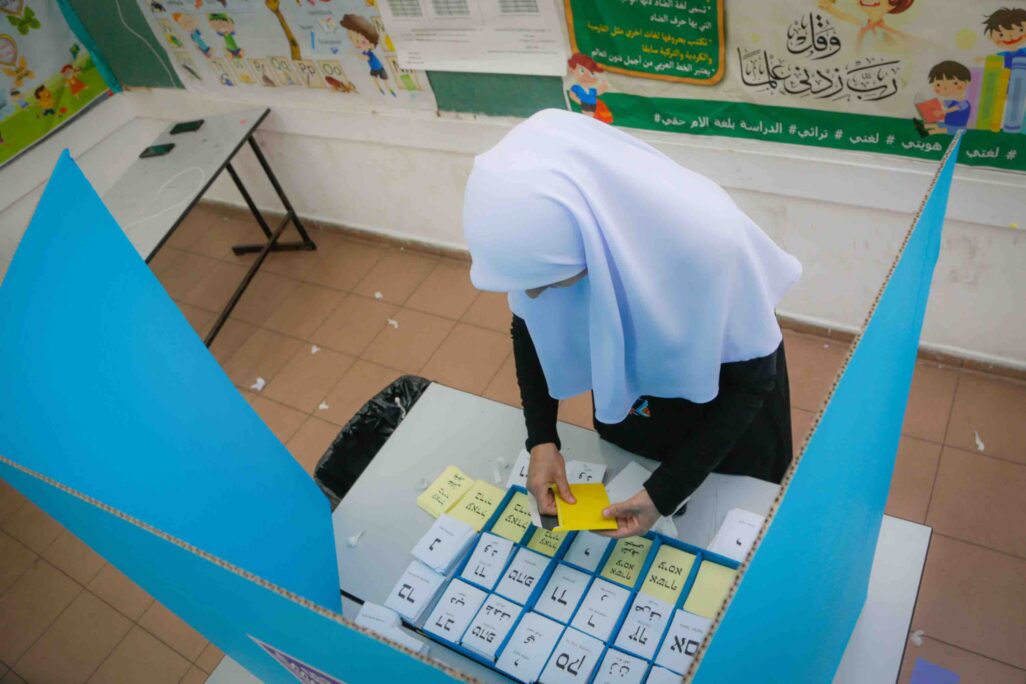
He supports efforts to encourage voting in Arab society. “The gap between the actual voter turnout and the potential voter turnout is essentially disappointment. Disappointment among the Arab public. Disappointment with the Israeli side and some disappointment with the Arab parties.”
Regarding efforts to lower voter turnout, Prof. ‘Ali estimates that statements by right-wing parties toward the Arab public and Arab parties in the days leading up to the election could have an impact on turnout. “I think this could lead to an increase in voting in Arab society,” he said. According to him, “This will be the reflex of Arab society, of course, provided that the Arab parties know how to capitalize on this.”