
The myth of Russia’s “August Curse” has followed the country for nearly four decades: from the 1991 coup attempt against Gorbachev, through the 1994 pyramid scheme and the 1998 financial collapse; from the Chechen War that broke out in August 1999, through the 2000 submarine disaster in which 118 crew members were killed, to the Russo-Georgian War that began in August 2008.
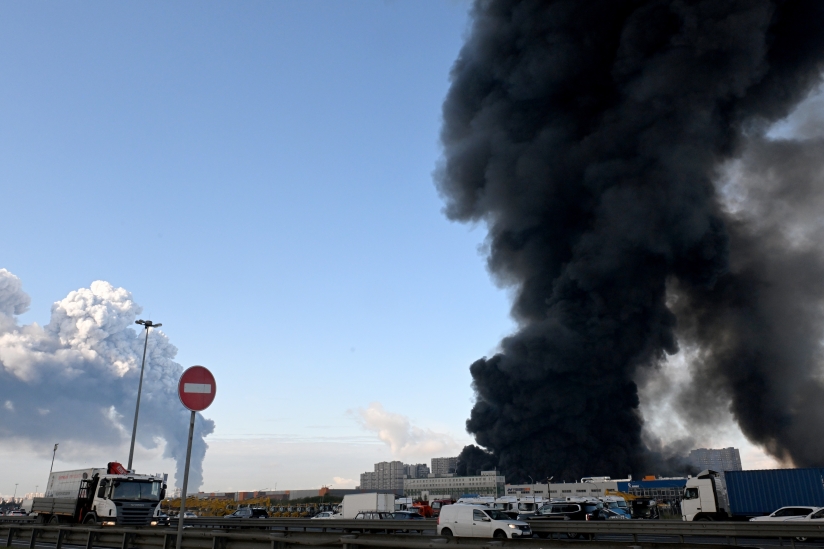
Now, it appears that the curse is exploding, igniting and plunging the country into crisis once again this August. After four and a half years of war, during which the Kremlin largely succeeded in keeping the direct costs of the conflict removed from the daily lives of most citizens, August 2026 had no single coup, financial collapse or national disaster commanding the country’s attention. Instead, the accumulation of several events is changing everyday life in Russia in ways not seen since the beginning of the war.
Warehouse Destroyed in Attack, Business Owners Won’t Be Compensated: “A Blow to Trust”
“Today, the warehouse in Krasnodar burned down, along with the remaining stock of my products. I’m officially unemployed and practically destitute. What am I supposed to do? Go home and use the last of my money to pay taxes. That’s it.”
Zhanna Petrova posted the short video, in which she cries in front of the camera, the day after a Ukrainian attack on a Wildberries warehouse in southern Russia in mid-July. Wildberries, or WB, is Russia’s largest online marketplace. Behind it are tens of thousands of small and medium-sized producers and retailers, whose goods, intended for some five million consumers, are stored in enormous warehouses spread across the country.
“I’m raising a child on my own and everything burned down. I simply can’t calm down,” said Viktoria Tul, a clothing seller from a provincial city in southern Russia, in another video. “I put so much effort and emotion into this business, so much money and investment, and now they’re telling us we won’t receive any compensation.”
Hundreds of videos like those posted by Petrova and Tul flooded social media over the past month, after Ukrainian drones struck around 20 of the company’s warehouses, destroying goods worth half a trillion rubles (around $6 billion). The cynicism and bitterness expressed in the videos are not calls for revolt, despite the fact that the losses suffered by producers are not covered by Russia’s wartime compensation laws. WB classifies attacks on its warehouses as “force majeure” and does not consider itself obligated to fully compensate sellers.
“WB would not be able to cover compensation costs on this scale, and no private company would take the risk of insuring it,” a businessman who works with the company told the Russian investigative outlet The Insider. According to him, even the possibility that the company, which relies on credit from a state-owned bank, could face a financial crisis is not merely a private matter. He therefore believes the government will support measures to ensure its stability, even if those measures are unpopular among sellers.
“Eighty percent of the company’s sellers have relatively modest annual sales of a few million rubles and are classified as small or medium-sized businesses,” he said. “For each of them, this is a disaster. From the state’s perspective, it means nothing.”
A former senior employee of the company who spoke with The Insider sees the impact elsewhere: “The failure to compensate for the damage is, first and foremost, a blow to trust. It no longer matters which marketplace it is or how much money was lost. We have reached a point where every producer in Russia will think twice about whether they are willing to put their home on the line for a personal business that could disappear in an instant without accountability.”
The economic activity of online marketplaces is estimated to account for around 5% of Russia’s GDP (approximately $162 billion), with WB, the largest of them, holding half of the market. After pressure mounted on social media, the company agreed to compensate some sellers for around 5% of their losses as a goodwill gesture—not in cash, but in vouchers. Producers who wanted to remove their goods from warehouses out of concern that they could be damaged reported that the company was making it difficult, and in some locations even prohibiting them, from accessing the warehouses.
“The State Has Stopped Fulfilling Its Role as Protector of the Private Market”
According to economic journalist Alexandra Prokopenko, a senior fellow at the Carnegie Russia Eurasia Center, for the first time since the beginning of the war, the Russian economy is undergoing a slow but steady shift toward stagflation: a prolonged period of little or no economic growth alongside high inflation.
In an interview with the Russian news outlet No.Media, Prokopenko emphasized that the data she presented are based on publications by the Central Bank. However, she said that the price increases actually experienced by Russian households when purchasing basic necessities can feel far more significant than the official figures suggest. The fuel crisis is one of the most prominent examples.
The problem began back in 2025, but this summer it has been felt much more acutely across large parts of the country. According to the Financial Times, at least 194 attacks were carried out on energy facilities and infrastructure during the first half of the year—11 times more than during the same period the previous year.
Economist Sergei Aleksashenko says that at the height of the crisis in mid-July, 85 regions had imposed restrictions on fuel purchases. Some regions limited the amount of gasoline that could be purchased per refueling to 20 or 30 liters; elsewhere, a system based on license plate numbers was introduced. Some private gas stations were forced to close, while others raised prices to as much as 300 rubles per liter – roughly three times the average price a year earlier.
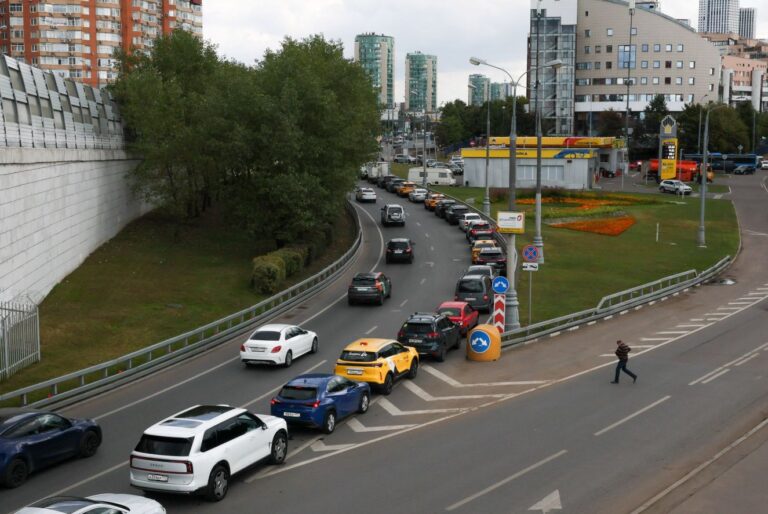
In Moscow, the problem eased considerably at the beginning of August, while shortages of fuel at intercity gas stations were still reported in outlying regions. “It cannot be said that the shortage of fuel for cars in Russia is over,” Prokopenko said. “Prices will continue to rise, and, as with Wildberries, the state does not intend to support the fuel industry either, which will cause prices to rise even further in the future.”
The damage caused to property by the war, in the absence of compensation, is adding to the pressure. Russia has no government mechanism comparable to Israel’s Property Tax and Compensation Fund, and according to Prokopenko, the private insurance market is not equipped to cope with the scale of the damage caused by the war. She describes the situation in the sector in recent months as “complete chaos.”
“The Russian insurance market has become increasingly domestic. It does not invest abroad, and no one invests in it,” she says. “Its collateral and reserves have been depleted, and now it is being asked to insure risks that it neither understands nor is prepared to handle.”
According to her, major oil refineries identified the problem as early as last year and approached the Finance Ministry with a request to establish government-backed insurance for them, but were turned down. The problem is now more severe and widespread, yet the state has given no indication to the market that it intends to change its policy.
Whereas during the economic crises of 2008 (the subprime mortgage crisis) and 2014 (the sanctions imposed on Russia following the annexation of Crimea), the government purchased high-risk debt from major banks and injected financial assistance, the situation is different today.
Central Bank Governor Elvira Nabiullina, who has managed to maintain relative stability in the market and the currency throughout the war, is expected to step down next year, and no successor has yet been appointed. Putin has already called twice on the Central Bank to cut interest rates to ease conditions in the credit market. The bank, however, in coordination with Putin himself, settled for a symbolic quarter-percentage-point cut.
“The state has stopped fulfilling its role as protector of the private market—the most important promise it made to the political system Putin created 25 years ago,” Prokopenko concluded. “The budget is unclear. It is unclear whether there will be support for businesses, where the state will invest money, and who will receive government contracts.”
Economists Warn: The Relationship Between the Market and the State Has Broken Down
For political economist Andrei Yakovlev of Harvard University, the prioritization of the war over all other economic needs is approaching a paradoxical situation.
“Yes, at the end of the day, there is food in the refrigerator, the electricity works, and people are getting paid. If you compare the situation with the 1990s, when people were paid in goods, the situation is fairly reasonable. But the system, as a market system, is reaching the limits of its capacity,” Yakovlev told the news outlet No.Media.
“The national deficit has doubled. In the regions, tax revenues from industries are collapsing, and some are approaching insolvency.” According to him, there are sectors that are growing—transportation and aviation, for example. By contrast, the construction industry is declining by tens of percent. The number of jobs unrelated to the military is shrinking significantly across the market.
Another indicator, in his view, is the decline in the number of government tenders and reports of delayed contract payments. According to him, about a year ago the Finance Ministry instructed government ministries and regional authorities to cut their ongoing expenditures, and the pressure was passed directly on to service providers and business owners.
“This is a situation that is beginning to resemble the 1990s,” he says, “although officially the state is still not at a point where it is unable to pay salaries or honor its contracts.”
According to him, there is also growing recognition within the government that the gap between the needs of the war and those of the broader economy is becoming dangerous.
“Economists in the Kremlin have been hinting for months that spending needs to be cut. They are not allowed to say it explicitly, but it is clear to everyone that they are referring to a very specific type of spending: war spending. In official publications, they warn that the relationship between the market and the state has broken down, and that this could lead to a significant deterioration in economic stability.”
Even the Elite Understand: “If Putin Needs Something, He’ll Take It From Everyone”
Last month, businessman and fertilizer tycoon Andrey Melnichenko, who for years was considered close to the Russian government, appeared on the cover of The Economist. In an interview, he warned about the toll the war is taking on the economy’s ability to function properly and described his unsuccessful attempts to persuade President Putin of his concerns.
His unusual appearance in the pages of the influential Western business magazine was interpreted by some commentators as a signal directed inward, a sense of deadlock that is beginning to penetrate even parts of the elite that have supported the government and the war.
Yakovlev argues that the position of the oligarchs themselves has changed during the years of war. Many of them have become more dependent on the state, while their ability to influence Putin has weakened relative to that of the security establishment. If the situation deteriorates, one possible outcome could be another wave of nationalizations and an expansion of the state’s direct control over the economy.
“With Trump’s rise to power, there was optimism in the business world, based on the rational assumption that some kind of compromise would be reached and that the situation would improve,” he said. “But now they understand that the Kremlin has no intention of ending the war. Stagnation, rising taxes, more expensive credit. The elite have not yet reached the point of panic where they think ‘everything is heading toward destruction,’ but there is an understanding that if Putin needs something, he will take it from everyone. No one is protected.”
Political Analysts: The Crisis Only Strengthens Support for the Government
“There is a profound misunderstanding of the Russian regime in assuming that a crisis of this scale could change public opinion or lead to regime change at all,” political researcher Nikolai Petrov told Novaya Gazeta, an independent Russian newspaper, in an interview about two weeks ago.
According to him, Putin’s years in power have created a deep process of atomization within Russian society. A person can be angry about the price of fuel, lose their business, or want the war to end, and still see no way to turn that anger into meaningful collective political action.
Despite Ukrainian propaganda portraying its military successes as actions aimed at breaking the Russian home front, Petrov argues that the effect is unequivocally the opposite: attacks on Russian civilians trigger a “rally around the flag” response and, at least in the short term, strengthen support for the government and the war.
The government’s next major political test will be the elections to the Duma, the lower house of the Russian parliament, which are expected to be held in September. According to Petrov, contrary to the intuition of a liberal observer from outside Russia, the elections are very important to Putin.
“This is a process of conditioning people to accept the legitimacy of the government,” he says. “The Russian president no longer needs the elites, so he appeals directly to the public.”
“So many people are being killed. So many business owners are being affected. I wish all of this would just end already,” said Viktor Adapet in an Instagram video. The contents of his business were damaged in the Wildberries warehouse in Krasnodar.
Political commentator Vladimir Pastukhov agrees that the situation in Russia is becoming increasingly extreme, but rejects the conclusion that this August signals the end of the war.
In an interview with the Echo news website, he agreed that if there has been one significant change this summer, it concerns the place of Russian civilians in the war.
“The situation in which we stood on the sidelines is over. From now on, the home front on both sides is an effective military target. Tanks, oil refineries, shops—this is our future everyday reality. We are in a transitional period, at the end of which there will be no turning point, but there will be habituation.”
“Russia is the largest country in the world. Even if something happens in one particular region, that does not mean it is a trend that will immediately spread across the country,” wrote Irina Busygina, a Harvard sociologist specializing in public attitudes and government in Russia, in an article published earlier this month in VoTak magazine. “It is possible in certain places. But this is where a simple fact comes into play: it will likely require a substantial accumulation of protest sentiment across the country as a whole.”
According to her, even if this summer represents positive momentum for Ukraine, the outcome of the war is far from certain. It could still end in a Ukrainian defeat, or alternatively, in structural change within Russia that does not result from a direct military defeat, but from a chain of economic and political pressures—perhaps like those we have seen this summer—that forces the leadership to rethink its course.
“If this happens,” Busygina wrote, “it will happen after Putin. He may still be alive, but he will no longer be able to remain in power. There will be no turning point without another leader coming to power.”
Contributed to the preparation of this article: Nicholas Timur.