
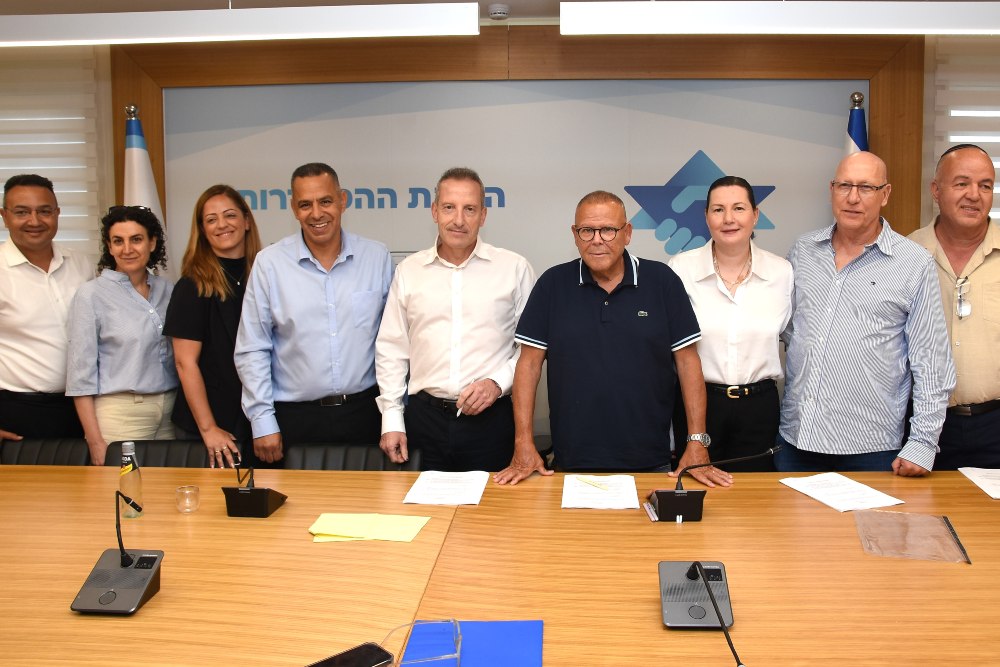
The Finance Ministry, Defense Ministry, and representatives of Defense Ministry employees signed a special collective agreement last week that replaces the incentive pay mechanism (“premiums”) that had been used at the ministry for decades with fixed salary increases recognized for pension purposes, along with attendance incentives and excellence bonuses. According to the Histadrut and the ministries, the agreement will bring the salary structure in line with the nature of work at the Defense Ministry today. The agreement increases the share of salary components recognized for social and pension benefits, while also addressing the needs of specific groups, including senior-level employees and students employed by the ministry.
Key provisions of the agreement include:
- New percentage-based salary increase (replacing the fixed premium): Employees in the administrative, academic, engineering, and technical classifications will receive a fixed salary increase of 14.3%.
- Social workers will receive a salary increase ranging from 10.73% to 15%.
- Annual excellence bonuses for 25% of employees each year, worth thousands of shekels, for employees in eligible classifications.
- A fixed-sum salary increase for senior employees.
- A monthly incentive for employees who do not take sick leave.
- Performance and output bonuses for students, worth thousands of shekels.
Histadrut Chairman: “It’s Good That Israel Has Defense Ministry Employees”
Histadrut Chairman Arnon Bar-David welcomed the agreement: “Every agreement signed at the Defense Ministry for Defense Ministry employees and IDF civilian employees is, in my view, an agreement that lies at the very foundation of the existence of the Histadrut and the State of Israel. I have always believed, and recognized, that it is good for the State of Israel to have a Defense Ministry and a strong IDF, and that it is good for the State of Israel to have its dedicated Defense Ministry employees. For us, as the Histadrut, it is important to preserve the ministry’s ability to remain versatile and adapt itself to its missions both in times of calm and in times of war. On the eve of the new year, we are signing this agreement and wishing everyone a good and sweet year, with new beginnings, cooperation, and growth.”
Director General of the Defense Ministry, Maj. Gen. (res.) Amir Baram: “There was a great deal of goodwill here, and all Defense Ministry employees and management stand behind this agreement. It is a modern and forward-looking agreement that truly encourages excellence and achievement—and in my view, that is what will preserve the quality of public service. I greatly appreciate the excellence bonuses established under the agreement. The agreement increases stability and certainty around salaries, and is part of the ministry’s broader vision, which benefits management, employees, and the wider ecosystem. This is an agreement that also brings good news for the future.”
Finance Ministry Wage Commissioner Efi Malchin says on the matter, “This is a complex agreement with many precedents that, in my view, reflect the fact that both sides stepped somewhat outside their comfort zones and chose to take risks in order to move forward. We see a great deal of potential in this agreement for other areas of the country and the public sector as well, and therefore we very much hope to see it succeed in practice, to see outstanding employees advance, and in that sense—your success is our success. We believe you will make the best possible use of this platform.”
Danny Hornstein, chairman of the Histadrut’s Association of Engineers and Technicians and head of the defense portfolio at the Histadrut: “This agreement is truly groundbreaking and is the result of painstaking and responsible work with courageous partners. We have created a solution that strengthens engineers, technicians, academics, and administrative employees alike, replacing fragile premiums with solid salary components protected for pension purposes. The defense establishment now has a workforce that is strengthened, better compensated, and highly motivated.”
Histadrut Deputy Chairman Roy Yaakov: “I know the Defense Ministry very well because I came from the ministry. When I previously worked at the Prime Minister’s Office and moved to the Defense Ministry, my daughter asked me, ‘Dad, what happened? Why are you coming home late?’ And that really illustrates the uniqueness of this ministry. There’s no getting around it—the Defense Ministry is a different kind of ministry, one where the lights are never turned off. Its employees work extremely hard, and it’s no coincidence that we have the best Defense Ministry in the world and the best army in the world. This modern and innovative agreement is further evidence of that. I truly believe that bringing together management, the workers’ committee, and the Histadrut to work together is an unbeatable force.”
Acting Deputy Director General and Head of Human Resources at the Defense Ministry, Einat Igoren Nahum: “The new agreement represents a significant and meaningful development for the ministry’s employees and management. It reflects an investment in human capital, strengthens employment conditions, and moves the ministry forward toward a more advanced, stable, and better-adapted compensation model. I would like to thank my negotiating partners at the Finance Ministry, the Histadrut, and the workers’ organization, who throughout the process demonstrated mutual partnership, commitment, and dedication to its success, while maintaining a high level of professionalism and forward-thinking.”
Senior Deputy Wage Commissioner at the Finance Ministry, Yifat Kozliner: “We are constantly working to develop innovative compensation mechanisms and change the way compensation and incentive mechanisms are structured and implemented across the country, where relevant. This agreement, which is part of this broader shift in approach and required no small amount of creativity and out-of-the-box thinking, replaces an existing salary component with new and more relevant additions for the Defense Ministry that will provide appropriate compensation.”
Chairman of the Defense Ministry Employees’ Committee, Sasson Peretz: “This agreement is a revolution at the ministry. It took a great deal of courage to give up and eliminate the incentive pay component, but I truly believe that it did not deliver the productivity gains it was intended to, and that the new agreement will both increase income for the vast majority of ministry employees and make a significant contribution to productivity. This is a major and complex agreement, very special and historic. I thank everyone who worked tirelessly around the clock to make it happen.”
The following participated in the negotiations on behalf of the Histadrut: Histadrut Chairman Arnon Bar-David; Danny Hornstein, chairman of the Histadrut’s Association of Engineers and Technicians and head of the defense portfolio at the Histadrut; Chairman of the Civil Service Workers’ Union, attorney Ophir Elkayim; Chairman of the Defense Ministry Employees’ Committee, Sasson Peretz; attorney Maya Franco, head of collective bargaining at the Legal Department of the Histadrut’s Trade Union Division; and advisers Avi Ayash, Tal Meirson, and Avi Nissenkorn.
On behalf of the Defense Ministry: Acting Deputy Director General and Head of Human Resources, Einat Igoren Nahum, and Head of the Salary Unit, Aryeh Peretz.
On behalf of the Finance Ministry: Yifat Kozliner, Senior Deputy Wage Commissioner; Noy Sofer-Laor, Senior Deputy Wage Commissioner; Gali Amir, Senior Director; Ilan Tzur, Director of Compensation and Incentives; attorneys Avital Cohen and Shiran Ben-Moshe, team leader; and attorney Rivka Ravilo, Deputy Legal Adviser, from the Legal Department of the Wage Division.