
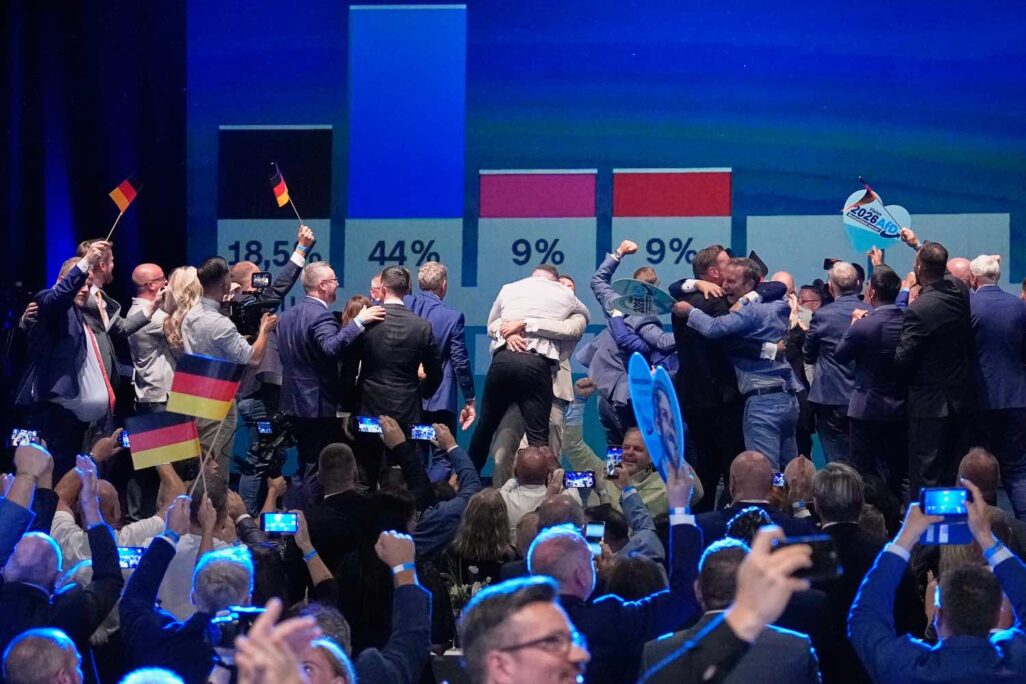
The far-right “Alternative for Germany” (AfD) party won around 44% of the vote—equivalent to 39 seats in the state parliament—according to exit polls from yesterday’s (Sunday) state parliamentary election in Saxony-Anhalt in eastern Germany.
The Christian Democratic Union (CDU), the party of current Chancellor Friedrich Merz and former Chancellor Angela Merkel, which has governed Saxony-Anhalt for the past 24 years, received just 18.3% of the vote, according to German broadcaster ARD.
The Social Democrats received 9.3%, securing eight seats. The Greens will also hold eight seats after receiving 8.9% of the vote, while the left-wing Die Linke party won eight seats with 8.6% of the vote.
The populist left-wing Sahra Wagenknecht Alliance (BSW), which holds five seats after narrowly crossing the 5% electoral threshold with 5.3% of the vote, will determine who forms the next government. Last night, during election broadcasts, a BSW representative, speaking in a joint interview with AfD co-chair Alice Weidel, declared the party’s willingness to cooperate with the far right.
One of Germany’s 16 Federal States
Saxony-Anhalt is one of the 16 federal states that make up Germany. Around 2.1 million people live there, and it has its own parliament and government. In the election, residents voted for members of the state parliament.
The election attracted considerable attention across Germany, and voter turnout was particularly high. In the weeks leading up to the election, polls showed around 40% support for the AfD and suggested that it could win an absolute majority. If it ultimately succeeds in securing a majority in the parliament and forming a government on its own, it would be the first time since the fall of Nazism that a far-right party has governed one of Germany’s states.
During the election campaign, the AfD widened its lead over its rivals, in part by focusing on the cost of living, immigration, declining birth rates, and the decline of the industrial sector. The party also pledged to promote a patriotic cultural policy if it came to power.
The AfD’s growing strength in Saxony-Anhalt comes amid a broader rise in its support nationwide. In Germany’s most recent federal election, the party doubled its strength and became the second-largest party in the parliament. Despite this, the other parties maintained their boycott of the AfD, and it was not included in the governing coalition.
Siegmund Attended Meeting with Neo-Nazis
Ulrich Siegmund, the AfD’s candidate for state premier of Saxony-Anhalt, declared victory in the local MDR television studio, saying: “We made history.”
Siegmund, 35, has been at the center of intense criticism in Germany in recent years. Der Spiegel described him as “the most dangerous man in Germany” in an article that appeared on the magazine’s cover. At his most recent election event, he was greeted with chants of “Sieg”-“mund,” echoing the Nazi slogan “Sieg Heil.” In response to the criticism, he said: “That’s my name; I don’t see anything wrong with it.” Several months ago, when asked whether the Holocaust was the worst crime against humanity in history, he replied: “I don’t know if I can make that judgment.”
")
Two and a half years ago, Siegmund was removed from his position as head of the Social Affairs Committee in the Saxony-Anhalt parliament after it emerged that he had attended a meeting with neo-Nazis at which the possibility of deporting migrants from Germany was discussed, including those who hold German citizenship.
Others in his circle and party have also been linked to extremist views. Siegmund’s spokesperson was a member of a neo-Nazi youth movement, while Hans-Thomas Tillschneider, the party’s ideologue in the state, blamed Jews for Muslim immigration to Germany and said that under an AfD government, the education system would teach “less Hitler, more Bismarck.”
AfD Could Form Government in a German State
The AfD’s victory could pose a significant challenge to Germany’s political system. Most parties in the country maintain a “firewall” policy against the AfD, refusing to work with it, share information with it, or include it in governing coalitions. If the party becomes the governing party in Saxony-Anhalt, this could make it more difficult for other parties to maintain this approach at the national level as well.
There are also concerns in Germany about the possibility of senior AfD officials gaining access to sensitive information if the party comes to power in the state. Jörg Mayer, a Social Democratic interior minister in Thuringia, told DW that if an AfD politician were appointed interior minister of Saxony-Anhalt, “in my view, that would pose a significant security risk to Germany.”
During the election campaign, Siegmund pledged to deport “from day one” foreigners who have no legal right to remain in the country but have been allowed to stay on humanitarian grounds. He also vowed to cut funding for pro-democracy organizations, human rights groups, and organizations providing assistance to migrants, and to require migrants to work.
Throughout the campaign, Siegmund repeatedly used the slogan “Patriotism is better than social diversity,” which gained considerable popularity and evokes associations in Germany with other periods in the country’s history.