
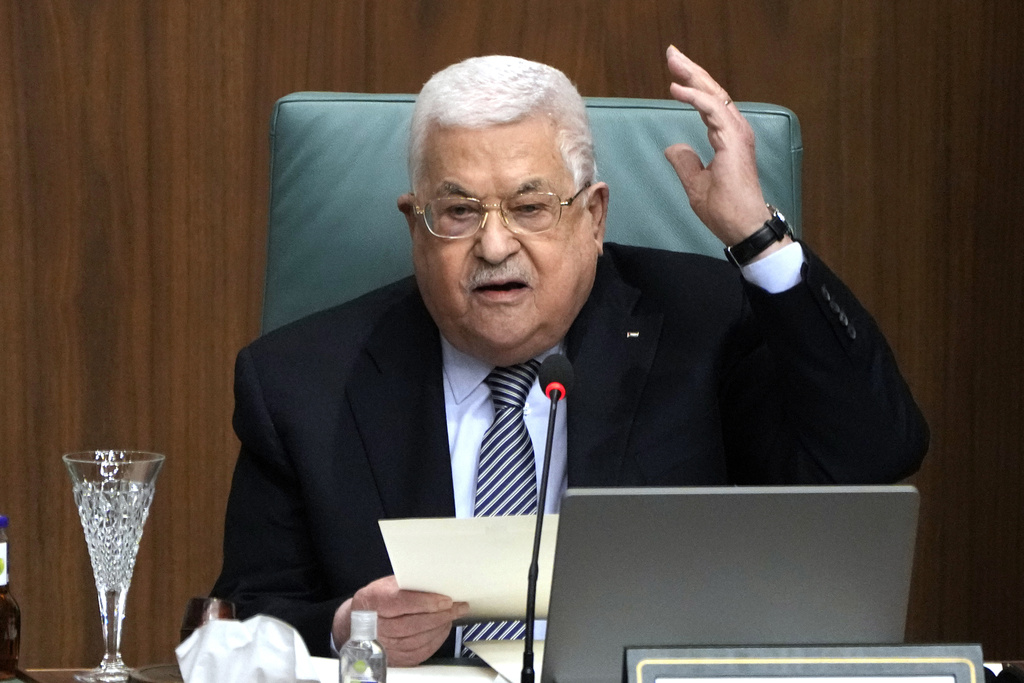
The Palestinian Authority has announced parliamentary elections for November 28, 2026, twenty years after the PA’s previous elections – but Dr. Michael Milshtein, an expert on the Palestinian arena and former head of the Palestinian arena in IDF Military Intelligence, estimates that the chances of the elections actually taking place are low, because the current PA leadership and the United States are not genuinely interested in holding elections.
At the end of last week, a senior delegation from the Palestinian Authority, the PLO and Fatah traveled to Cairo, headed by Vice President Hussein al-Sheikh, along with other senior PA officials. The visit took place several days after leaders of almost all Palestinian political factions convened in the Egyptian capital to discuss the elections and the possibility of forming a broad bloc against Fatah. In an interview with Davar, Dr. Milshtein explains the circumstances that led Palestinian Authority President Mahmoud Abbas (Abu Mazen) to promote the holding of elections this time, and points to the reasons why they may not actually take place.
Twenty Years Without Elections
Milshtein explains that the very announcement of the elections is a direct result of international pressure on Abbas “to begin showing some semblance of freshness, improvement, democratization” – pressure that increased primarily around the desire to move forward with the plans for Gaza. This pressure has already led, in recent months, to Fatah’s Eighth General Conference. The elections planned this time are for the parliament only, a decision related to the PA’s risk management, since a defeat in the parliamentary arena would serve as a warning sign for presidential elections and would likely lead to their cancellation.
“Twenty years have already passed without elections,” Milshtein says, recalling that the last serious attempt was in 2021, and that its cancellation, he says, “to some extent, ultimately, led to Operation Guardian of the Walls.” The person who pushed for advancing the process at the time was primarily Jibril Rajoub, Secretary-General of Fatah’s Central Committee. However, the elections were canceled because Fatah had split into several lists, and once assessments indicated that a defeat against Hamas was likely, “they suddenly came to their senses.” Previously, in 2006, the only genuinely democratic elections ever held in the PA actually took place – and Hamas was the winner.
Jerusalem as an Obstacle, Israel as an Alibi
Milshtein points to the “smoking gun” that was put on the table about two weeks ago and is expected to eliminate the possibility of elections: East Jerusalem. “At a press conference, Vice President al-Sheikh set a condition that the elections would be held in Jerusalem,” meaning that East Jerusalem residents would vote as they did in 1996 and 2006, within the municipal boundaries and within Israeli territory, including for Hamas lists. This is precisely the condition that was used as an excuse to cancel the elections in 2021, and therefore the assessment is that the PA “is counting on there being an external party, namely Israel, that will give them an alibi for canceling the elections.”
Another complication that could thwart the elections is that Hamas has declared that it intends to participate in the elections, while the PA requires it, as a condition, to honor the political agreements to which it is a signatory, foremost among them the Oslo Accords – “a condition Hamas has never been willing to accept,” Milshtein says. According to him, the conclusion is that the chances are high that “either Israel will stop the elections, or Hamas will cause problems.”
“The Palestinian Public Is in Despair”
“The Palestinian public is in a very, very low and despairing state,” Milshtein says, outlining the factors behind the erosion among Palestinians: the system is divided, the war is still present, and there is a sense that the world is no longer interested in what is happening to them, and certainly not in the internal issues of Palestinian society.
“Even the discourse around a two-state solution seems completely unrealistic at the moment,” Milshtein explains, adding that, in fact, the Israeli elections are of much greater interest to the Palestinian public than the elections in the PA, based on an understanding that these elections “will determine their fate much more at this point than the elections in the PA.”
The Strong Candidates Challenging Abbas
The most prominent candidate in the elections is Marwan Barghouti, a Fatah member serving a life sentence in an Israeli prison for acts of terrorism. According to Milshtein, throughout a decade of Shikaki Institute polling, he has defeated every candidate in presidential elections by a wide margin, from both Fatah and Hamas. However, no date has yet been set for the presidential elections, and the parliamentary race is more complicated: Barghouti will have to put forward his own list and run it from prison, without regular contact with the outside world and without an agreed-upon representative to act on his behalf. Therefore, at this stage, “he is mainly a symbol that they are running.”
Milshtein says that Qassam Barghouti, Marwan’s son and also a political activist in his own right, told him that the family intends to run Barghouti when presidential elections are held, partly in the hope that his election would help secure his release from prison. Other candidates who may put forward lists include Nasser al-Qudwa, the former Palestinian foreign minister, and Salam Fayyad, the former prime minister. However, according to Milshtein, support for Fayyad is very low in the polls.
Dahlan’s Return
Another figure returning to the discourse and public arena is Mohammed Dahlan, who headed the Preventive Security in the Gaza Strip until 2007. Following fierce clashes with Abbas, he was expelled from Fatah in 2011 and has lived in exile in Abu Dhabi ever since. According to Milshtein, Dahlan is a man of the Emirates – he is funded and supported by them, and to a large extent also by Egypt, “whom he is also very close to.” According to him, Dahlan also enjoys broad support among the public, particularly in Gaza. A poll conducted by the Palestinian AWRAD (Arab World for Research and Development) Institute last May illustrates this: according to its results, if presidential elections had been held, 38% of Gazans would have voted for Dahlan, 21% for Barghouti and 14% for Hussein al-Sheikh, while Hamas candidates would have barely received around 5%.
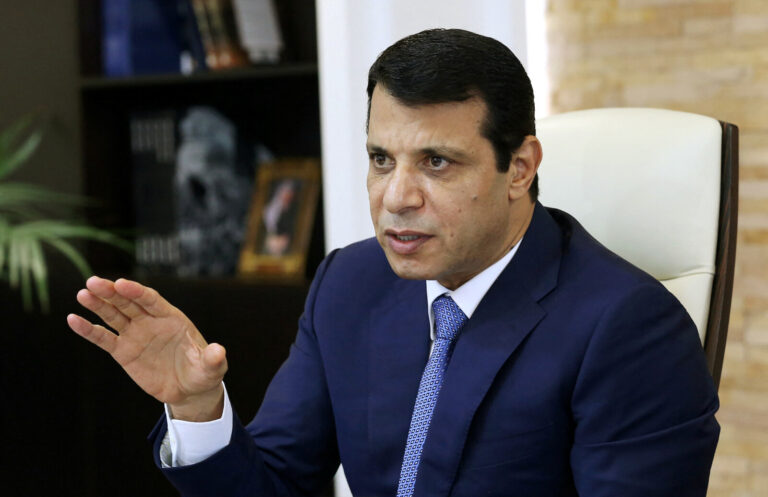
“What brought Dahlan into the picture was mainly the desire to take part in decision-making, among other things in order to advance the second phase in Gaza,” Milshtein explains. According to him, Dahlan saw “a real opportunity to return to Gaza, but at the moment it seems that this opportunity is fading.”
Despite his good relations with the Hamas leadership abroad, and the discussions about a “national front” that would include an alliance between Dahlan and Hamas members, Milshtein estimates that the chances of Dahlan and Hamas running on a joint list are very low. Coordination or cooperation between them may be possible around a future arrangement in Gaza, but Dahlan, he says, “is, after all, a Fatah man.”
In the meantime, Dahlan is using the discourse surrounding the elections to promote himself among the Gazan public. Two television channels associated with him are broadcasting in the Strip with the message that he is capable of bringing about an arrangement and an end to the fighting. He was involved in an effort that brought together Hamas leaders abroad, the U.S. president’s son-in-law and envoy Jared Kushner, and the Gulf states, and led to a brief period of calm, but fighting has since resumed. The very fact that this effort took place, Milshtein says, caused Abbas and PA officials to “shift uncomfortably in their seats,” fearing that they were becoming irrelevant.
The Americans Are Not Interested
Milshtein believes that the chances of the elections taking place are low, and not only because of the state of affairs within Palestinian society and its internal politics. According to him, the previous elections held in the PA took place to a large extent as a result of external intervention, rather than as a sovereign decision by the Palestinian public and leadership.
“If we compare the circumstances that led to the 2006 elections, the people who essentially pushed for the elections were U.S. Secretary of State Condoleezza Rice and U.S. President George W. Bush, in the name of an ambition to promote democracy, which ultimately led to a Hamas victory,” Milshtein says, adding, “I don’t see any signs that the Americans are really interested in this matter. They are so preoccupied with Iran, and they have neither the motivation nor the bandwidth for the Palestinian issue.”