
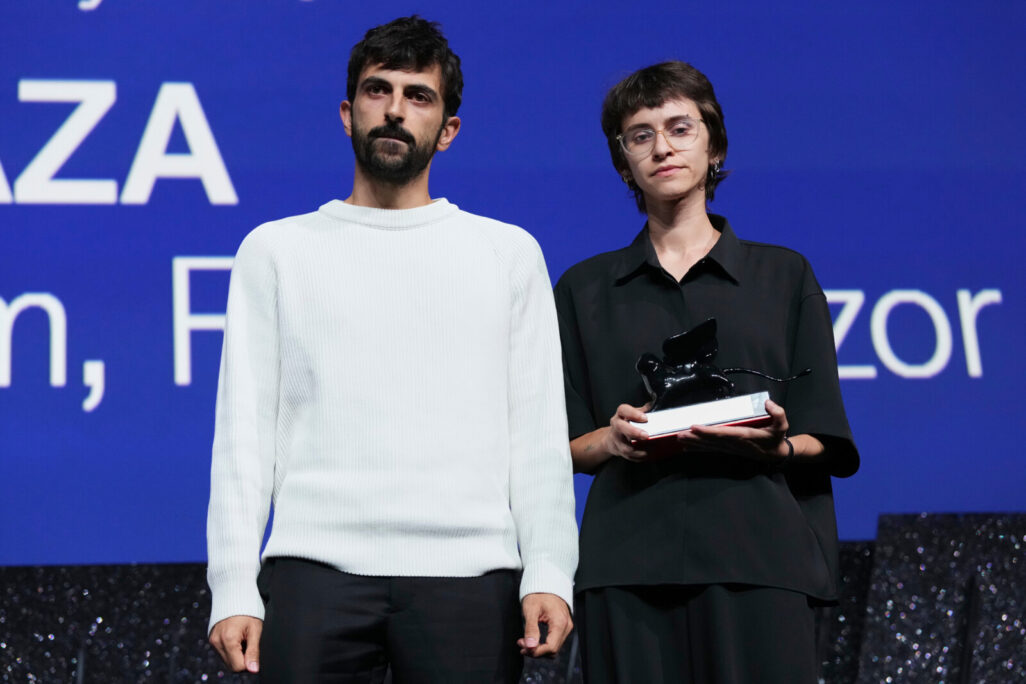
The documentary film “NAZA” by Israeli filmmakers Yuval Abraham and Rachel Szor won the Special Jury Prize on Saturday evening at the Venice International Film Festival. The film, which presents testimonies from soldiers and intelligence personnel, has sparked extensive discussion in recent days following the serious claims presented in it, and was received at its premiere with prolonged applause.
“NAZA” was the only documentary film among the 21 films competing this year in the festival’s main competition. It was added to the competition at a late stage and had its world premiere on Thursday. The Golden Lion, the festival’s main award, was given to “Woman Unknown” by Danish director May el-Toukhy.
Abraham and Szor were two of the four creators of “No Other Land,” which won the Academy Award for Best Documentary Feature last year. “NAZA” was produced by The Guardian and James Wilson of JW Films, while British director Jonathan Glazer, director of “The Zone of Interest,” serves as an executive producer on the film. The film, which is approximately 80 minutes long, was filmed in Hebrew and English and is also expected to be screened later this month at the New York Film Festival.
24 Interviewees, Tel Aviv Rooftops and Target-Identification Systems
The film was secretly shot over nearly three years, mainly at night and on rooftops in Tel Aviv. At its center are the testimonies of 24 Israeli soldiers and intelligence personnel, whose faces and voices were digitally altered to protect their identities. The filmmakers asked the interviewees to describe the surveillance, intelligence-gathering, and target-selection systems in which they were involved during the war in Gaza.
The name of the film is the military acronym in Hebrew for the words “Collateral Damage”, a term referring to the number of civilians the military estimates could be killed in an attack on a military target. The film is partly based on investigations published between 2023 and 2025 in +972, Local Call, and The Guardian, and seeks to connect the findings published in them with filmed testimonies from those who, according to the filmmakers, actually operated the systems.
")
Among other things, the interviewees describe the use of artificial intelligence-based systems and information collected from mobile phones to identify suspected Hamas operatives. According to the testimonies in the film, targets were sometimes attacked in homes where family members were also present, with prior knowledge that civilians could be harmed. Other interviewees describe shooting at civilians who entered areas that the military had designated as off-limits, including near aid distribution points. These are claims that the security establishment rejects.
Abraham told Reuters in an interview that the film seeks to show a system in which, according to the filmmakers, harm to civilians is not merely an accidental consequence of the war but is built into some of the target-selection processes. Szor explained that the decision to film in Tel Aviv was also intended to create a contrast between the life continuing in the city and the destruction taking place in the Gaza Strip, about 60 kilometers away.
The film contains almost no graphic images from Gaza. Most of it relies on lengthy conversations with the interviewees and the way they explain their work, sometimes using drawings and technical descriptions. The filmmakers said they chose not to focus the film on the question of whether the interviewees regret their actions: some expressed regret, while others did not, and according to them, the focus is on the system rather than the personal story of the whistleblowers.
25 Minutes of Applause – and a Strong Response from the IDF
The world premiere in Venice ended with approximately 25 minutes of applause, which according to Reuters was by far the longest at the festival this year. Palestinian flags were also waved in the auditorium during the applause. The film received enthusiastic reviews from much of the international press, including Variety, The Hollywood Reporter, and IndieWire. The Guardian critic Peter Bradshaw described it as a disturbing and important film, but noted that the fact that all the testimonies are given anonymously somewhat weakens their power as evidence.
In Israel, the film sparked strong criticism, including over the claims it makes regarding the IDF, the anonymity of the interviewees, and the historical comparisons raised by some of them. At the same time, supporters of the film argued that the fact that these are testimonies from Israelis who were part of the system itself requires public discussion of the claims.
Following the film, the IDF published an official response in which it rejected the claims “in their entirety.” According to the IDF spokesperson, the film relies on anonymous testimonies whose identities, roles, or degree of involvement in the issues they speak about cannot be verified. The military further claimed that some of the interviewees attribute to themselves knowledge of policies that are not within their authority or knowledge.
The IDF also rejected the claims regarding the use of artificial intelligence for the purpose of making decisions about strikes. According to its response, technological systems are used only as an aid, while “decisions regarding the selection and approval of strikes are made by human beings alone.” It further stated that its activity in the Strip is directed against Hamas and other terrorist organizations, is carried out in accordance with international law, and includes efforts to reduce harm to civilians.
The award in Venice gives “NAZA” a broad international platform even before its commercial distribution. Its North American premiere is expected to take place at the New York Film Festival at the end of September, and mk2 Films is marketing its distribution rights worldwide.