
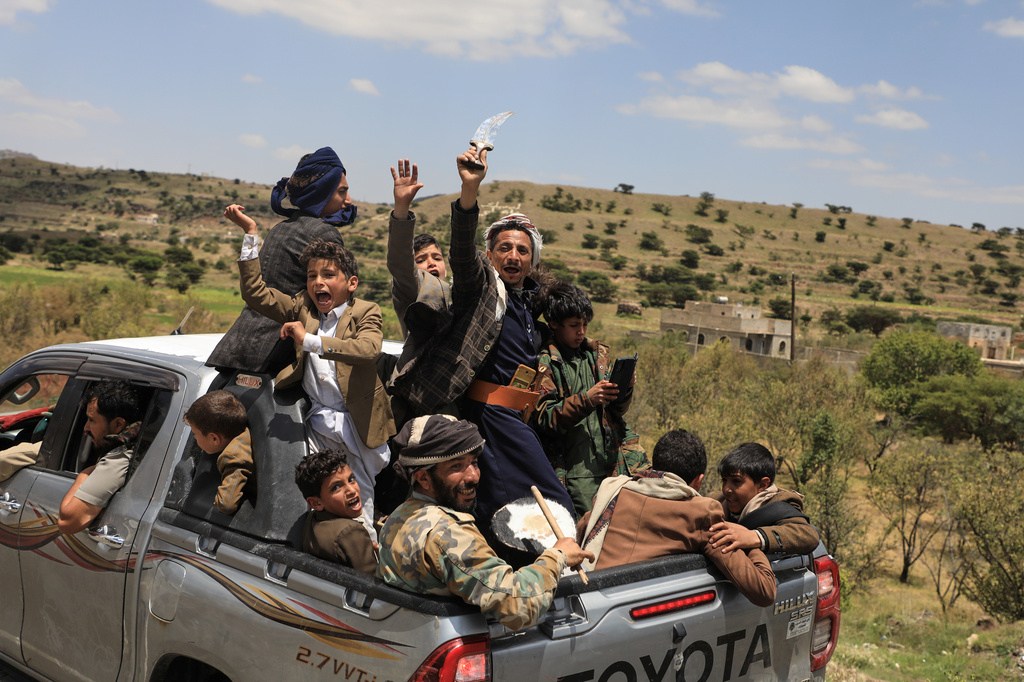
The Houthis recorded a series of gains last week in the war against the Saudi-backed Yemeni army, including in the Bab al-Mandab Strait, while the confrontation between them and the Saudis continues to escalate. Saudi Arabia announced on Wednesday that it intercepted a Houthi drone over the city of Mecca last night—the first attack on the holy city in nine years. The attack triggered alerts yesterday in Mecca, as well as in the Saudi cities of Taif and Jeddah. The Houthis said that over the past 24 hours, Saudi Arabia had carried out 52 airstrikes targeting civilian sites in Houthi-controlled areas of Yemen, and claimed that they had managed to shoot down a Saudi F-15 aircraft.
“I’m not ready to write off the Yemeni army and the coalition fighting the Houthis, but it is clear that they suffered a major defeat,” Inbal Nissim-Lubaton, a Yemen researcher at the Open University and Tel Aviv University’s Dayan Center, told Davar. “And the defeated group is made up of the most skilled and best-equipped forces that this coalition can currently offer. However, fighting is also taking place in other provinces, where the Houthis do not necessarily have the upper hand. The forces fighting them are regrouping and will try to launch another attack, including along the coast.”
The ceasefire between the Houthis, Saudi Arabia, and the Yemeni militias fighting against them collapsed completely about two months ago. After four years of limited fighting, the Houthis have been attacking Saudi Arabia daily over the past two months, launching ballistic missiles and drones at it, [targeting infrastructure and civilians], and threatening it from the border.
“So far, we are not seeing any intervention by the Mecca Alliance,” Nissim-Lubaton says, highlighting the lack of response from Turkey and Pakistan after the three countries signed mutual defense agreements dubbed the “NATO of the Middle East.” The Reuters news agency reported from Ankara that a vote in the Turkish parliament on the alliance’s legal validity is not expected to take place for another month. Even if Ankara and Islamabad decide to intervene, it may be limited to the symbolic level.
According to Nissim-Lubaton, “It seems that the Saudis are on their own in this campaign at the moment. Trump is turning his back on them. This connects to a long period in which they have felt that America betrayed them, which has already led them to form regional alliances as an attempt at a substitute. They made sure to push the Emiratis out of Yemen, and for now they prefer not to bring them back.”
The shift in favor of the Houthis came after it had appeared that the coalition fighting them was succeeding in making gains and capturing territory. Last week, the Houthis captured thousands of square kilometers; pushed the groups fighting them southward; and seized several strategic islands, as well as the tip of the land at the Bab al-Mandab Strait. According to a report in Bloomberg, senior officials in “several Western European militaries” assessed that Saudi Arabia and the forces associated with it are struggling to halt the Houthis’ advance, and that they have a low chance of recapturing the port of Mokha on the Red Sea in the near future.
The Alternative to Bab al-Mandab Has Also Been Hit
The Houthis announced that the Bab al-Mandab passage was closed only to the Saudis, under the slogan, “A siege will be answered with a siege.” But insurance companies have long refused to insure ships passing through the strait, near which, on one side, the al-Qaeda-affiliated terrorist organization al-Shabaab is in control, while on the other side, the Houthis had been in control even before the events of recent weeks.
The global media noted that Bab al-Mandab is the gateway to the Red Sea, an important trade route, but largely overlooked the fact that the passage has not been safe for shipping since the end of 2023, due to the Houthis’ war against Israel, and that traffic through it has declined by tens of percent in recent years.
Significant damage was also recorded to infrastructure intended to establish an alternative to the strait. This week, Saudi Arabia shut down its strategic oil pipeline, which allows it to export oil without transporting it through the Strait of Hormuz or Bab al-Mandab. The pipeline was damaged in several drone attacks that, according to Saudi Arabia, originated from Iraqi territory. The decision, which contributed to a rise in global fuel prices, was made as the Houthis succeeded in striking sensitive sites in Saudi Arabia, including an international airport and energy infrastructure.
The Saudis Seek to Organize a Yemeni Force
Nissim-Lubaton says that the Saudis are placing their hopes in an attempt to organize a serious Yemeni force to fight the Houthis. The force will be led by Tariq Saleh, commander of the “Popular Resistance Forces” in Yemen. According to her, “Saleh recently promised that he would free the fighting forces from other obligations, and that they would give him a lot of money to retake the coastal strip. This would be a move similar in nature to the operations of the ‘Southern Transitional Council’—the Emirati proxy force that managed to rapidly take control of large areas in southern Yemen, until the Saudis decided to stop it and outlaw it.”
Do the Saudis regret restraining the forces linked to the Emirates?
“It’s possible, but for now they are not saying anything about it. In the fighting in Hadramaut province, some of the forces can be seen flying the flag of South Yemen—which means that the story with the Southern Transitional Council may have ended on paper, but in practice the fighters are still there and fighting. Criticism of the Saudis is being voiced, but they have not yet decided to reverse their decision.”
Why did they return to the war if their forces are not capable of fighting it? Do they also see it as an opportunity for themselves?
“The war in Yemen broke out again, not necessarily because the Saudis wanted it to. They tried to put the forces in order. Formally as well, to regulate payments to the fighters, train them, and make sure that every salary actually reaches a real soldier and not someone who exists only on paper. This is a process that takes time.”
How is it that the fighting has broken out again now, rather than during the height of the fighting in Iran?
“It shows once again that the Houthis act first and foremost for the Houthis, despite all the slogans and agendas they espouse. The arena that affects them the most is the civil war in Yemen. Every conflict in the Middle East has its own internal clock, and although the Iranians put a great deal of pressure on the Houthis to join the fighting about six months ago, they are escalating now, driven by motives that are coming to fruition now.”
What can we expect going forward?
“This war is still in its early stages. It could develop in all kinds of directions, it depends on who wins the battles on the ground. It could have benefited the Saudis if they joined forces with the Emiratis and brought a significant force in southern Yemen back into action, but it is not certain that they would want to do so. The United Arab Emirates has certainly earned the right to take pleasure in Saudi Arabia’s difficulties, but the problem posed by Iran and the Houthis is also at its doorstep, so taking pleasure in Saudi Arabia’s misfortune will not advance its interests.
“The Southern Transitional Council could have provided a significant boost here. The conclusion is the same one that emerged from previous rounds: it is not only that the Houthis are strong, but that the coalition and alliances being formed against them are not serious enough.”