
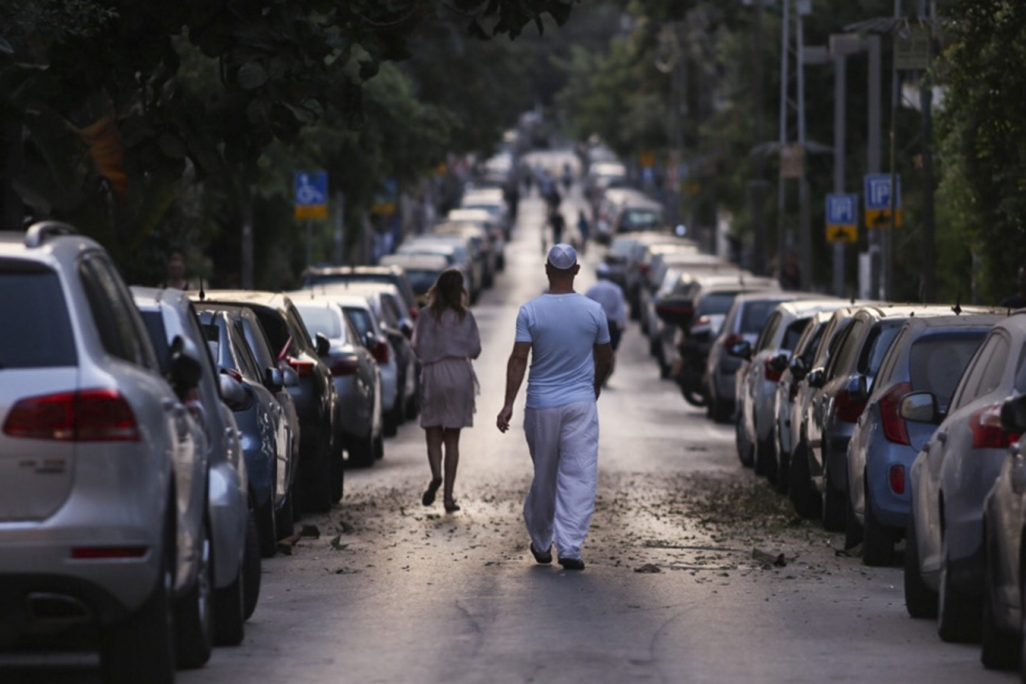
Three years ago, on Yom Kippur, the country was in turmoil. The disturbing scenes of clashes in Dizengoff Square over the ability of different groups to express what is sacred to them in the public sphere left an open wound. In those moments, just as the young Shmuel Yosef Agnon wrote at the beginning of his book Days of Awe, I felt how “my soul suddenly crumpled, and I burst into great sobs.”
")
At the beginning of Days of Awe, Agnon describes his childhood experience of the holiness of Yom Kippur: a prayer house filled with people wrapped in white tallitot, wondrous light, and the scent of candles. As a four-year-old child, he says he did not distinguish one person from another, because they all appeared to him as a single, pure and innocent whole. The great rupture in young Agnon’s experience came when the prayer ended—the melodies stopped, people removed their tallitot and began talking among themselves. In an instant, these exalted figures returned to being ordinary people, occupied with their everyday lives, and the beautiful and sacred whole fell apart.
All of us, religious and secular alike, need grace and holiness. Each of us can identify with Agnon’s longing for pure beauty and contact with the spiritual, and with the profound disappointment of the moment when holiness dissipates in the face of the concerns of everyday life.
As this Yom Kippur approaches, my soul is crumpling again. It seems that even after the turbulent and difficult years we have gone through together, we still struggle to put our disagreements aside and walk through the gates of the “palace in time” that this holiday offers us. For us to be able to do so, every Israeli needs to find their place on this day.
Between the Synagogue and the Empty Roads
For some of us, the natural place to be is the traditional synagogue. For others, the day offers an opportunity for quiet and rest, devoted to reading, watching TV series, or cycling along the empty roads. But there is a third, large and significant group—many Israelis who do not find themselves within the walls of the synagogue, yet whose hearts seek to connect with the holiness of the day. They want to pause, turn inward, engage in introspection, reflect on social change, and infuse the holiday with living, relevant Jewish and Israeli content.
While the first two groups have broad and clear options available to them in Israeli society, the third group is largely left without one. Its members find themselves, against their will, chasing after bicycles or standing in the back rows of the synagogue, without experiencing that same profound spiritual experience.
Three years after the events in Dizengoff Square, the time has come for the non-religious public to stop focusing only on what it does not want, and instead offer a meaningful, inclusive, and accessible Yom Kippur—one in which everyone can observe the day in accordance with their conscience and beliefs, without feeling like an outsider or excluded.
A New Space for an Israeli Yom Kippur
Out of this longing emerges an urgent need to create new spaces in Israeli society—open spaces where people can come together on Yom Kippur to learn, reflect, and connect with the spiritual, including those for whom the traditional synagogue is not home. This is an open call and invitation to communities, organizations, and social movements: open your doors, take the initiative, and make an inclusive and unifying Yom Kippur possible for hundreds of thousands of Israelis who are searching for their own way into the holiday, but need a different language through which to connect with it.
We should heed the wise advice of Haim Nahman Bialik: “Celebrate the holidays of your forefathers, and add a little of your own according to your ability, your taste, and your circumstances. The important thing is that you do everything sincerely and out of a living feeling and a spiritual need, and do not overthink it.” The time has come for a broad and unifying Israeli Yom Kippur, in which everyone has a place beneath the tallit.
The author is the CEO of BINA, an educational-social organization focused on Jewish-Israeli identity.