
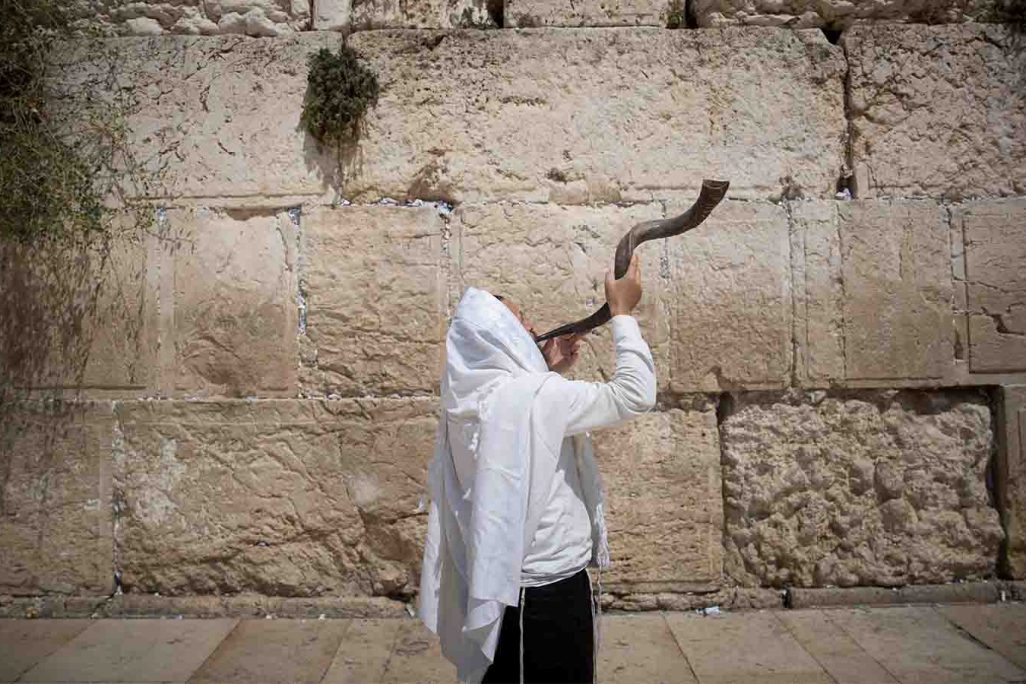
"And a great shofar will be sounded, and a still, small voice will be heard… On Rosh Hashanah it is written, and on the fast of Yom Kippur it is sealed… For they are flesh and blood. Man’s origin is dust, and his end is dust."
(From the liturgical poem “Unetaneh Tokef”)
Once again, we have reached Yom Kippur, and the daily-national whirlwind will come to a halt for 24 hours. Families will gather, each according to their culture and customs; synagogues and the Western Wall plaza will fill with worshippers; children will ride their bicycles on the roads; and many will engage in introspection, some of them also offering prayers. And the land will fall silent for a brief moment. A very brief one.
In the murmurs of their hearts, and likely in public as well, many detractors will write about the soul-searching and rectification that their opponents, those from the other camp, are required to undertake. Because “they” are tearing things apart, hurting others, sinning, stealing, and doing wrong to their fellow human beings—for which, as is well known, Yom Kippur does not atone.
And indeed, there are many, many who hurt others, sin, tear things apart, and insult. The wounds that bleed, the fractures, the pain, and the loss in our small country, whose inhabitants it devours, run deep and burn fiercely. And yes, there are harms for which, even on Yom Kippur, the Day of Judgment, there can be no complete atonement, since, as it is said, “That which is crooked cannot be made straight.”
Yet recognizing responsibility does not exhaust the soul-searching and rectification required of us. Without blurring the distinction between perpetrator and victim, and without assigning equal responsibility to those whose responsibility is not equal, we must still ask courageously what in our shared lives made these harms possible, deepened the rupture, or prevented its repair.
Soul-Searching That Does Not Stop at Others
Many years ago, during one of my visits to the late Professor Eliezer Schweid at his home in Jerusalem, we spoke about Yom Kippur. He wanted to emphasize to me that according to Jewish sources, it is not only the individual who stands in judgment on this day; the entire community is also judged together, as a single whole. This conception of the unity of the community places the individual within a collective, within a covenant of mutual responsibility and accountability. Therefore, he said, we are called upon not only to engage in personal soul-searching, but also in communal and national soul-searching. A shared soul-searching.
At the time, I found it difficult to accept Schweid’s words, not because I disagreed with the idea of communal unity, but because I feared that shifting the focus of soul-searching and rectification to the public sphere could become a way of evading and escaping the honest examination of one’s inner self and the personal change required of each individual. But over the years, I have come to understand more clearly that the line separating the individual from the collective, and the personal from the public, is very thin. My actions, thoughts, and personal identity are inevitably and deeply intertwined with our shared collective and national identity. In this sense, genuine national soul-searching does not absolve the individual of looking inward; rather, it expands the boundaries of their responsibility.
Yet this expansion of responsibility is emptied of meaning when the national “we” is used to speak, in practice, only about “them.” Shared soul-searching begins only when “we” includes me as well—my actions, my part, and the possibility that I, too, was wrong, caused harm, or made a mistake.
Perhaps that is why, in the confession recited on Yom Kippur, we say: “For we are not brazen-faced or stiff-necked, to say before You… ‘We are righteous and have not sinned.’” Even before detailing the sins, the confession seeks to break through the wall of self-righteousness. It recognizes that the first obstacle on the path to repentance is not only the sin itself, but the refusal to acknowledge it and the absolute certainty that we are in the right; that we possess the whole truth; that only others are required to change.
Holding Firm Without Becoming Stubborn
Standing against this stubbornness is humility. Not a humility that gives up my identity or my values, nor one that claims that all opinions are equally valid. Humility is recognizing that the truth is greater than me and that I, like every human being, am flesh and blood. My perspective is always partial, and even when I am convinced that I am on the right path, that does not make me immune to being wrong, causing harm, or taking a wrong turn. It means recognizing that I, too, may fail to see another person’s pain, and that in an encounter with the person before me, I may discover a truth I had not previously seen. Humility is the ability to hold firmly to a principled position while at the same time leaving room within myself for listening, learning, and change.
This humility takes on particular significance in education. A humble educator does not give up their knowledge, experience, or beliefs. They understand that an educational encounter is not one-directional: they come to teach and influence, but remain open to learning, refining their understanding, and renewing themselves through the encounter. Perhaps this is one of the deepest lessons we can give our students: an example of a person who remains true to their values, but does not become stiff-necked in the face of another person’s voice.
If we seek to raise here human beings who are capable of asking questions, examining, grappling with disagreement, and taking responsibility for a Jewish-democratic society, we must cultivate in them the ability to hold a position without becoming stiff-necked; to listen to another position without giving up their identity; and to seek to repair society without exempting themselves from the need for change. Perhaps this is one of education’s deepest contributions to national soul-searching: teaching us to quiet, if only for a moment, the need to win and prevail, and to listen to the “still, small voice”—to the voice of the other, to another person’s perspective, and to the moral imperative to examine ourselves as well. And perhaps this is why the land falls silent on Yom Kippur: not so that we stop speaking, but so that we can finally listen.
Tamir Zeiger is the CEO of the “HaMeorer” Training Center.