
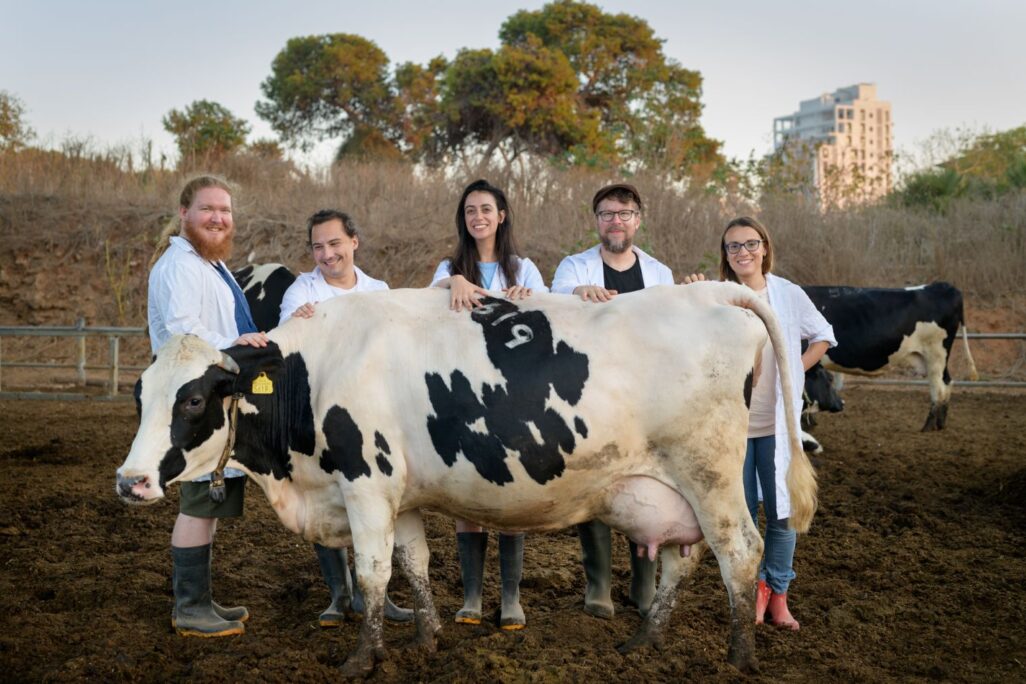
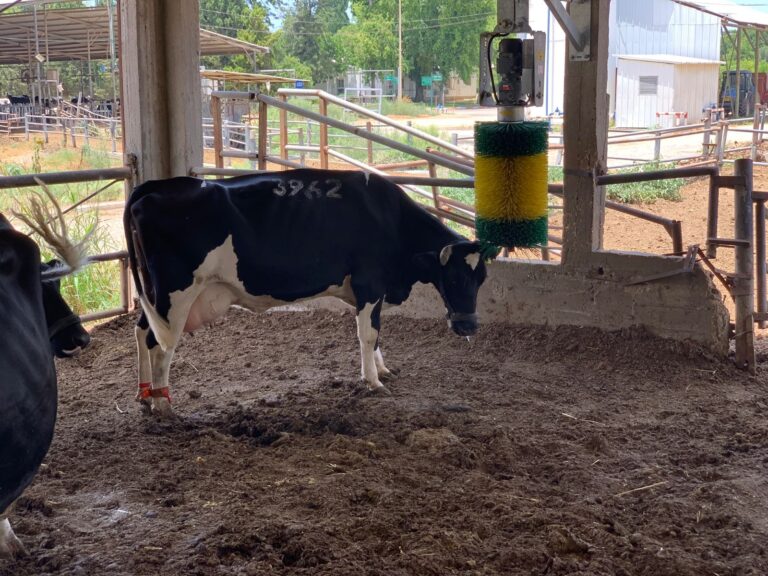
A cheerful cow sat enjoying the pleasant afternoon breeze when she felt a slight vibration from the device hanging around her neck. She already knew what the signal meant. After several weeks of taking part in a “game” devised by Dr. Oren Forkosh, she had learned that when she felt the vibration, it was worth heading over to the “surprise box” in the corner of the cowshed. When the vibration is continuous, there is a tasty treat waiting for her with high probability, about 90%. When the vibration comes in pulses, the odds drop to just 20%.
The cows learn the game fairly quickly and remember what each signal predicts, with one exception: an “intermediate signal” that gives them no indication of whether a treat is waiting in the box. There is no certainty, only a possibility. The cow can go and check, or she can choose not to. Perhaps she sees the world as a place where it is worth taking a chance. Perhaps she does not. The researchers watching her wait to see what she will do, because it is precisely at this moment, when the information is ambiguous, that her behavior may reveal something that is exceedingly difficult to ask an animal directly: Is she optimistic?
It may sound like an amusing question, but behind it lies a serious scientific challenge: How can we know what an animal is feeling if it cannot tell us?
A Wagging Tail Doesn’t Necessarily Mean a Dog Is Happy
Dr. Oren Forkosh, 47, lives in Rehovot with his daughter. He earned his doctorate in computer science and neuroscience at the Weizmann Institute of Science before going on to complete a postdoctoral fellowship in Germany. In the research he leads at the Hebrew University’s Faculty of Agriculture, conducted at a dairy farm at Mikveh Israel, he is trying to understand how animals’ brains work without causing them discomfort. His research involves no electrodes or invasive procedures. Instead, he uses “games” that allow him and his team to observe and measure behavior, in an effort to “read” animals without relying on language.
“When researchers study happiness in humans,” Forkosh explains, “the simplest tool is to ask: Are you happy? How satisfied are you with your life? How do you feel? But even that tool is not as straightforward as it seems. People can lie, their answers can be influenced by wishful thinking, and sometimes they themselves do not know exactly what they mean when they say they are happy. There is no single definition of happiness, and different people may understand the word differently.”
Animals cannot even be asked. But for Forkosh, that also has an advantage. “The nice thing about animals is that you’re never tempted to ask them questions. It forces you to work in different ways to figure out what happiness is.”
Without the option of asking, researchers are forced to grapple with difficult questions: Can happiness be measured? And what, exactly, can be measured?
The human instinct when trying to understand an animal is to observe it and interpret what it sees—to project the human inner world onto the animal. A dog wags its tail when its owner comes home, so obviously it is happy. Or is it? Not necessarily, Forkosh says.
“We assume the dog feels good, but the same behavior can have other interpretations. What we call ‘happiness’ may actually be related to social relationships and hierarchy. The approach we try to avoid is interpreting for ourselves whether an animal feels good or bad.”
A False Finding: The Mouse Was Blind
The human presumption that we can interpret animals and their emotions is a trap that is remarkably easy to fall into, Forkosh says. As an example, he points to a classic experiment in mice designed to measure anxiety based on which arm of a maze a mouse chose to enter. A mouse that ventured into the wider arms was considered bold, while one that chose the narrower arms was deemed more anxious. The researchers went even further, breeding the mice according to their apparent anxiety levels and creating groups classified as “bold,” “anxious” and “normal.”
But another study later showed that the finding was wrong. The mice considered “bold” were actually blind and could not perceive the width of the maze walls at all. The researchers’ assumption about why the mice avoided the open areas had been mistaken.
“That comes from the fact that we aren’t mice,” Forkosh says. “Mice don’t rely on vision the way humans do, so their decisions may be based on other sensory information.”
Dogs and cats, he says, also fail tests based on vision. “When you modify the test so that it relies on their sense of smell, you get different responses.” In other words, perhaps researchers had simply been asking the question in the wrong language. So how do you ask?
One possibility is to let the animal choose. Forkosh describes an experiment he and his team conducted with mice, in which an individual mouse could choose between entering one of two similar arenas. On the face of it, there was no reason for the mouse to prefer one over the other. Yet it did.
“If there is one environment it chooses,” Forkosh says, “we can assume it feels better there and is happier.”
The choice becomes a kind of answer. Choice manifests itself as behavior. If researchers know which options are available to the mouse and can track its choices repeatedly, perhaps its behavior can provide information about its internal state, its preferences and its “sense of happiness.”
“Happiness Isn’t a One-and-Done Thing”
That is the idea behind the cow experiment. In humans, the ability to reassure ourselves that things will work out can be a sign of optimism. In cows, optimism is tested through the decision of whether to approach the “surprise box,” where a treat may or may not be waiting.
Forkosh emphasizes that the cows in the experiment are not deprived of food. They are ordinary cows that can choose whether or not to “play” the “game,” and the treats are given in addition to their normal, nutritionally complete diet.
Nor are the researchers trying to determine whether one cow is “more optimistic” than another. “One cow,” Forkosh says, “might simply be more food-motivated.” Instead, they compare each cow with herself. “If I see changes in her level of optimism, that usually indicates that she is feeling worse at that moment, or that she is happier.”
It may seem like a subtle distinction, but scientifically it is significant: The goal is not to rank cows against one another, but to detect changes within the same individual. The experiment is still underway, and Forkosh stresses that there are no definitive answers yet. But a parallel study conducted by the researchers has already yielded intriguing clues.
In that experiment, the researchers made the cows’ environment more pleasant and stimulating: There were fewer cows in the group and more toys. The response, Forkosh says, was clear. Cows that spent time in this environment showed lower levels of the hormone cortisol, a measure associated with stress and anxiety. Giving the cows more space, placing them in smaller groups and providing more opportunities for enrichment affected their condition.
But the effects did not remain constant over time. Some of the positive effects faded. The change in cortisol levels was relatively short-lived, while other physiological changes, including increased milk production, lasted longer. “Changing the environment has a positive effect,” Forkosh says, “but it isn’t necessarily permanent. Happiness isn’t a one-and-done thing.”
Humans know the phenomenon well. We go on vacation and enjoy ourselves immensely, but eventually what was once exciting becomes routine. Maintaining the same sense of pleasure requires renewing and sustaining the conditions that produce it.
“We all have a baseline level of happiness that is almost like a personality trait,” Forkosh says. “We can play with it; we can push it up or down. But after a certain amount of time, we almost always return to that same baseline level of happiness. And now we’re seeing that in cows, too.”
Sensors to Build a Behavioral Profile
If a “good environment” can improve a cow’s well-being, what exactly makes an environment good? That is where personality enters the picture. Forkosh describes an interplay between an individual’s temperament and basic comfort level and the situation in which that individual finds themselves.
“An introverted person who is forced to spend all day at parties will be miserable. An extroverted person condemned to isolation may suffer just as much in that same environment. Each of those people will create an environment in which they can feel comfortable over time. Personality largely determines the tipping point between happiness and misery.”
What does that mean for animals?
“With animals, as with humans, there isn’t always control over the circumstances. When you put an animal in a situation where it doesn’t fully control all the variables in its environment because humans control them, you often deprive it of the ability to express its personality and character—to meet its own needs and desires. In doing so, we artificially create unhappiness.”
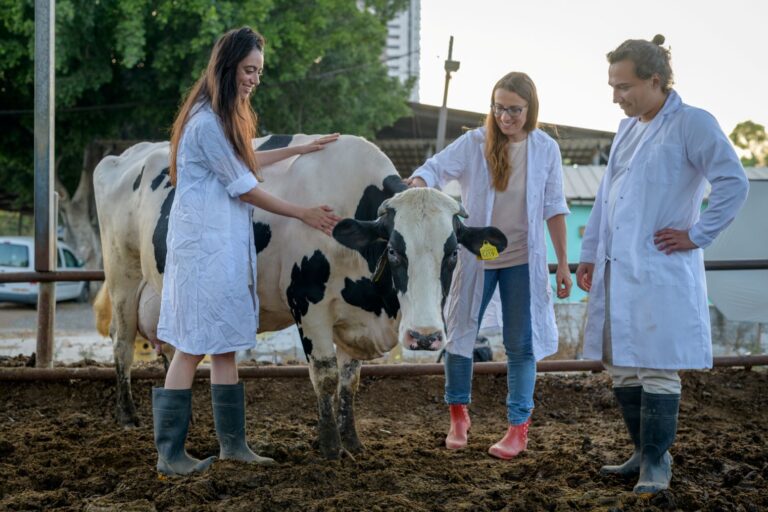
If so, the question is not simply how many square meters a cow needs to be happy, but how she can express her individual personality. To answer that, researchers first need to identify the differences among cows.
The sensors attached to the animals allow researchers to build remarkably detailed behavioral profiles. A computer can learn the habits of each cow: One likes to roam, while another prefers to stay put; one is particularly fond of food; another has a steady circle of companions; yet another constantly changes her social connections. Hundreds of behavioral measures accumulate every day, leaving researchers with the task of separating background noise from enduring traits.
“Behavior changes from day to day,” Forkosh explains. “A cow might be more active one day and less active the next. She might encounter another cow, be startled by a stranger or change her movement patterns.” But amid those circumstantial fluctuations, something more stable may be hiding. “Our assumption,” Forkosh says, “is that personality is relatively constant. It doesn’t change very much.”
The researchers use mathematical tools to determine whether stable characteristics unique to each cow can be extracted from hundreds of constantly shifting measurements. But this is where, Forkosh says, an intriguing scientific paradox emerges. “Science often tries to generalize. But in order to make those generalizations and learn about the herd as a whole, I have to go down to the level of the individual cow and get to know her personality.”
“Even Flies Remember”
Viewing animals as individuals also changes the way researchers can think about their social lives. In the mouse experiment, the researchers discovered a phenomenon they call a “social niche.” When a new mouse replaced one that had been removed from a group, the researchers found that the group’s response to the newcomer was shaped not only by the new mouse’s physical characteristics, but also by the personality of the mouse that had previously occupied its place.
Forkosh explains the phenomenon through the sitcom Friends. “Each of the characters on Friends, like each mouse, has a distinct personality and a defined social role. If I take out the funny one, somebody has to fill that role. Everyone has a ‘typecast.’ You can’t bring in another Joey or another Ross. You need a Chandler, or someone who fits that niche.”
Behind the playful analogy lies a serious question: Do animals, too, create social systems in which each individual occupies a particular role? And does the group reorganize itself when one member disappears?
Among cows, the social dimension is particularly pronounced. Dairy farmers know how to identify highly social cows, and Forkosh says the research reinforces those observations. Cows do not behave as a herd simply because humans have placed them together. They have social patterns of their own, both at the individual level and across the herd.
Nor is the phenomenon limited to mice and cows. Research on fruit flies, conducted by Prof. Galit Shohat-Ophir at Bar-Ilan University, has found changes in behavioral patterns based on formative experiences, such as living in a group or in isolation.
“We don’t assume that flies can recognize one another, because we don’t think of flies as social creatures,” Forkosh says. “But they appear to remember. Their social behavior changes when the composition of the group changes. It’s just like people entering a new social circle and trying to present a particular version of themselves. To see that in a tiny fly, with a nervous system far simpler than a human’s, is a surprising result.”
")
Figuring Out Why Cats Purr
One question the researchers are exploring in cows is the push and pull between social contact and personal space. “Cows have a sense of personal space,” Forkosh says. “Older cows, for example, tend to need more of it. That could be because they’re larger, but it may also be something that changes with age.”
The vast amount of data collected at the dairy farm allows the researchers to create computer simulations populated by virtual cows whose behavior is modeled on that of real animals. The same patterns emerge in the simulated herd: Cows that require more personal space tend to drift toward the edges, where there is more room.
“People sometimes give that behavior a very human interpretation,” Forkosh says. “Maybe the older cow stands at the edge to protect the younger ones. Maybe. But there’s another explanation: She simply needs more space.”
Behind the sensors, simulations and mountains of data lies a far more ambitious goal. Forkosh wants to find a way to understand animals without relying on the stories humans tell about them. “We have this dream of creating a kind of ‘universal translator’ for animals,” he says. It would not be a simple dictionary of animal sounds — less “‘Moo’ means ‘I’m hungry’” and more a system for deciphering behavior and the patterns behind it. With animals, Forkosh says, nonverbal behavior may be particularly revealing.
“The idea is to build a data-driven behavioral translator, without imposing our own interpretations or projecting human qualities onto animals,” he says. “The algorithm shouldn’t ask what we think the animal is feeling. It should find the connections on its own.”
Forkosh compares the idea to translation between human languages. Instead of matching one word with another, the system would build a kind of “semantic field,” layering behavioral patterns from different species over one another to identify where they overlap.
“Cats purr when they’re happy, but they can also purr when they’re distressed,” he says. “It would be really cool if we could figure out why cats purr. Maybe the data will finally tell us, instead of leaving us to guess from experience.”
“Learning to Live in Greater Harmony”
Forkosh describes the driving force behind his research simply: a desire “to do good for the animal world and the human world.” As the science advances, he says, the questions inevitably become ethical ones.
“If animals aren’t simply machines responding to stimuli, but creatures with personalities, preferences, social relationships and perhaps emotional states, what does that knowledge mean for the way we raise them, study them and eat them?”
For Forkosh, the goal is not merely to avoid harming animals. It is to understand them. “I hope we learn to live in greater harmony,” he says. Harmony, in fact, is central to the way he thinks about happiness.
“When we talk about happiness, we’re talking about harmony,” he says. “That doesn’t necessarily mean being happy all the time. A person can be sad and still be in a place where sadness makes sense. You don’t have to immediately run away from the feeling or try to fix it. When you’re happy, be happy. When you’re sad, be sad.”
The Downside of Imagination
Trying to determine whether a cow can be optimistic, or happy, ultimately leads Forkosh back to a more familiar question: How do humans know when they are happy?
The human brain gives us the ability to look ahead, make plans, imagine possibilities and construct entire worlds in our minds. But that ability comes with a catch. The same imagination that allows us to envision a better future, and to feel optimistic about it, can also make us miserable over things that have not happened yet.
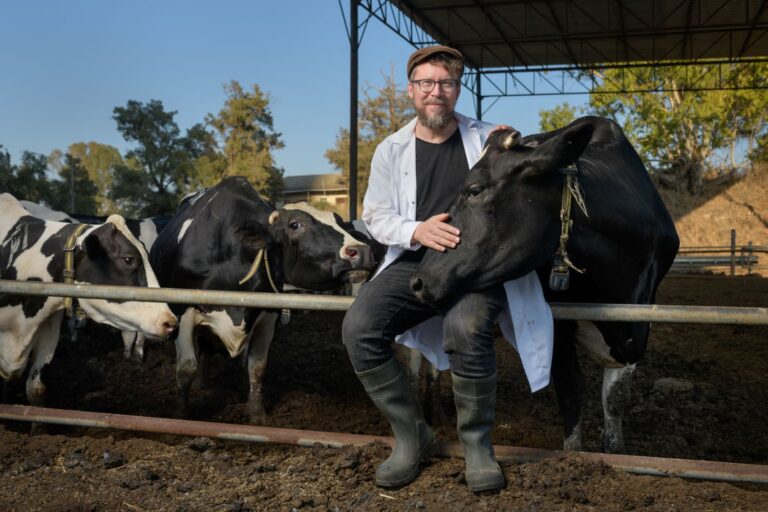
“We can think endlessly about tomorrow,” Forkosh says. “We can chase after something because we imagine it will make us happy, even when it isn’t actually right for us. We end up spending too much time thinking about what tomorrow will bring, and about abstract things like money. Maybe we would be happier if, like the cow, we could allow ourselves simply to be here, in the present, without the downside of our capacity to imagine.”
Personality, harmony, happiness. So what makes a scientist happy?
“Routine. A day when I spend the morning with my daughter, go to work, do research, have lunch, go back to the lab and see my partner in the evening — that’s a happy day. There’s a cliché that says if you do what you love, you’ll never work a day in your life. Ever since I was a kid, my dream was to become a scientist. I’m living that dream.
“Of course, the effect of these things fades, because like everyone else, I get used to them. But my work is varied enough to keep challenging me, and the balance between my family and my work is exactly where I want it to be. As long as things remain steady and that welcome routine continues, I’m happy.”