
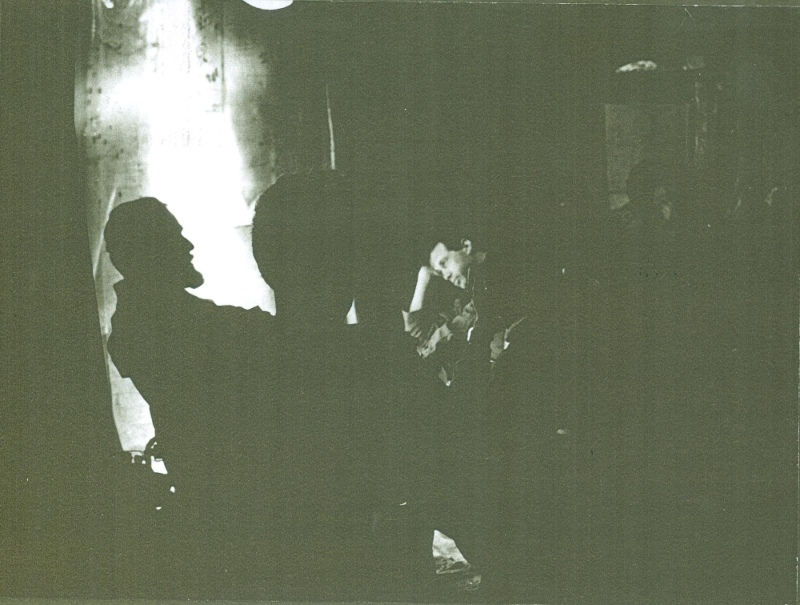
In the shadowy black-and-white photograph, a weary, pensive man sits leaning to the side, his head resting against his right hand, illuminated in a sharp pool of light. Opposite him sit two silhouettes—one with his back to the camera, the other in profile, a pointed beard jutting from his face. The photograph was taken nearly 53 years ago, at the height of the Yom Kippur War.
The man whose face catches the light is Major Ezra Orni, Communications Officer for the 247th Paratroopers Brigade. The bearded man in profile is Brigade Commander Col. Dani Matt, and the figure with his back to the frame is Ops Officer Major Avraham Tzur. They sit inside the brigade’s forward command tent near the Mitla Pass in Sinai, mapping out the final details for crossing the Suez Canal on the night of October 15–16, 1973.
But who captured the moment? Was it Micha Bar-Am, one of Israel’s greatest photojournalists and later an Israel Prize laureate?
For decades, Ezra Orni, now 85, was certain Bar-Am had taken the shot and personally handed him the print. Three years ago, in 2023, he arranged to visit Bar-Am at his home in Ramat Gan, only to discover that through the lens of time, objective truth becomes a elusive thing.
, Ezra Orni, and Yoav Orni. Ezra: "You brought me the photo and left, and I haven't seen you since" (Photo: Asaf Tzvi)")
Joining that meeting was Ezra’s older brother, Yoav Orni (91), whom Bar-Am had definitively photographed almost two decades earlier—in 1955, inside a cave in the Judean Desert. That picture became one of Bar-Am’s first published works in Israeli media, helping launch his legendary career.
In Bar-Am’s living room, the three men gathered to piece together memories, photographs, and the stories behind them.
The Six-Day War: "Wherever the Drama Is, You Try to Be There"
Ezra and Yoav Orni grew up in Kiryat Haim. Their father, Zvi, arrived as a pioneer in the Third Aliyah and worked as a bus driver for Egged; their mother, Bat-Sheva, came from a farming family in Metula. Raised in the ethos of the Labor movement, the brothers went through the Tnua Meuhedet youth movement before serving in the IDF.
During the 1967 Six-Day War, Ezra served as Communications Officer for the 55th Paratroopers Brigade under Motta Gur during the battle for Jerusalem. It was Ezra who held the radio microphone when Gur uttered the immortal words, "The Temple Mount is in our hands." Under Gur's direct order, Ezra also climbed to the dome of the Al-Aqsa Mosque to raise the Israeli flag—only for Defense Minister Moshe Dayan to order it taken down ninety minutes later.
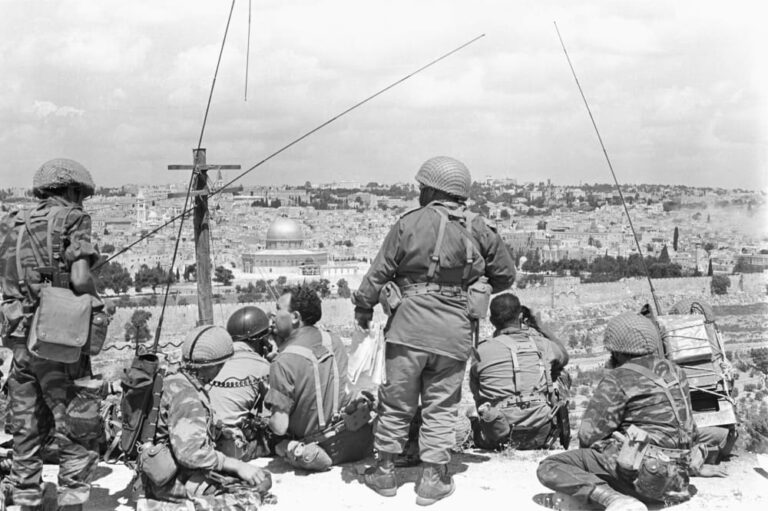
That same day in 1967, Bar-Am was working as a freelance photographer, roaming Jerusalem alone. He hitched a ride on a truck carrying reservists and made his way to the Temple Mount, arriving right alongside Gur and his paratroopers.
"I was alone for twenty-four hours," Bar-Am recalls. "I was crazy, I was alone. I hitched a ride on a truck with reservists and made it to where the war was."
Yoav Orni: "Did you ask permission?"
Bar-Am: "I didn't ask anyone. Maybe people recognized me a little."
Yoav: "Did you realize it was a historic moment?"
Bar-Am: "Of course, it was obvious. That’s what a person’s instincts are for."
Yoav: "How did you manage to be in that exact spot—where Motta Gur was, where everything was happening?"
Bar-Am: "Luck. I took a gamble. I'm not a gambler, but look, I don't have the patience to dissect the hidden impulses of a field photographer. The point is, the moment it becomes clear where the drama is unfolding, you do whatever it takes to be there and capture it on camera."
Yom Kippur: "A Car Headlight Illuminated Our Maps"
Six years later, Ezra was mobilized again following the surprise attack by Syria and Egypt on Yom Kippur, October 6, 1973. For the first three days of the war, Ezra's brigade remained in central Israel as a General Staff reserve before being deployed to Refidim Airbase in Sinai as a Southern Command reserve. After recovering from the initial shock of the assault, the IDF decided to change the equation and shift from defense to offense. Ezra's brigade, under the command of Dani Matt, positioned itself on the southern front and prepared for a daring operation: crossing the Suez Canal to capture territory to its west, encircle the Egyptian forces, and decisively turn the tide in the southern campaign.
"We got the order from Ariel Sharon’s division that we’d be the first to cross in rubber dinghies," Ezra recalled. "The night before the crossing, we sat in the command tent near the Mitla Pass. We pulled a 'Sylv' headlight out of a vehicle, connected it to a communications battery, and used it to light up our maps. There was no night, no rest, no sleep. We knew as soon as planning was finished, we had to brief the battalion commanders so everyone could move at dawn."
"How did you feel that night? Did you realize you were about to embark on an operation that would turn the tide of the war?"
"We knew by heart what needed to happen, because we were the only brigade designated to carry out the canal crossing in the event of war. During the three years prior to the war, we practiced such a crossing four separate times, using rubber dinghies and troop transfers. It was obvious to everyone in the IDF—and especially in Southern Command—that if we ever needed to cross the canal, our brigade would be the one to do it, and no one else. We were already nine days into the war when we finally received the order. We knew this was it; the moment had arrived.
"None of us thought, 'We are going to save the homeland.' That wasn't in our heads at that moment, that we were about to reverse the tide of the war. But it was clear that we were the only ones who knew how and were capable of executing the crossing. You capture a bridgehead on the western side, allowing the IDF to lay pontoon bridges over which tanks can cross and conquer the entire western bank of the Suez Canal. For us, it was clear that we were the force that could deliver, and from that point on, it depended on us."
"And what do you feel when you look at yourself in that photo, taken the night before?"
"The headlight was aimed straight at me, and it is truly a very special photograph. There is no other picture of me, or of anyone else, with that unique quality. It is part of the brigade’s legacy."
The next night, it happened. Brigade 247 forces crossed the canal and transmitted the code word over the radio: "Acapulco"—the signal for a successful crossing. Over the following week, IDF forces advanced 20 kilometers deep into Egyptian territory and encircled the Egyptian Third Army stranded in Sinai, forcing Egypt to request a ceasefire.
"There Are Photographs, But I’m Not So Sure About Memories"
Ezra Orni recalls meeting Bar-Am on the western side of the canal. "You brought me the photo and left," Ezra says to Bar-Am, "and I haven't seen you since, until today."
"I never stopped walking," Bar-Am quips, "though I limp a bit now."
When Ezra asks Bar-Am, "How did you know it was me?", it turns out Bar-Am remembers things differently. "I’ll try not to ruin your memories," he says. "I don't recall that exact moment. I’ll tell you what I do remember, and from there, you are free to remember whatever suits you best."
 and Ezra Orni. "Today you can tell whatever story you want about photos, and the truth is that it's hard to prove anything like that" (Photo: Asaf Tzvi)")
According to Bar-Am, he never reached the Mitla Pass area where Ezra's brigade was preparing for the crossing. "At the end of the first day of the war, I reached Baluza [an airbase in northern Sinai], and later I photographed the meeting with the female soldiers evacuated from the bases. For some reason, I headed back. I remember that suddenly Dudu Halevi, a journalist for TIME magazine, arrived with a car full of gear. (Halevi served as a reserve company commander in the 189th Armored Reconnaissance Battalion in the south and was wounded at the start of the war). It turned out Halevi had been wounded, retreated, escaped from the hospital, stole a car, filled it with gear, and drove all the way to Tasa or Baluza," Bar-Am recalled. "I hitched a ride in the car he stole on his way back to his unit at the canal. What I remember is reaching Baluza again, and that was two or three days after the crossing."
"The profile in the picture—maybe that's you, but I wouldn't take out a loan based on it," Bar-Am remarks.
Despite stating he wasn't at the location where the photo was taken, when Bar-Am looks at the print, he relates to it as his own work. "I am very proud of this photograph, because I shot it in near-total darkness," he says. "Then we paused briefly and kept going."
The stance of Orna Bar-Am, Micha’s wife who also participated in the conversation, is much more definitive. She manages Micha's photography archive, which holds tens of thousands of photographs spanning his entire career, ensuring each photo is documented with the exact date, location, subjects, and circumstances. Ezra's photo is completely absent from the archive, and a follow-up search after the meeting yielded no results. She raises the possibility that the photo was taken during a training exercise a year before the Yom Kippur War, though Ezra insists that's impossible, adding, "Or maybe it was taken a week before the crossing."
Bar-Am notes that even around photographs, which serve as hard evidence of reality, there are often conflicting stories and versions: "There are photographs, but I’m not so sure about memories. Just as my voice is raspy, my mind isn't entirely clear either, and I can't be certain. Today, you can tell whatever story you want about a photo, but the truth is hard to prove that way."
Descending into the "Cave of Horror"
The conversation shifts to a photograph taken nearly twenty years earlier. This time, Bar-Am remembers the details vividly. It shows a young man around 20 years old, lying in dark trousers and a white undershirt inside a cave, holding a hammer. He looks forward with confidence, away from the camera. The cave ceiling consists of jagged white limestone, resembling the jaws of a giant beast.
")
The man pictured is Yoav, Ezra’s older brother. It is part of a series of photos Bar-Am shot during an expedition to the "Cave of Horror" in the Judean Desert in May 1955. Located on the southern cliff of Nahal Hever, the cave sits beneath the ruins of an ancient Roman camp. It earned its name after the discovery of 40 skeletons of men, women, and children who hid there during the Bar Kokhba revolt against the Romans and perished from hunger and thirst.
"Archaeologist Yohanan Aharoni organized the expedition to the Cave of Horror, and Micha and I joined as volunteers. You were at Kibbutz Gesher HaZiv," Yoav reminds Micha, "and I was at Nir Eliyahu, but at the time I was sent to instruct in the Tnua Meuhedet youth movement in Jerusalem. We knew each other generally from the movement, and here at the Cave of Horror we were together constantly because Micha needed a subject to photograph."
"The official photographer of the expedition was Benno Rothenberg," Yoav shared. "Yohanan Aharoni was a Yekke [German Jew], Rothenberg was a Yekke, and Micha was a Yekke too."
Bar-Am, then at the very start of his career, used Yoav as a model. "You had just bought a camera—you showed up with this Leica and started shooting," Yoav tells him. "And everywhere we went, you'd say, 'Yoav, stand here! Yoav, stand there!'"
According to Yoav, "Micha asked Benno [Rothenberg] about lighting and how to shoot." Rothenberg, an established professional, recognized young Bar-Am's raw talent. "Benno put a hand on Micha and said, 'If you send your photo to BaMahane and write Benno Rothenberg, it will get published; if you send my photo and write Micha Bar-Am, they won't publish it.' But in the end, Davar HaShavua published a photo taken by Micha, showing Benno Rothenberg climbing."
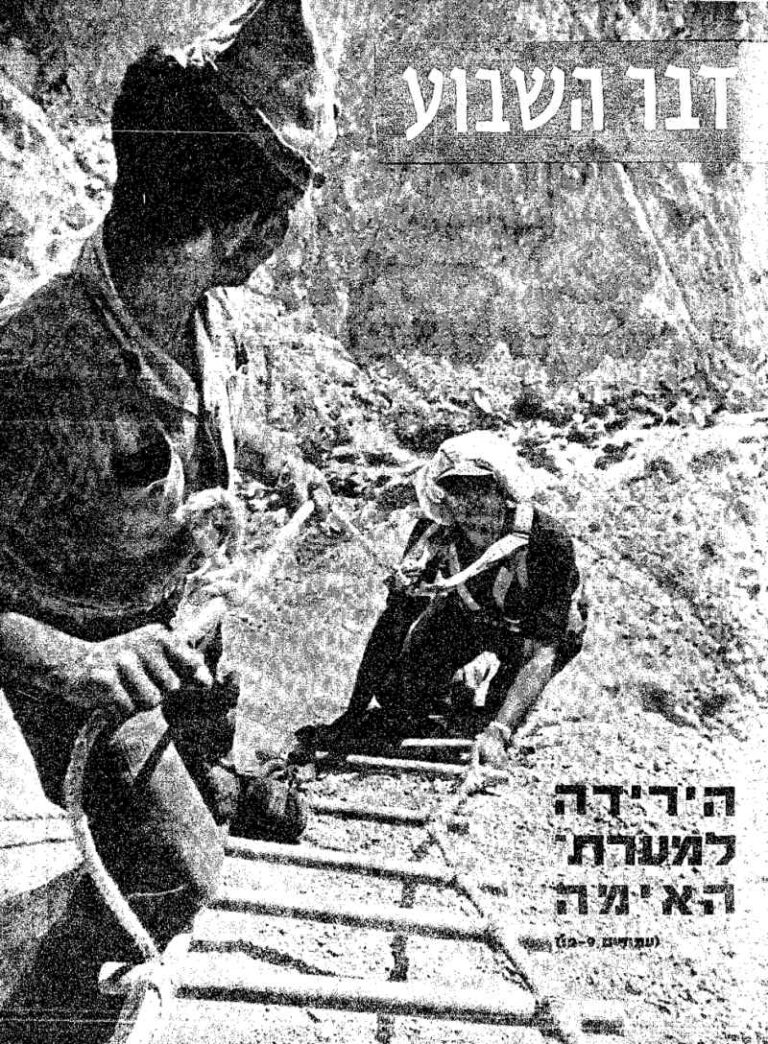
This happened because Bar-Am decided to try his luck and submitted his shots to Davar HaShavua, which was running an article by Rothenberg about the excavations. While Rothenberg’s photos were placed inside the article, Bar-Am’s photo landed on the magazine's front cover, launching his lifelong career as a photojournalist. Following that publication, BaMahane military magazine hired Bar-Am as a staff photographer.
The photograph of Yoav inside the cave was published in a different newspaper. Years later, a friend found the original clipping. To this day, searches in historical digital archives haven't revealed which paper printed it, though it may yet come to light.
"Menachem Crawled and Reached the Cave—Micha and I Right Behind Him"
Reaching the cave itself was exceptionally dangerous. "You could walk along a narrow trail very close to the cave, but not all the way," Yoav explained. "The plan was to secure a rope ladder from the cave. You walk along the path, go down as far as possible, and descend the final ten meters on the ladder. They brought someone from the Navy who was an expert in rope ladders; they anchored it, but it took time."
Impatient, Yoav and Bar-Am decided to attempt the riskier, faster route. "On the first day, we went down the path to try and reach the cave," Yoav recalled. "We reached an extremely narrow ledge with a 400-meter drop below us. I was in front, Micha behind me, and I said to Micha, 'There's no way.' So we turned back and reported to the top that it was impassable."
Then came the turning point. "There was a paratrooper security detail with us, and they had a driver named Menachem. He yelled, 'I want to try, I'm going down!' He crawled along the ledge and made it to the cave. Micha and I crawled right behind him."
")
"The first thing we found was a ceramic potsherd the size of two hands with three Hebrew letters written on it. I picked it up, tucked it inside my shirt, and then—how do you get back? It was terrifying. We asked them to lower a rope, and Micha and I climbed up the rope, but Menachem didn't know how to climb a rope. He had to crawl the entire dangerous way back."
"When we got back to the top, everyone was astonished, hoping we’d found a trove of ancient artifacts," Yoav said. "But across the entire excavation, that potsherd was the only item found with letters on it. Clearly people had been there before us—Bedouins had dug around. The earlier diggers simply forgot to take that potsherd."
"I just want to add one thing, though I don't know who it interests today," Bar-Am added. "I didn't have sophisticated photography equipment back then. I shot you during the excavation using flash pouches made of magnesium powder the size of tea bags—and I think you were the one holding them for me!"
"Exactly!" Yoav laughed. "You taught me how to hold them. To me, you were like an older brother, telling me where to go and where to stand."
, Ezra Orni, and Yoav Orni. Yoav Orni: "You came with this 'Leica' and started shooting, and then everywhere you said, Yoav stand here, Yoav stand here" (Photo: Assaf Tzvi)")
Orna adds that Micha's climbing skill remained a theme throughout his life: "Micha and I graduated from a mountaineering course in Switzerland in 1964. We were rappelling before people in Israel even knew what it was."
This moment provides a chance to correct a historical omission. "In the article published afterward about the excavations in Davar HaShavua, they wrote that Menachem and Micha descended, but they didn't mention me," Yoav says. "One day I ran into Benno and Aharoni on the street, and I asked, 'Why didn't you mention me?' They said, 'You're right, we'll fix it.' Later they published a book, but the book matched the article, and I was left out again."
"I Wish Someone Would Come Up to Me and Say: 'It Was Me'"
As the gathering drew to an end, the core mystery remained unsolved. Who took the picture of Ezra Orni in that desert command tent in Sinai? How did he identify Ezra to hand him the print? Will the publication of this story help solve the puzzle?
"As far as I'm concerned," Ezra says with a smile, "until someone comes up to me and says, 'Ezra Orni, it was me who brought you that photo,' then it was Micha Bar-Am. I only wish someone would come up and say: 'No way, it was me!'"