
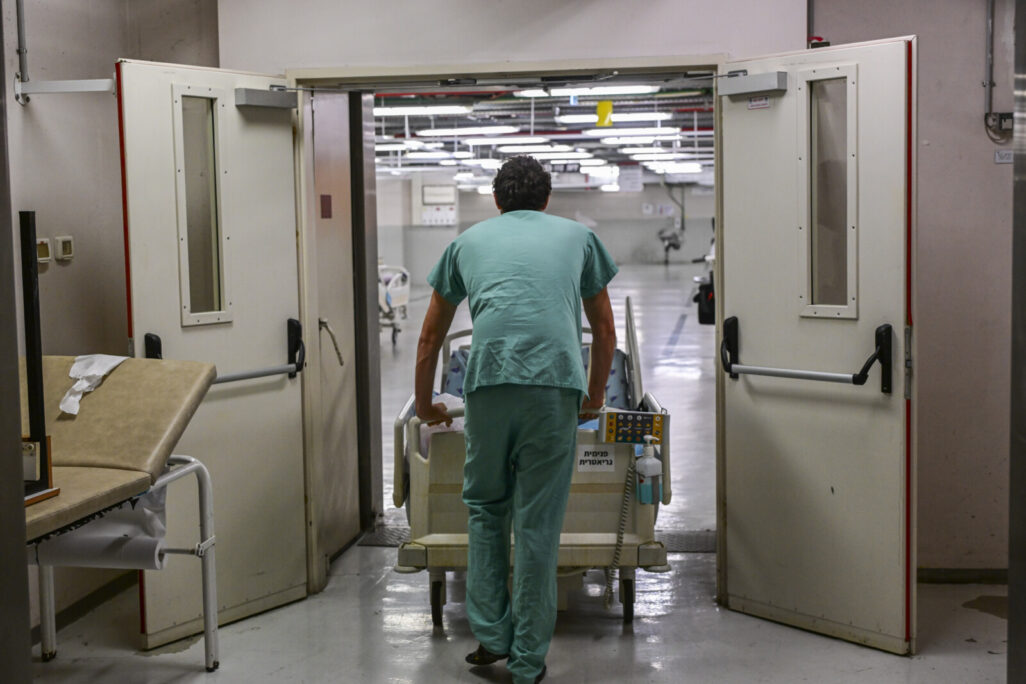
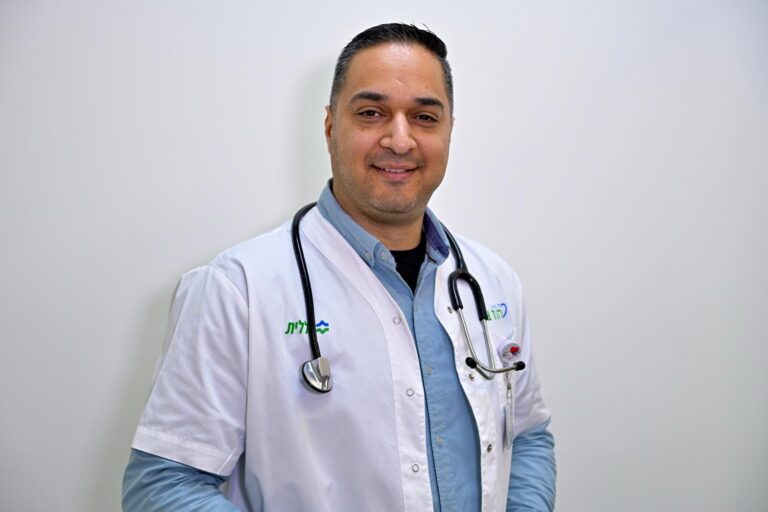
On October 7, Dr. Yahya Amar was on call at Hadassah Hospital. The hospital began receiving the wounded, and subsequently, soldiers and civilians requiring long-term care were admitted to the rehabilitation department. "I was working at Hadassah Hospital at the time; I was on duty that day. We treated many wounded individuals, soldiers and civilians, who were admitted to the rehabilitation department."
For an extended period, Amar—now a regional rehabilitation physician at Clalit Health Services in the Northern District—continued treating others. Only later, he recalls, did he begin to realize that the caregivers themselves were suffering from burnout. "We all work, and our batteries are constantly draining a bit, but since October 7, we poured all our energy into the patients. At first the batteries were full, but then, as time went on, everything slowly drained. When they offered me the chance to participate in a resilience workshop, I didn't think twice. I felt that it was helpful."
Amar is one of the Arab healthcare workers who recently participated in dedicated resilience workshops. Over the course of two days, doctors, nurses, and other medical professionals from across the country gather to discuss the mental toll, the tension that has seeped into the workplace, and incidents of racism and discrimination. Precisely within the healthcare system, which is considered one of the most prominent arenas of joint work between Jews and Arabs, a feeling emerged from the field that Arab staff members do not always have a safe space to speak about their experience. The workshops were initiated by Attorney Mourad Mfaraa, chairman of the Forum for the Advancement of Healthcare in Arab Society, with support from the UJA-Federation of New York.
"The Arab doctor is under threat both inside the hospital and outside it," says psychotherapist Abeer Al-Halim, who facilitates the workshops. According to her, a general resilience workshop does not always answer this need. "The situations are the same , but there is a difference. Resilience needs to be adapted to the Arab doctor. In general workshops, there is no space; the language is not suitable. It's not just the translation, but the metaphors and examples. We want to create a safe space. We do not want separation from the Jewish staff members, but rather a place to process the difficult experience—so that we approach our interactions with our fellow colleagues from a place of resilience."
The workshop begins with processing experiences and examining the professional and personal identity of the participants. "We start discussing concepts and experiences, processing various situations in small groups. We use general models but adapt them to Arab society. Part of the work involves shaping identity, as a doctor, as an Arab doctor, as an Arab doctor in Israel."
In recent years in Israel, there has been a growing realization that it is impossible to build a shared society without media coverage that reflects it fairly. Although Arab society accounts for about a fifth of the country's population, it suffers from underrepresentation, and at times even distorted depiction, in mainstream Hebrew-language media. Following the events of October 7, 2023, the representation of Arab voices in the public sphere decreased even further, amid a strengthening of divisive narratives that erode trust.
"When you feel heard, it's empowering."
Dr. Maram Khazen, a pharmacist by training and a senior lecturer at the Max Stern Yezreel Valley College, researches communication within medical teams. She came to the workshop as a researcher, but according to her, the very opportunity to talk about experiences that are difficult to process alone was significant. "Every type of workshop is important, in my opinion, when it comes to events that are hard to digest alone. This safe space is very important."
The participants did not come from the same hospital or the same team, and many of them did not know each other at all. According to Khazen, this distance was one of the gathering's advantages. "We didn't know each other at all; these weren't people from the same team. Everyone came from a different place, and that’s what made it special. People from different locations and backgrounds—we had truly undergone different experiences. We needed to sit down and process what we had been through, and how we felt the day after, or a year later."
According to her, the meeting allowed participants to discover that some of the experiences they had considered personal were shared by others. "Everyone came from a different background, and that made it possible to empower each individual. Expressing yourself, feeling that others are listening and providing feedback, is empowering." She adds: "It was good to hear that this isn't just happening with him specifically, but is part of a broader picture. It was important to realize just how much those organizations want to listen and are committed to change. That is very important."
The workshop provides participants with tools for coping in the workplace. "There was a psychologist who spoke about dynamics between teams and how to approach conflicts." Khazen says that some of the topics are familiar to medical professionals from their training, but in the workshop they received a different kind of processing. "Here in the workshop it was deeper; there was also film therapy. We wrote a script together, and each person modified it a bit. We learned to collaborate within a diverse group."
Even after the two days come to an end, the connection between the participants does not necessarily fade. "It is something that develops, much like a friendship." Khazen recounts how one participant, a nurse, reached out to the head nurse a few months later following an incident in her ward; this was a step she says she would not have naturally taken previously. "Everyone undergoes their own small transformation."
Amar returned for an additional workshop. "The first workshop was for sharing and processing the experience. In the second workshop, we learned various tools to deal with problems or with a specific emotional state." Some of the tools were familiar to him from his studies, but the reality since October 7 made them far more relevant. "When you return home after meeting a patient, there are always small scars. But we never thought we would reach a state where an event like this happens, where we ourselves would need psychological resilience for an extended period. Now we have returned to using these tools."
"We all think that we don't need to attend workshops like these, but after I participated in the first workshop, I didn't hesitate to go to a second one. We think we are strong people, after all, we treat people, but when you think about everything happening, it is a vital thing for all of us to do."
“We need courageous leadership, we cannot wait for the next crisis”
The burnout the participants speak of stems from more than just the professional workload and years of working against the backdrop of war. Some also describe instances where they encountered racism from patients yet were required to continue functioning as professionals in the situation. Amar recounts an incident in which patients treated him in a racist manner; what remains etched in his memory, however, is the way the department head responded. "He told them, 'If you aren't happy here, you can leave. We are all one team, and we treat everyone, regardless of religion, race, or gender.' That gave us a sense of dignity and the strength to keep caring for people."
Khazen also remembers an incident from the beginning of her career as a pharmacist. "It was hard. The head pharmacist told me, 'Okay, step inside, I'll serve the customer.' That same customer who had verbally attacked me. It felt really terrible. It's hard to recover from things like that."
From her perspective, anti-discrimination regulations are not enough if staff members do not know how to react at the moment itself. "It is very important that the Jewish colleague also knows what to do in such cases." Expanding on this, she articulates the dilemma: "We were taught never to refuse treatment, but what do you do when the patient doesn't want to receive treatment from you? Here you need leadership to step in and say that this is unacceptable."
However, Khazen emphasizes that the workshop’s separate space is not intended to create a divide between Jewish and Arab staff members. From her perspective, the goal is the opposite: to provide an opportunity to process difficulties so that dialogue can resume within the shared workplace. She recounts that during the workshop, "everyone shared ideas on how to mend relationships. Everyone was interested in repairing ties with the Jewish population—with the people they work alongside every day."
She aims to take this conversation out of the workshop room and into the departments, clinics, and staff rooms. "I truly believe that both sides want to rebuild. We need to mend things rather than wait for the next crisis. It calls for courageous leadership. Instead of silencing the issue, we need to put everything on the table. That takes courage; it isn't something to be taken for granted. Communication is crucial—we can't ignore it. Positive interaction among the staff benefits not only medical care but also our physical and mental well-being."