
The effects of the climate crisis were felt more sharply this year in Israel and around the world: an unprecedented heat wave in Europe, flash floods caused by melting glaciers in Nepal and Tibet, rain in parts of Israel in the middle of August, and the reappearance of a deadly amoeba in the Sea of Galilee, which researchers say thrives in warmer water.
“There is broad agreement that we will not meet the goal of limiting warming to 1.5 degrees Celsius above the preindustrial average,” Dr. Dov Khenin, chair of the Israeli Climate Forum, established by Israel’s president, told Davar.
“In the best case, if every necessary measure is taken, average warming will reach 1.8 degrees, and that’s only the lower bound. People hear 1.8 degrees Celsius and think it sounds small, but it’s just an average. It reminds me of the joke about the statistician who drowned in a river that was, on average, two centimeters deep,” Khenin said. “The extremes are the real story: heat waves above 50 degrees Celsius alongside cold spells of minus 48. The system that allowed humanity to live comfortably and develop civilization is breaking down before our eyes.”
Uncertainty, he argues, is the most dangerous dimension of the climate crisis. “When I was doing postdoctoral research on the climate crisis at Oxford, we invited a group of British politicians to explain how we saw the situation—why it was dangerous, difficult and alarming. After a long day of graphs and models, one of them said, ‘Listen, you’ve blown our minds here, but we need to understand in one word what’s going to happen.’ The lead climatologist in our group answered with one word: ‘Surprises.’ So we should expect surprises, and bad ones.”
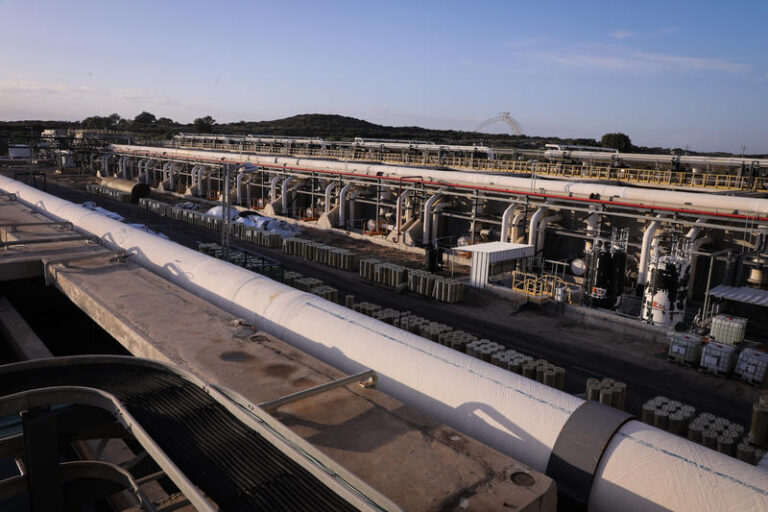
Khenin points to Israel’s recent water crisis, following the shutdown of desalination plants along its coast, as a concrete example of how a changing climate can upend confidence in technological fixes. “We were told: ‘A water crisis? No problem—we’ll desalinate seawater.’ What we didn’t foresee was the proliferation of microalgae that apparently came from the Nile Delta. They flourished in the warm Mediterranean waters and fouled the desalination plants’ membranes. Except for the plant in Hadera, most of the facilities shut down, leaving Israel in a serious bind.”
Still, Khenin stresses that technology has a vital role to play in confronting the crisis. The obstacle, he says, lies elsewhere. “The IPCC [Intergovernmental Panel on Climate Change] has already established that we have all the technologies we need to address the crisis: solar power, energy storage, conservation, and efficiency. The question is not technological but social and political. Governments around the world continue to subsidize the oil, gas and coal industries that are destroying our future to the tune of hundreds of billions of dollars a year.”
“Some people say the climate crisis is a privileged concern. The opposite is true.”
“The climate crisis has a social profile: its victims are not all affected in the same way,” Khenin says emphatically. “Poor people, residents of outlying areas, people living in older homes, and those who work outdoors, construction and agricultural workers, are hit much harder than people who live in beautiful buildings in leafy neighborhoods with plenty of trees. We have to recognize that and act accordingly.”
“There are people—very few in Israel, but they exist—who say, ‘The climate crisis is a concern for the privileged.’ It’s exactly the opposite.”
")
That understanding, Khenin says, is central to the work of the forum, which President Isaac Herzog established in 2022. “The connection between climate and social issues is at the heart of what we do, but first and foremost, it is a fact of life. The crisis is social in nature, as are the solutions and the response to it. We need to understand that the environmental and social dimensions are inseparable.”
Among other initiatives, the forum is advancing proposals for a fair transition in the Haifa Bay area, climate adaptations for homes, and solar panels in unrecognized Bedouin villages in the Negev.
With elections approaching, Khenin, who served in the Knesset for 13 years, is troubled by the lack of political figures committed to environmental and climate issues. “There are no candidates with a serious commitment to this issue, and even those who paid it some attention in recent Knessets have lost their seats. In Israel, it is still treated as a marginal concern. People don’t understand that we are not talking about some vague notion of the quality of the environment. We are talking about our ability to produce energy and food, protect our health and lives, and physically sustain ourselves in the place where we live.”
")
Khenin says the central problem is the lack of attention Israel pays to environmental issues. “We are in a prolonged political crisis that makes it very difficult to address questions that affect our daily lives. On top of that, we have the continuing war since October 7. There are many obstacles. But we cannot say, ‘Let’s wait for something to change before we get to work.’ We don’t have time. The climate crisis will not wait for Israel to solve all its other problems. We have to confront it now.”
Climate Solutions for Security Threats
In Israel after October 7, Khenin argues, the shift to renewable energy is a security imperative as well as an environmental one. He sees solutions to the climate crisis as answers to some of Israel’s security and social challenges, too.
“Israel’s energy sector depends on an ‘unholy trinity’: gas, coal and oil. It is highly centralized and extremely vulnerable. When the war broke out, we immediately shut down the Tamar gas field because of its proximity to Gaza. During each escalation with Hezbollah or Iran, the northern natural gas fields—Leviathan and Karish-Tanin—were shut down because there was an unwillingness to risk a mass casualty disaster if an operating facility were hit. This is not sustainable.”
Khenin says the other fossil fuels offer little more security. “Coal is expensive and polluting, and we have to import it from politically unstable countries such as Colombia and South Africa. It comes through just two marine terminals. One of them, in Ashkelon, was damaged in a storm in the past, forcing hundreds of trucks a day to transport coal from Hadera. A strike on a terminal or a cargo ship during wartime could cripple electricity supply. Oil comes mainly from Azerbaijan through a pipeline that crosses Turkey, which could turn off the tap at any moment. If Iran follows through on its threats to strike our gas fields directly, we will be in serious trouble.”
After the war began, the Climate Forum developed a resilience plan centered on a distributed renewable energy system. “Solar power paired with storage is now cheaper to produce than energy from gas, coal or oil. Israel’s Electricity Authority tenders have shown this since 2019. If we install solar panels on hundreds of thousands of rooftops across the country, then even if 1,000 or 2,000 rooftops are hit during a war, 300,000 others will still be supplying electricity. That is real energy security.”
")
Alongside rooftop installations, the forum promotes ways to use land for both energy production and other purposes without encroaching on open spaces. Chief among them is agrivoltaics: installing solar panels above farmland.
“In many parts of Israel, crops get more sunlight than they need. Shading fields with panels generates electricity while protecting crops at the same time. Expanding renewable energy in the unrecognized Bedouin villages of the northern Negev could turn an area facing severe hardship into a Silicon Valley for renewable energy, generating income for residents and the state.”
Another urgent issue is the national food security plan, which the Climate Forum helped develop under the Agriculture Ministry’s leadership, together with the National Security Council, the National Emergency Management Authority and the Health Ministry. The plan was submitted to the government but stalled because of opposition from the Finance Ministry—a serious mistake, Khenin says.
“The idea that we should import agricultural produce because it is cheaper will break the back of Israeli farmers. In a global crisis or regional war, we would be wholly dependent on outside supplies that might never arrive. Food security requires direct support for Israeli agriculture and farmers. It is deeply regrettable that the Finance Ministry portrays this as a fight against a ‘farm lobby’ instead of recognizing it as a matter of national survival.”