
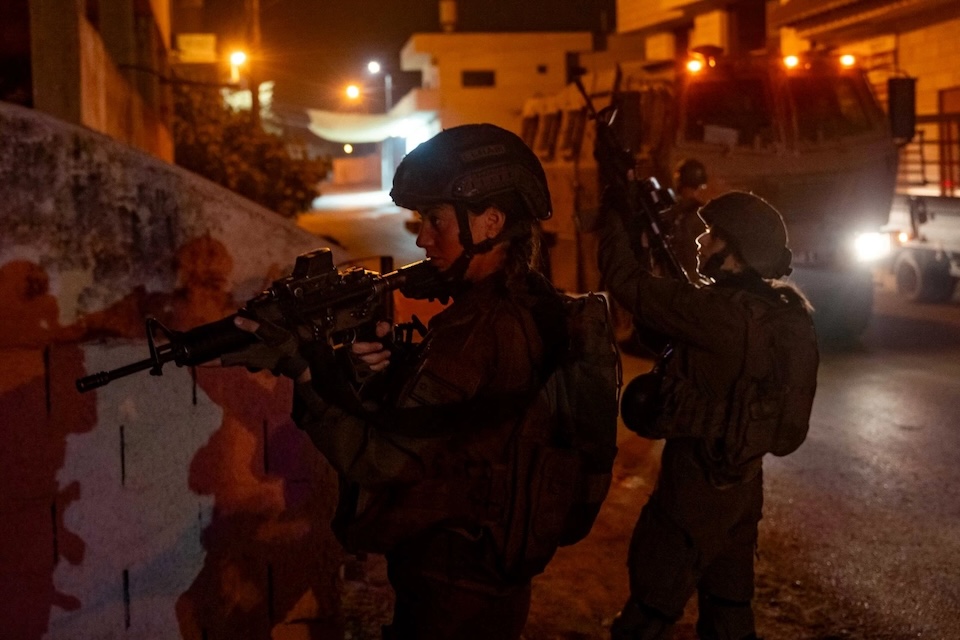
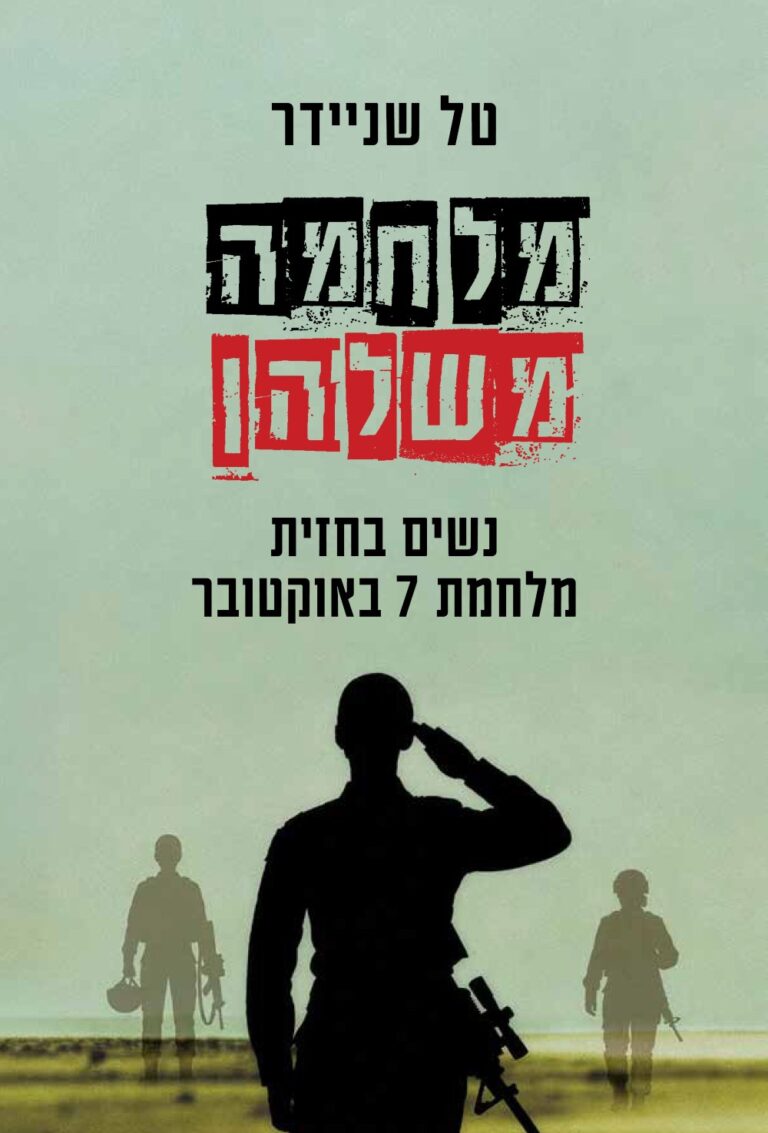
About half a year after October 7 and the outbreak of the Swords of Iron war, Times of Israel journalist Tal Schneider realized she needed to document the participation of women combatants in the battles. Not just a need, but a duty and a mission. Now, after extensive research, her book Israeli Women Warriors is being published. The book recounts the stories of the battles and the heroism of the women who fought in them on October 7, as well as the history of women's struggle to become combatants in the IDF. "I understood that if things aren't documented, they can disappear," Schneider says in an interview with Davar. "As the work on the book progressed," she wrote in the introduction, "the feeling grew stronger in me that I am documenting not only a war, but also a broad historical change."
The book moves along two parallel threads. The first is the stories of the battles and the heroism of the women who fought, among them Lt. Col. Or Ben-Yehuda in the battle at Sufa; the battle at the Home Front Command base in Urim and the story of the late Alina Pravosudova; the battle at the combat intelligence collection base in Urim; the battle at the Zikim base and the stories of commanders the late Lt. Or Moses and the late Lt. Adar Ben Simon; the stories of the women at the Nahal Oz outpost; the lookouts and the battle in the war room; and the stories of policewomen who fought that day, among them Chief Inspector Shifra Buchris and Chief Inspector Mali Shoshana. "Women's heroism in this war," she writes in the book, "burst forth with unprecedented force."
The battles are described in detail based on conversations Schneider held with the women combatants who took part in them. "Documenting the battles is truly my mission," she says. "I felt I needed to document, I thought there had been under-documentation in the past. I wanted to tell who was where, what happened that day, what she did, what she didn't do. And of course everything is accompanied in the background by very difficult stories, because while they jump into action, people are being slaughtered, and they don't know everything in real time."
"The counterarguments adapt themselves to the spirit of the times"
The second thread in the book is the story of the struggle to integrate women into combat roles in the IDF. Schneider: "It's a super important story, on the assumption that the IDF is also the greatest tool of social mobility. That's why it's the parallel path in the book that runs along the timeline—the events in the way the state and the IDF conducted themselves toward women all these years.”
")
In the first chapter she writes: "Despite the tradition of joint struggle—women and men shoulder to shoulder—in the underground period and in the War of Independence, for decades Israeli women were not full partners in defending the country on the battlefield. Until October 7, 2023."
After October 7, the women combatants received great admiration, both from the public and from the chief of staff, and three years later a campaign is under way against integrating women in combat roles. How do you explain that?
"There has been opposition to the issue since the founding of the state. Ben-Gurion reached a compromise with the religious Knesset members that religious women would not be drafted. But you can see how the treatment of women in the IDF began to change. In the 1980s, even before the Alice Miller Supreme Court case [in which an Israeli pilot who successfully sued the Israeli military for the right to enlist in the Israeli Air Force Flight Academy], women entered instructor roles, they start to be found more in closed military bases [where soldiers live and stay throughout the week], and already then there is a letter from religious Knesset members complaining about it. That is, the problem then was not women in combat or women combatants, but a problem of integrating women in general.
"Every period has different arguments. Now there is opposition to women combatants on the claim that it drives away men, it drives away Haredim, but in the past it was the female instructors who drove them away, and then their presence in closed bases. The counterarguments take on shapes and shed shapes, they adapt themselves to the spirit of the times. Before the war the main argument was that the presence of women weakens the IDF's strength. Now there is a new argument that if there are many women, the Haredim won't want to enlist."
Is it endless?
"It comes back and always will come back in public discourse, especially since the Hardalim [religious-nationalist Haredim] have very, very strong political power in the country. They will always be 'on it.'"
You write that among the opponents are those who want to assign women roles in promoting peace and avoiding conflict. What would you say to feminists who oppose integrating women in combat, arguing that it is a "surrender" to the male ethos, to militarism?
"There are several streams of feminism, and one can always talk about and be interested in the positions of all the streams. But in Israel, unfortunately, one cannot today pursue the type of feminism that calls for taking the security situation into account."
"Let women say what they want to do"
Schneider comes to writing the book and to the struggle for integrating women in combat from a personal place. When she enlisted in 1990 she wanted to be a combat soldier, but combat roles were not yet open to women, and she went to what was then "the most combat"—becoming a Moran instructor, a combat-support position in a classified unit in the Artillery Corps. "Today there are women combatants in the Moran unit with no problem at all, both officers and company commanders," she says. "I couldn't. It didn't exist. So the engagement with the subject comes a bit from that personal place."
")
After she was discharged, she recounts, she read in the newspaper about the High Court petition by Alice Miller, who asked to open the pilots' course to women. "I remember saying: 'Wait, how did I miss it?' It never even crossed my mind that you could petition, and I'm a lawyer's daughter. Women have barriers they place on themselves, they don't even think the boundary can be broken."
Beyond the personal side, she sees social reasons for integration. Much of the social infrastructure in Israel is based, she says, on connections from the army. "How and where people advance in society, they eventually return to their team from the army, to friendships from the army, to acquaintances, to connections from the army. Whoever was an officer has many doors open to them in managing schools, in running companies, so I say: 'Once you require women to enlist, give them also the right to say what they want to do.' Each one, provided that she meets the standards. But if someone wants to, you can't tell her no."
"The IDF cannot manage today without women combatants"
The IDF, despite the opposition, Schneider argues, has been moving toward integration all along. "True, it moves very slowly, true, it doesn't do it in a way that so celebrates the women, and perhaps sometimes doesn't take enough pride in it, but in practice the IDF keeps moving the needle. Today we are in a situation where IDF manpower, in terms of combat strength, can't manage without women. It moved and moved and reached a situation where, from a security standpoint, it's no longer possible. The desire to remove women from combat roles can't be realized, because there is no one to do the job, there simply isn't."
The figures on the book's timeline are eye-opening: in 2011 the share of women combatants in the IDF stood at 4% of the total combat force; in 2015 it stood at 7.2%; and in 2025 it stands at 21.2% of the combat force.
So from the IDF's standpoint, it's not an ideological matter of equality, but simply a need for manpower?
"Yes. The IDF doesn't say: 'I believe in the value of equality and it's important to me to advance women.' It simply takes advantage of the fact that it needs manpower, and the women want it very much. The IDF constantly faces public and media difficulties with the religious, so it does its thing quietly, without confronting them too much. The IDF listens to them and in the end does what it wants, because it's an operational need."
Still, women are treated differently. Schneider cites as an example the integration of women into the Armored Corps. Despite a number of successful pilot programs in armor training, women continue to be called "tank operators" in the IDF, and they are part of a women's platoon in the Border Defense Corps. Schneider talks about the choice to keep calling them tank operators and not armor soldiers, even though they went through armor training exactly like men and fought on October 7.
")
“In the book I tell a story of the chief armored corps officer who meets the Caracal [infantry combat] battalion commander, Lt. Col. Or Ben-Yehuda, after the battles, and says to her: 'Listen, I listened to the radio, to the recording of the course of the battle of the tank operators, it's amazing, they worked excellently.' And she says to him: 'Why are you surprised? They're very professional.' Just because they put them in Nitzana [along the Israel-Egyptian border], and didn't let them in recent years train and be part of the corps, doesn't mean they stopped training. They didn't stop training the whole time they were in Nitzana, on a supposedly quiet line, so they came very prepared. And she says to him: 'What's the surprise at all?' She doesn't understand what the surprise is, but he praises them because he's amazed that they managed to function so well."
How do you explain his surprise?
"It's still the male ethos. The IDF doesn't believe it can train women and that it will go well. Even after training them they keep raising an eyebrow. Some of the interviewees told me: 'What's the big deal? I did what I was trained to do.' It really made me laugh, in the middle of the war, that people marveled at women pilots attacking in Iran. After all, the attack in Iran was in June 2025, that is, a year and 10 months into the war, and what do they think the women pilots did until then? Didn't they attack in Lebanon, in Gaza and in Syria? As far as pilots go I feel society has already completely accepted it, it's no longer a big deal, and so there are no pilots in the book at all. The Air Force issue is already behind us."
"Operational need comes before aspects of religion and state"
The struggle for integrating women is waged outside the army by feminist organizations and by women before enlistment who petition the Supreme Court. Women who serve are careful about joining the struggle for advancement and treatment of women in the IDF. "Most of the women who reach senior positions," Schneider says, "don't like to rock the boat too much, because they still have to be combatants inside a very male framework."
According to her, civil society organizations that work on the issue, led by the Forum Dvorah, also have to act carefully. "They want the cooperation of the chief of staff and of senior officers. When the IDF tries to exclude women, they jump in and speak out, but when the IDF answers them: 'It'll be fine, rely on us,' they basically cooperate."
The caution is evident among the enlisted women themselves as well. "They all understand where they are, so they very much play the game of male codes." Some refused to be interviewed, and there were interviewees she had a really hard time persuading. For them, they are officers and soldiers doing their job. "They don't want to run around all day with this flag of 'look what I did.' They say: 'I came to do my military profession. It has nothing to do with whether I'm a woman or not.’"
In recent years, and in the past year especially, there is a growing trend of expanding gender segregation. How do you see the situation in the IDF?
"I'm troubled by the segregation. I understand the religious issue, I respect the religious and their wishes, but inside a battle, in a security situation, segregation is harmful to some degree. In the IDF it's customary to have separation in the protected rooms, inside the outposts. They didn't think there would be an infiltration, they thought about rockets and a situation of prolonged stay in protected rooms, so they assumed that in that situation it would be more comfortable for male and female soldiers. Naturally, because in these outposts there are more female command soldiers, they had fewer weapons (for example, on October 7 at the Nahal Oz outpost). No one believed there would be an invasion, but the result was insane. I say: Decide on the division into protected rooms according to operational need. Where are there more weapons? Where are there more commanders? Do you need to split up? Split up according to operational needs. Need to go into an operation in Gaza with a paramedic? Operational need comes before aspects of religion and state."
"Young women are flooding the IDF, wanting to volunteer for combat"
What, in your view, will the state of integration in the IDF be in a decade? Will women be part of the Armored Corps?
"I think so. They will be Armored Corps soldiers. We already saw it in the war. Caracal's Pere Squad is a tank unit consisting only of women. Inside the tank there were only women, and at some point the brigade commander came in, who is, by the way, a religious man who wears a kippah, and he had no problem at all. The man gets applause from me. He looked at the operational side and at the need to defend the communities. He and none of the officers and combatants that day thought about segregation, it's nobody's concern. In the end, in the war, reality hit them, inside houses in Gaza, when they hid in all kinds of places, they couldn't separate. When the IDF really needs to run things, there is no segregation. All the female officers and all the women combatants who entered Gaza in countless operations were there together with men inside buildings, including sleeping, including eating, and including relieving themselves.
"On the other hand, there are people who say the peak is behind us, that what we saw in the war is the peak of integration."
What new trends in recruiting women to combat do you see three years after Oct. 7?
"Today young women are flooding the IDF, wanting to volunteer for combat. It's a bottom-up process, because the IDF doesn't encourage it or initiate it. 40% of young religious women enlist, and huge proportions of them go to combat corps. The war shook up their society very much. The war broke the concept of going to national service for them. One of the young women I interviewed for the book started national service, left after a year, asked to enlist and went to combat. A young woman from a religious home, whose mother didn't serve. That's something that is changing now. Among secular women there's no question. Got a draft order? You go. In secular cities the numbers are crazy."