
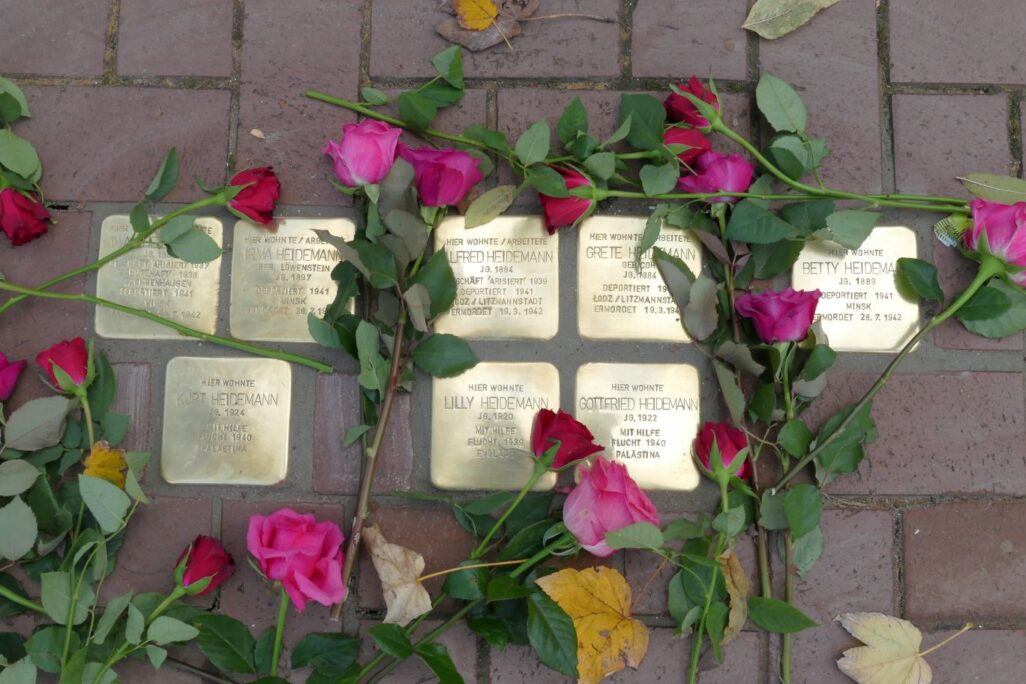
The Heidenau city council approved a ban on the installation of “Stolpersteine” commemorating victims of the Nazi regime and the removal of existing Stolpersteine from the city’s sidewalks, following an unprecedented cooperation agreement between the Christian Democrats (CDU) and the far-right Alternative for Germany (AfD).
In a secret and contentious vote held last week in the Heidenau city council, near Dresden in Saxony, council members approved by a vote of 13 in favor, 6 against, and one abstention a decision banning the installation of new Stolpersteine in the city’s public spaces and relocating the five existing stones to the remote Nordfriedhof cemetery, despite opposition from the Israeli Embassy in Germany and protests from the Jewish community.
The story received extensive coverage in the German media because of its dual significance: it is among the first times in Germany that a decision has been made to ban the installation of Stolpersteine and remove existing ones, and it also represents the most significant cooperation between centrist parties and the far-right party since the boycott against it was declared.
The cooperation between the CDU and another local party, BOD, and the AfD represents another crack in the traditional “firewall,” which could collapse as the AfD gains strength. The “firewall” is the name given to the cross-party boycott against the far-right AfD, through which the party has been kept from power over the past decade. In recent weeks, concerns have grown that the “firewall” could collapse after the far-right party won elections in two states in eastern Germany and, according to polls, is expected to win in the western German state of North Rhine-Westphalia—the most populous state in Germany.
In the explanatory notes accompanying the decision, its initiators argued that placing memorial stones on sidewalks does not honor the victims, because passersby “step on them knowingly or unknowingly.” Instead, they proposed establishing at the cemetery “a central memorial area for the victims of war, tyranny, terrorism, and expulsion.” Civil society organizations and the Jewish community, on the other hand, said that this was an attempt to push Holocaust remembrance out of public spaces and into a marginal corner “that no one visits.”
The Stolpersteine project, initiated by artist Gunter Demnig in the 1990s and now comprising more than 100,000 stones across Europe, is based on the idea of embedding the names and details of victims in the sidewalk outside their last known homes, in order to remind people of their absence amid the routines of everyday life. Most Stolpersteine are located in Germany, and the majority are dedicated to Jews murdered in the Holocaust.
For some time, the Heidenau city council has been debating a request by the local educational organization AKuBiZ to install Stolpersteine commemorating Martha and Fritz Goldstein, a Jewish couple from the city who were murdered by the Nazis. The current decision effectively puts an end to efforts to commemorate them. As noted, there are currently five Stolpersteine in the city, which will be moved to the cemetery.
Christoph Heubner, Vice President of the International Auschwitz Committee, responded very strongly to the vote’s outcome: “This is a blatant and disgraceful attempt by Heidenau to once again drive the victims of the Nazis out of the city and throw them into the place where the AfD believes remembrance belongs—the cemetery. It is a scandal that CDU council members cooperated in this matter.”
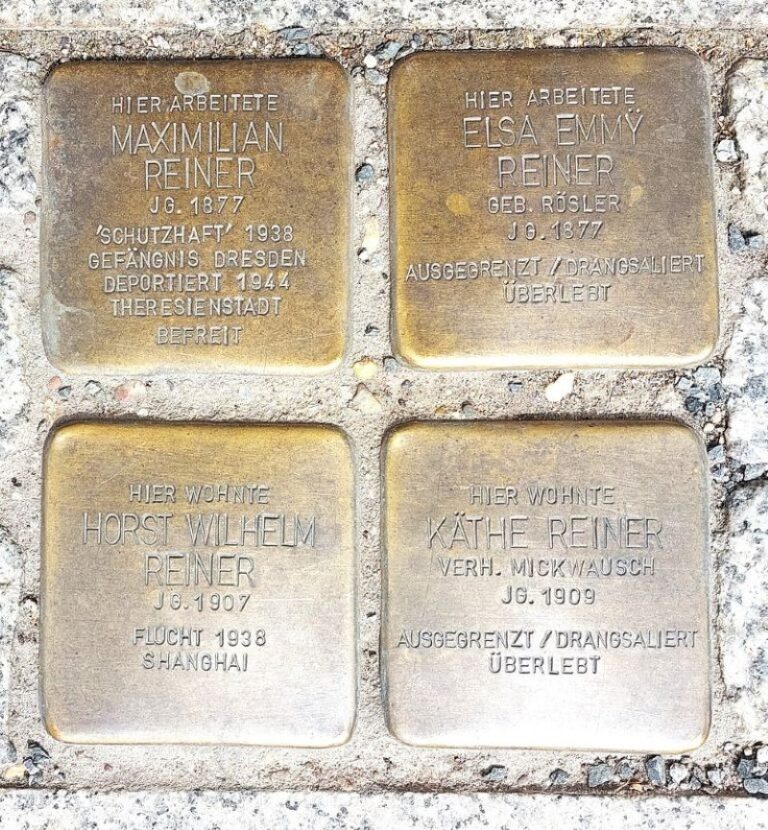
His remarks were echoed by Katja Demnig, CEO of the Foundation for the Stolpersteine, who described the parties’ support for the proposal as “an extremely troubling precedent.” Among Israel’s representatives in Germany, Ambassador Ron Prosor, whose family members were commemorated with four Stolpersteine laid in Berlin in September 2024, has consistently voiced his opposition to the move and supported the installation of additional Stolpersteine as a step toward “fighting discourse that seeks to blur the uniqueness of the Holocaust.”
Pushing Holocaust remembrance out of the public sphere is one of the foundations of the AfD’s policies. But the political significance of the vote extends beyond the municipal level: Germany’s major democratic parties, led by the conservative CDU, have drawn an explicit red line—an absolute ban on cooperation, coordinated votes, or forming coalitions with the AfD, which is classified as a far-right organization in parts of eastern Germany (including Saxony) and is monitored by the Office for the Protection of the Constitution.
However, while the national CDU leadership insists that the “firewall” remains firmly in place, at the local and state levels in eastern Germany, party members repeatedly join forces with the AfD to advance conservative initiatives—ranging from budget and immigration issues to matters of culture and historical memory.
The results of three state elections held in Germany in recent weeks threaten to bring down the “firewall,” as the AfD won in two of the three states, while in the third (the state of Berlin), the far-left Die Linke won and will seek to form a coalition with the Social Democrats and the Greens, a move that would require them to compromise on their principles. The two parties are demanding that the far-left party expel “extremist elements” linked to Palestinian jihadist organizations and crime families.
Political commentator Miriam Lau of Die Zeit wrote that “the moment the Greens and Social Democrats form a coalition with Die Linke, without it having separated itself from the extremist elements within it, will be the moment when the CDU’s firewall against the AfD also falls.”