
Members of the UK Green Party voted yesterday (Sunday) in favor of a motion stating that Zionism is a political ideology that supports an “ethno-nationalist Jewish state” and calling for “one democratic state across the entirety of historic Palestine,” with equal rights for all citizens, including the Jewish people. However, the motion states that Zionism should be regarded as “another form of racism.”
The Green Party is now the first party in the British Parliament that does not recognize the existence of the State of Israel at all.
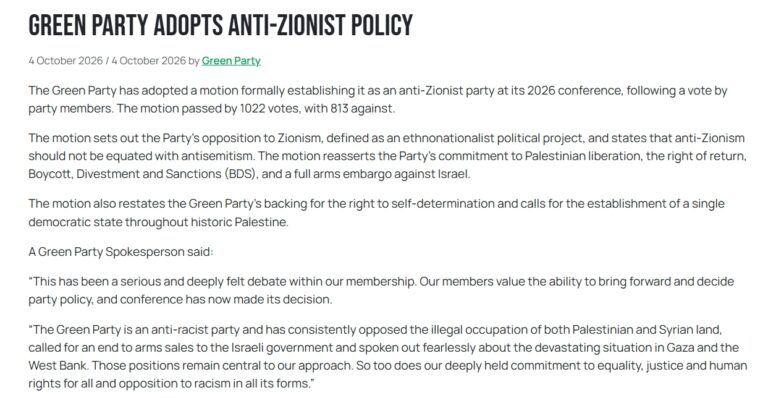
The motion, titled “Zionism Is Racism,” was brought to a vote by members of a group called “Greens 4 Palestine.” The vote was held at the party’s annual conference in Brighton and passed by a margin of 1,022 supporters (56%) to 813 opponents (44%), among them several senior party members.
The party’s Jewish leader, Zack Polanski, did not vote on the motion, but supported amendments intended to soften it and to introduce protections for Jewish party members who identify as Zionists. The amendments were rejected.
Peter Walker, a journalist for The Guardian who covered the conference, wrote: “This could be a major problem for the party, among other things because four of its five MPs have spoken out strongly against it, while Zack Polanski ‘sort of’ supported it. Some, but not all, Jewish members were concerned about the decision.”
The Foreign Ministry strongly condemned the decision: “The Green Party in Britain today ceased to function as a political party and became a body that supports terrorism. The shocking decision calls for the establishment of a Palestinian state from the river to the sea—effectively the destruction of the State of Israel. This is a text that crosses the boundaries of political discourse, and as long as it is not removed, it will remain a stain on the history of the United Kingdom.
“The Greens have officially adopted Hamas’s green color and its ideological doctrine, which calls for the elimination of the State of Israel through armed struggle. It crosses the boundaries of political discourse, and as long as it is not removed, it will remain a stain on the history of the United Kingdom. All political parties in Britain, led by the governing Labour Party, must immediately and unequivocally distance themselves from this distorted text.”
The decision defines Zionism as a racist and colonial political ideology that operates a system of racial discrimination and control over the Palestinian population, and declares the Green Party to be an “anti-Zionist party.” It states that Jewish identity should not be linked to or equated with Zionist ideology, while emphasizing that criticism of or opposition to Zionism (anti-Zionism) does not constitute antisemitism. The party calls for the establishment of a single democratic state throughout the territory of historic Palestine, with Jerusalem as its capital and full equal rights for all its residents. The decision recognizes the Palestinians’ right to self-determination, liberation, and “resistance to Israeli occupation and oppression by all available means,” in accordance with international law, and calls on the British government to impose a full arms embargo and comprehensive sanctions on Israel, alongside support for the Boycott, Divestment and Sanctions (BDS) movement in a manner similar to that imposed on the apartheid regime in South Africa.
The decision also calls for the release of all Palestinian prisoners, an end to the use of administrative detention, and for Palestinian fighters to be recognized as prisoners of war in accordance with international humanitarian law.
In a statement published after the vote, a party spokesperson said: “The discussion among members was serious and thorough. Our members value the ability to express ideas and decide on party policy, and the conference has now made its decision.”
Yaakov Hagoel, chairman of the World Zionist Organization: “The decision by the Green Party in Britain to adopt a resolution defining Zionism as racism is a shameful and scandalous decision, deeply tainted by antisemitism. Zionism is the national movement of the Jewish people and expresses its historic, legal and moral right to self-determination in its homeland. The attempt to portray it as racist is a recycling of modern blood libels and dark UN resolutions (such as Resolution 3379), which have already been revoked and consigned long ago to the dustbin of history.”
“It is distressing and infuriating to see how a party that claims to uphold the values of progress, tolerance and human rights has been hijacked by extremist elements and adopted rhetoric of hatred and antisemitism. Instead of promoting peace, understanding, and inclusive and democratic dialogue, the Green Party has chosen to give a boost to the rising antisemitism on the streets of Britain and endanger the Jewish community.”
Earlier, Foreign Minister Gideon Sa’ar posted an astonished reaction on X after reports that the Green Party had opened a “safe room” to protect its Jewish members at the conference in Brighton: “I read this. Then I read it again. Then I read it one more time. Everything you need to know about the direction Britain is heading in 2026.”
According to a report in the Mail on Sunday, demonstrations were held outside the conference center in Brighton where party members had gathered, and police were forced to separate pro-Israel and pro-Palestinian demonstrators.
A party member told the newspaper that a special room had been designated for Jewish members who felt threatened inside the building: “A ‘safe room’ was designated for Jewish members to use in an emergency. The room was used on the first day of the conference for a meeting between a rabbi and several Jewish members. This is an extremely disturbing and infuriating situation, but this is the reality.”
The Green Party currently holds a historic record of four of the 650 seats in the British House of Commons, after winning approximately 6.7% of the vote in the 2024 general election.
At the local level, the party has a significant and growing presence, with hundreds of representatives on various local councils across England and Wales.
According to nationwide opinion polls, the party is on an upward trajectory, receiving approximately 10% to 14% support, and is expected to become the fourth-largest party in Britain at the next election.
However, Britain’s constituency-based electoral system makes it difficult to translate national levels of support into a large number of seats, meaning its actual potential for growth in Parliament is concentrated primarily in a number of specific urban constituencies.