
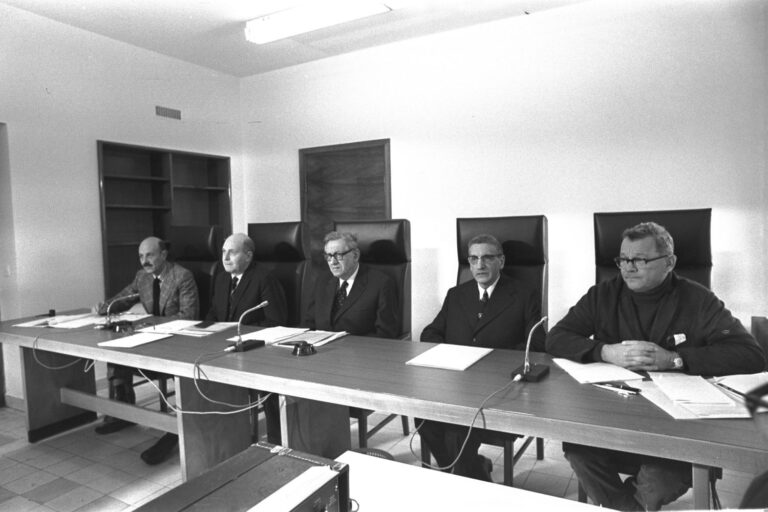
Prof. Yoav Gelber, 83, one of the last surviving members of the Agranat Commission investigating the Yom Kippur War, does not oppose establishing a state commission of inquiry into the October 7 massacre. However, in his view, “it’s more of the same, and it won’t change anything.” In a sober, slightly exasperated tone, he says: “We live in a post-truth era. So what difference does it make what the state commission of inquiry says when it is established? The findings will not be accepted by the other side in any case. And in general, it is impossible to conduct a commission of inquiry into a complex, multi-layered process like the one that led to the failure surrounding Hamas’s October 7 attack. By the time the findings are published, some of those responsible will already be dead. A state commission of inquiry is not the solution.”
Gelber, an accomplished historian, has extensive experience with commissions of inquiry and the struggle to establish them. After the Yom Kippur War, during which he commanded one of the paratrooper companies that fought, he was seconded by the IDF to the Agranat Commission. He served as the commission’s research assistant and produced its final report.
He resigned from the Bechor Commission, which investigated the assassination of Haim Arlosoroff in 1982, in protest against the government’s refusal to establish a commission of inquiry into the Sabra and Shatila massacres. A commission was eventually established—the Kahan Commission, in 1982—following a public campaign during which Gelber went on a hunger strike outside the Prime Minister’s Office.
")
A prolific historian who has published more than 20 books, Gelber has researched, among other subjects, the history of Israel’s defense forces, the establishment of the IDF and the history of intelligence. Over the years, his extensive research has established him as one of the sharpest critics of post-Zionism and anti-Zionism. In his view, the October 7 massacre is not a turning point in the history of Zionism, but it is “the greatest disgrace in its history.” He is not identified with the political left, but believes that “the very fact that the government under whose watch this disaster occurred is still in office, and may even remain in office, is very serious.”
“The Remedy Must Be a Political Step”
You say a state commission of inquiry is not the solution. Why?
“The political crisis we are in must be resolved through political means, not legal ones. The remedy must be a political step. The opposition’s original sin was trying to solve a political problem through legal means. They dragged Netanyahu into court, which only made him stronger, instead of confronting him on the political playing field. Now they want to turn to a commission of inquiry, which means that for several years they will not address the political crisis because they will be waiting for findings that will never come and that one side will reject in any case. That is why I keep saying that the political crisis must be resolved through political means, and that it must be separated from the search for the truth. There is no truth in politics, and in any case, the truth about this terrible massacre will only come to light decades from now, when the archives are opened.”
A commission of inquiry is the established way to uncover the truth. Do you have an alternative to suggest?
“The Commissions of Inquiry Law was enacted in a different era, almost 69 years ago, when the concept of truth still had value. Commissions of inquiry were never intended to be courts that set up gallows, as the public treats them, but rather to establish the truth. That law suited the circumstances of its time, but it is not suited to the situation today. Its mechanism, particularly Section 15 of the law, protects those being investigated rather than the victims. The people who need protection for their rights are not those being investigated, but the victims.”
“If a state commission of inquiry is established and all those being investigated arrive with entourages of lawyers, while the investigators bring opposing lawyers and conduct cross-examinations, it will never end. The Commissions of Inquiry Law needs to be amended so that it allows those being investigated to be questioned and the truth to be established. A new law should prohibit people from bringing lawyers to interrogations. Those being investigated are not the victims. The careers of Netanyahu, Herzi Halevi or Aharon Haliva are no more important than the dead, the disabled, the wounded and their families.”
Not One Commission of Inquiry, but Three
And suppose the Commissions of Inquiry Law is amended?
“There are many other problems. State commissions of inquiry have always investigated specific, discrete events—events that took place over a single day or, at most, a few days, such as the assassination of Arlosoroff, the Sabra and Shatila massacres, and the massacre at the Cave of the Patriarchs. Even the Agranat Commission investigated the first four days of the Yom Kippur War and the preceding several months. It did not investigate the entire Yom Kippur War. No single commission will be able to handle the volume of material in the present case. So at least three state commissions of inquiry need to be established, not one:
- A commission to investigate the government’s policy before the war and the interface between the political and security leadership;
- The events of October 7 and the intelligence and tactical developments that preceded them;
- The government’s failure to function in the period following October 7.”
So it sounds as though you do believe state commissions of inquiry should be established?
“There are other problems. I don’t see how we can find 15 people of suitable standing, who are honest and decent, and who enjoy a consensus across Israeli society, to sit on these commissions. The commission would be established without consensus from the outset, so the only people who would accept its findings would be those who pushed for its establishment in the first place. The Agranat Commission, of which I was a part, was established by consensus, but the moment we published the interim report, that consensus ended. So I think that this time, too, the public pushing for the commission’s establishment will use it to cut off heads, but that will not necessarily lead to change.”
“Guilt Should Be Determined by a Court, Not by Leaks to the Media”
What if there is no state commission of inquiry?
“The commissions should establish what really happened, not look for someone to blame. As for questions of guilt, my starting point is that if people are guilty of criminal negligence, that should be determined by a court, not through leaks and media manipulation. Nothing is based on investigation and evidence, only leaks, media manipulation and public discourse. It is all manipulation. All of it is fake. It is all post-truth. Everyone has a narrative they want to advance. To advance it, they smear others. The media is merely a conduit. And there is no one sitting down and investigating these matters without ulterior motives, with a sincere desire to get to the truth.”
So what do you propose?
“The polarized conflict now encompasses almost everyone. We need to remember that the problem is not the investigation; the problem is society. In a society that is falling apart, it is impossible to appoint a commission of inquiry built on consensus and an agreed-upon truth, or one that will create consensus, which may be the fantasy of each side. Unfortunately, this polarization will remain.”
“Memory Is the Basis for a Narrative, Not for History or Truth”
How do you think the memory of the October 7 massacre will take shape in the future, given the public controversy surrounding it?
“As a historian, I oppose memory; I fight against it. Memory conveys what I already know. Historical research challenges memory and tries to understand what really happened. No one has control over what people will remember, and I am certain that in 50 years, people will view this massacre in a completely different way. I just can’t tell you how.”
Did the Agranat Commission influence the shaping of memory? Did it help create a shared narrative?
“The Agranat Commission’s report was classified, and the public could not access it. In the period immediately after the war, everyone who had been in the senior leadership wrote their memoirs and, if they could, included documents they had access to. But their aim was to emphasize their own narrative, not to investigate the truth. And I say this: memory is the basis for a narrative, not for history or truth. Six months after the war, people already remembered nothing. When we asked eight people who had participated in an event to recount it, we heard eight different versions that had no connection to one another. Serious historical research into the war only began in the past decade. That is why I say that, in this case too, people will look at everything differently in 50 years.”
Can you give an example of something from the Yom Kippur War that is viewed differently today?
“For example, the fact that the central problem was a complete disconnect between the senior command echelon, from the chief of staff down to division commanders and some brigade commanders, and the fighting forces on the ground. It wasn’t a lack of understanding; it was a complete disconnect. The troops on the ground did not understand the reasoning behind the orders, and the commanders at the top did not understand what was happening on the ground. The Agranat Commission did not recognize this disconnect, and the public did not discuss it after the war either. The generals blamed Golda Meir and Dayan, while Dayan and Golda blamed the generals, just as they do today. No one talked about the most significant issues. I think there are similar disconnects in this case too, which are not being discussed, and I don’t think a state commission of inquiry will expose them.”