
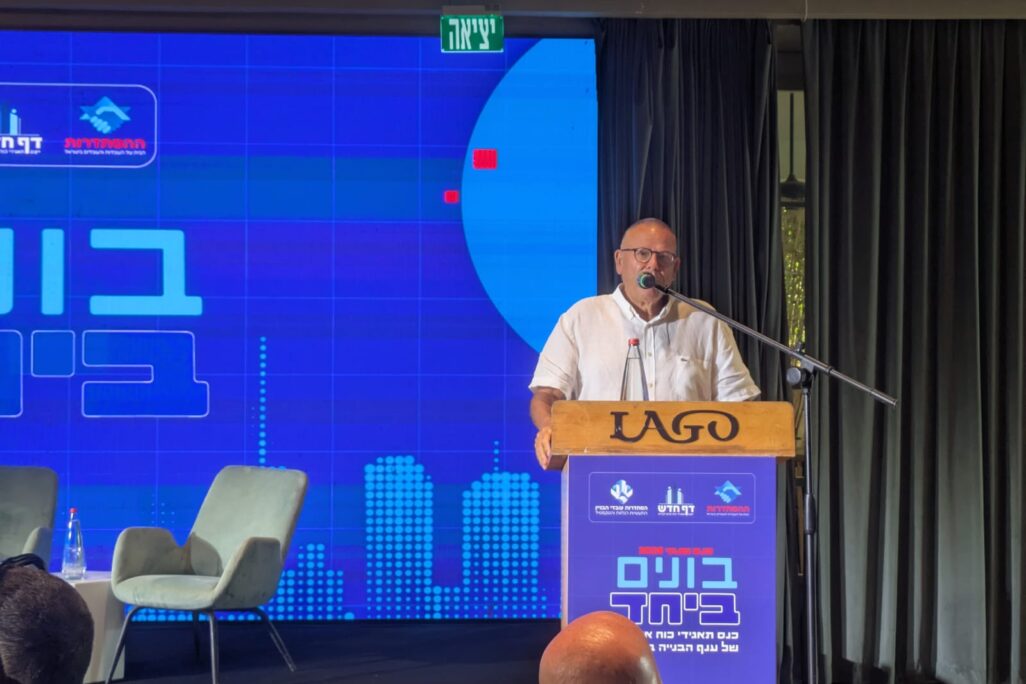
“We have a shared interest in acting against violations of the law and ensuring that both workers and employers know their obligations and rights. We will be judged by our ability to work together to advance this sector,” Histadrut Chair Arnon Bar-David said on Monday at a conference organized by the Histadrut’s Construction and Allied Industries Workers’ Union and “Daf Hadash,” an association representing foreign manpower corporations in the construction sector.
“Our goal is for the construction sector to keep moving forward and developing, because there is no growth without a strong construction sector, and no strong construction sector without workers.”
Bar-David noted that, according to Population and Immigration Authority data, 73,000 foreign workers were employed in Israel’s construction sector at the end of 2025. “We are still talking about a shortage of 40,000 workers, even after all the intensive efforts. We are still short of workers. Manpower corporations are a key link connecting the needs of the economy with the workers. This includes the ability to bring workers here, train them, and provide them with support and accommodation. That is why your problems reach my desk on a daily basis, and I am here to assist you.”
Bar-David estimated that Palestinian workers would not return to the construction sector in the near future. “Tel Aviv was built by Jewish workers. We have reached a point where, as in the rest of the world, we use foreign workers, but we need to do it properly. I think we should rely on Jewish labor and foreign labor, but we all need to come together and help one another so that this sector can move forward.”
")
MK Eti Attiya (Likud), chair of the Knesset’s Special Committee on Foreign Workers, addressed the need to reduce the costs imposed on manpower corporations and employers in the sector. “There is already some good news. The finance minister, together with the committee of director-generals, decided that fees would be reduced to help small businesses. But with elections on the horizon, the measure is still not being advanced. I think this should be incorporated into the state budget, reducing fees, permit charges and other costs. We and the corporations are on the same side of the economy, and we all want to see more workers, more construction and more growth.”
“The Einhorn Committee decided to establish foreign manpower corporations for the construction sector in order to create a clear framework with oversight of the employment conditions of foreign workers arriving in Israel,” said Mazal Golan, chair of the Histadrut’s Construction and Allied Industries Workers’ Union. “That is why I want the corporation model to become the standard for the construction sector. The state should know that when it needs to build, it has an organized, regulated and responsible sector it can rely on.”
Golan stressed that the Histadrut also opposes bringing additional foreign construction and contracting companies into Israel, including as part of the metro project, arguing that this would undermine the sector’s independence and harm Israeli companies.
“When the sector is in crisis, workers and employers cannot afford to stand on opposite sides of the divide. We need to understand our shared interests and work together,” Golan said. She emphasized that the Histadrut had worked with the Israel Builders Association to enable safety training for foreign workers to be funded through the Fund for the Encouragement and Development of the Construction Industry, and to make the sector’s existing mechanisms for protecting workers’ rights and resolving disputes between workers and employers accessible to foreign manpower corporations.
“When I took on responsibility for the manpower corporations, we encountered a difficult reality: corporations that had received allocations for foreign workers were barely managing to get any workers at all. They would receive just one or two workers on each flight. I raised the issue with Arnon, who said, ‘I understand. I’ll take care of it.’ He threw his full weight behind it, and indeed, just a month later, there was an airlift bringing in thousands of workers.”
Dispute Over the Recruitment of Foreign Workers
“We are here at home, alongside the Histadrut, which genuinely helps us on a daily basis,” said Ari Alexis, CEO of the “Daf Hadash” association, which currently represents more than 160 manpower corporations employing over 40,000 foreign workers.
He said that over the past two and a half years, the association had worked to reduce fees and increase the caps on deductions from foreign workers’ wages for housing, so that they would reflect actual costs. In addition, the association petitioned the High Court of Justice, and following the petition, workers who arrived in Israel on visas from India and Sri Lanka were prevented from submitting asylum applications in Israel.
“Our goal today is to preserve the private recruitment mechanism for foreign workers, because recruitment through the bilateral mechanism brought in unskilled and unsuitable workers who were ultimately directed to industry and other sectors, as government ministries also came to recognize. We believe that private recruitment of workers is critical to the sector,” he said.
Director-General of the Ministry of Construction and Housing Yehuda Morgenstern emphasized that the private recruitment model was initially adopted as a temporary, rapid solution to the labor shortage that emerged after 7 October. However, he said, members of the government’s committee of director-generals on foreign workers now believe the model has significant advantages and want to continue advancing it. The Ministry of Justice, by contrast, has identified risks associated with the model, including risks to the protection of foreign workers’ rights and the prevention of human trafficking.
“It is possible to recruit workers privately while ensuring oversight of their rights,” Morgenstern said. He added that, as part of negotiations with various countries to advance new bilateral agreements, the aim is to develop a model that would allow contractors to select workers from a pool of candidates.
According to Morgenstern, the key measure is the number of new housing units, and reaching 75,000 new units will require an additional 40,000 workers in the sector. He noted that for every additional foreign worker who enters the construction sector, two or three Israeli workers join them, meaning that the arrival of foreign workers also increases the number of jobs available to Israelis.
")
Director-General of the Ministry of Labor Ruby Shemesh said that the Finance Ministry’s previous goal of reducing the number of foreign workers in the economy was relevant before 7 October, whereas the current target is approximately 330,000 foreign workers, representing 3.3% of the population.
“When I look at the Ministry of Labor and the Population and Immigration Authority, I think this is achievable. The ministries need to improve coordination between them. The state is doing everything it can to sign as many bilateral agreements as possible, led by the Ministry of Foreign Affairs,” he said.
Shemesh emphasized that signing a bilateral agreement is a lengthy process, which is why negotiations are being conducted with several countries simultaneously. “In principle, the bilateral recruitment channel, based on an agreement between countries, is safer and more appropriate in terms of protecting workers’ rights and preventing the collection of illegal recruitment fees. But we need to bring workers in quickly, so we too are flexible and support recruiting workers through the private channel.”
Histadrut Opposes Foreign Companies in the Metro Project
Attorney Ilan Bombach, who represents the “Daf Hadash” association in its campaign against bringing foreign construction companies into Israel’s construction sector as part of the metro project, emphasized that the struggle concerns the future of the sector, including workers’ rights.
“We want the metro project to succeed, and we recognize its importance for transportation and the economy. But precisely because of the project’s scale, the decision on how workers will be employed must be well-considered and in accordance with the law. It will also affect future national projects,” he said.
According to Bombach, the direct recruitment of foreign workers by contractors, including foreign construction companies, rather than through regulated and authorized manpower corporations, could seriously undermine workers’ rights, competition and fairness in the sector.
“Our concern is that this project, too, will ensure formal employment arrangements that allow for oversight to guarantee full payment of wages and social benefits. If unregulated employment becomes a cheaper alternative, everyone will pay the price. That is why the Histadrut’s and Mazal Golan’s demand to halt the entry of foreign construction companies is so important.
“If there is no alternative, we will also have to petition the High Court of Justice and demand that the state present the alternatives it examined and the consequences it anticipates. No proper preparatory assessment has been carried out. The state needs to hear you before decisions are made, rather than engaging with you only after the fact.”
Hazi Schwartzman, chief labor inspector at the Ministry of Labor, presented the new safety training regulations, which will come into effect on 16 October and require eight hours of training for every new foreign worker arriving in Israel. The training will take place at approved colleges and be delivered in the worker’s own language.
Schwartzman also discussed safety regulations for construction sites, which include a comprehensive reform of the definition of site roles and the allocation of responsibility for safety at construction sites, as well as regulations governing work at heights, intended to combat the forgery of certificates authorizing such work. Moshe Ba-Gad, director-general of the Institute for Occupational Safety and Hygiene, emphasized that the institute offers construction companies and foreign manpower corporations safety training services in a variety of languages.