

Nearly two weeks have passed since the attempted terror attack on a FlyDubai flight to Israel, and the question of how an Omani co-pilot who was not supposed to be assigned to a flight to Israel managed to reach the cockpit continues to occupy the authorities. Since the incident, details have emerged about the chain of checks that preceded the flight, alongside a fierce dispute between the various bodies over who was supposed to have prevented it.
The attorney general of the United Arab Emirates confirmed that the co-pilot, Hammam Al-Hamami, planned to take control of the aircraft and crash it at Ben Gurion Airport. Such an incident could have ended in a mass-casualty disaster.

As further details came to light, it became clear that the problem was not limited to a single flight. Information presented to the Knesset revealed that hundreds of aircrew members from countries with which Israel has no diplomatic relations arrived in Israel over the past year. At the same time, it emerged that information about crew members was collected in the state’s systems, but in many cases was not used for security screening.
The Fundamental Failure: A Pilot from Oman Was Assigned to a Flight to Israel
Al-Hamami is an Omani citizen whose mother is Syrian. According to reports, even before joining FlyDubai, he was grounded from a flight in Oman over concerns about Islamist radicalization. Despite this, he was hired by the Emirati airline and was also assigned to the route to Israel.
According to the Transportation Ministry, FlyDubai had pledged to Israel that it would not assign crew members holding passports from countries that do not maintain diplomatic relations with Israel to flights to the country. According to the head of the Civil Aviation Authority, an Omani citizen should not have been allowed to board a flight to Israel in the first place.
However, it emerged that Al-Hamami was not an isolated case. During a meeting of the Knesset Foreign Affairs and Defense Committee’s Subcommittee on Intelligence, it was reported that 1,240 aircrew members from countries with which Israel has no diplomatic relations entered Israel over the past year, including individuals holding Syrian and Lebanese citizenship.
This figure shifts the focus of the question: not only how Al-Hamami managed to board a particular flight, but how a situation in which crew members who ostensibly do not meet the requirements set for flights to Israel became a widespread and ongoing phenomenon.
The State Comptroller Had Already Identified a Systemic Problem
The dispute between the authorities did not begin following the attempted terror attack. In May 2024, the State Comptroller published limited excerpts from a classified report examining the security of international aviation to and from Israel. The audit examined, among other things, the security of foreign aircraft entering Israeli airspace.
Most of the report remains classified, but in the published section, the comptroller recommended that the National Security Council (NSC) conduct interagency staff work involving the Transportation Ministry, the Finance Ministry, the Israel Airports Authority, the Shin Bet and the police, and reassess aviation security as a whole. The comptroller noted that some of the government and cabinet decisions underpinning the system dated back to the 1970s, and recommended that the prime minister, transportation minister and finance minister formulate a comprehensive policy on the issue.
In other words, the need to redefine the division of responsibilities had already been identified more than two years before the attempted terror attack. However, since most of the report’s findings remain classified, it is impossible to determine from the publicly available section alone which authority was identified as responsible for a failure of the kind exposed by the FlyDubai flight.
The Transportation Ministry, Shin Bet, Mossad or Population and Immigration Authority?
One of the main problems that has emerged since the attempted terror attack is that the word “responsibility” actually refers to several different actions: setting security requirements for foreign airlines, checking information about crew members, conducting intelligence checks, and approving an individual’s entry into Israel.
Transportation Minister Miri Regev pushed back against the allegations directed at her ministry following the incident and pointed to the Mossad as responsible for intelligence matters. In an interview with Kan 11, she said: “The Shin Bet is responsible for Israeli flights, and the Mossad is responsible for foreign airlines. FlyDubai is a foreign airline; it has nothing to do with the Shin Bet, but rather with the Mossad.”

However, the legal framework is more complex. The Shin Bet is indeed responsible for the security arrangements for Israeli aviation abroad, while foreign flights are subject to a different mechanism. At the same time, the Security Division of the Transportation Ministry is defined as being responsible, among other things, for “the security screening of foreign flights passing through or arriving in Israel.”
The Population and Immigration Authority also has its own role. According to the official policy document of the National Passenger Data Assessment Center, the Population and Immigration Authority has “exclusive authority to approve or reject a request concerning the boarding of passengers and crew members on flights arriving in Israel.” However, the authority maintains that this power concerns border control and eligibility to enter the country, rather than professional security screening of aircrew members. According to the authority, the security screening of crews is handled through the Transportation Ministry’s mechanisms.
In contrast, the Transportation Ministry argued that it is not an intelligence agency and cannot independently conduct background checks on every foreign pilot. This gets to the heart of the dispute: the Transportation Ministry is responsible for security arrangements for foreign flights, but maintains that it lacks the intelligence capabilities required to screen the people operating them.
NPDAC: The Information Was in the System, but Who Was Supposed to Use It?
The National Passenger Data Assessment Center (NPDAC) has entered the dispute. It was established under a law approved in 2023 and operates within the Israel Tax Authority. The center receives data from airlines about passengers and crew members on flights to and from Israel. This includes names, nationalities and passport details. The law was intended to enable the use of this information for counterterrorism, aviation security, border control and other purposes.
The law establishes a division of responsibilities between the agencies. The Transportation Ministry, Population and Immigration Authority, Israel Tax Authority and Health Ministry may contact NPDAC and request a query or assessment of the data. The Shin Bet, Mossad and police may also establish branches of the database within their own organizations. However, access to the information does not in itself mean that each agency is required to manually check every passenger or crew list.
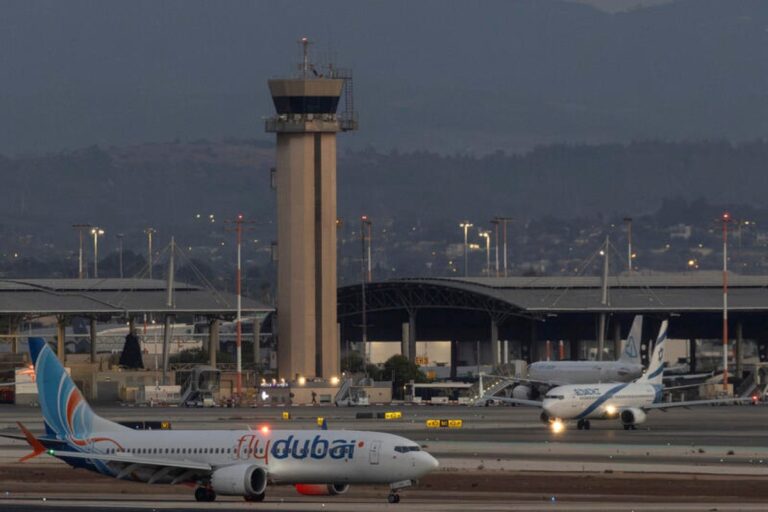
The Israel Tax Authority confirmed that the crew list for the FlyDubai flight, which included Al-Hamami’s details and his Omani citizenship, had been received before takeoff. According to reports, the Transportation Ministry did not systematically retrieve crew data from the database for screening, and therefore the Omani citizenship did not trigger an additional alert.
ynet reported that since the system was established, the Transportation Ministry had not requested to make practical use of the access granted to it to the database. The ministry, in contrast, argued that the information in the format in which it is received does not provide it with the necessary intelligence tools, and that such screening should be carried out by the security agencies.
This is also where the claim that “the Mossad and Shin Bet jointly held a database” needs to be corrected: the law allows both agencies broad access and even the establishment of their own branches of NPDAC, but this does not mean that a “shared database” exists that they operate together, or that the law obligates them to screen every flight crew.
Documents Reinforce the Transportation Ministry’s Responsibility — but the Dispute Is Not Over
Several reports published in the days following the incident strengthened the argument that the Transportation Ministry bore primary responsibility for the security of foreign flights. Channel 12 News published an internal document signed by Abraham (Avi) Cohen, head of the ministry’s Security Division. The document, circulated one day after the attempted terror attack, stated that “the Security Division of the Transportation Ministry is responsible for the security of flights arriving in Israel,” under provisions of the Aviation Law. The document also stipulates that the division must conduct repeated threat assessments and inspections at relevant airports.
Another report claimed that the Shin Bet ceased to be responsible for part of the aviation security system as early as 2021, and that in 2025, Prime Minister Benjamin Netanyahu ruled that the Transportation Ministry would assume responsibility for the security of foreign flights. However, this point is disputed: in its response, the Transportation Ministry argued that the decision at the center of the discussions concerned charter flights operated by Israeli airlines, rather than regular foreign flights, and that responsibility for security arrangements in foreign aviation had in any case rested with the ministry under the law for decades.
Therefore, at this stage, it would be inaccurate to state simply that “Netanyahu transferred responsibility for foreign flights to the Transportation Ministry in 2025.” It would be more accurate to say that this was reported based on the interagency work conducted, while the Transportation Ministry disputes that interpretation and distinguishes between foreign flights and charter flights.
Nevertheless, the publicly available documents and the defined role of the Security Division clearly indicate that the Transportation Ministry bears substantial responsibility for security arrangements in foreign aviation. The question that still requires clarification is exactly where the boundary lies between this responsibility and the intelligence background checks that the ministry claims it is unable to conduct.
The Lahav 433 Investigation: Two Senior Officials in Focus
Alongside the examination of the systemic failure, Lahav 433 has opened an inquiry into the conduct of two senior officials in the Transportation Ministry’s security system: Security Division head Avi Cohen and Dvir Rubinstein, director of the Operations Center for Aviation Security. At the stage reported publicly, this is an inquiry; it does not establish that either man committed an offense.
In Cohen’s case, investigators are examining a report alleging that, alongside his role at the Transportation Ministry, he served as a “reserve security officer” in the Ofek system, which secures Israeli airlines abroad. According to reports, the question is whether his additional employment was properly authorized. Cohen claimed that he received approval from the director general of the Transportation Ministry in 2018, while the report stated that the Civil Service Commission had not granted such approval.
Rubinstein’s case is different. He is not a civil servant, but provides services to the Transportation Ministry through outsourcing and manages the Aviation Security Operations Center. According to reports, alongside his work for the ministry, he provided consulting and training services to foreign airlines, including FlyDubai and Emirates, through a private business. Investigators are now examining whether a conflict of interest existed between these roles.
The Transportation Ministry stated that Rubinstein’s additional professional activities were duly approved and are carried out outside his working hours for the ministry. The question being examined is not simply whether he was employed as an external service provider, but whether a business relationship with companies subject to his oversight created an actual conflict of interest.
Both cases also raise a broader systemic question: how are such sensitive positions within the aviation security system staffed, and what oversight mechanisms govern additional employment and business relationships involving those who hold authority in this field?
What Remains Unknown
Even after nearly two weeks, there is still no single answer to the question of “who is responsible.” Some aspects of the picture are already clear: FlyDubai assigned a crew member who, under its commitment to Israel, should not have been on the flight; Al-Hamami’s details had reached the state’s systems before takeoff; the Transportation Ministry holds powers and responsibilities regarding the security of foreign flights; and other authorities, including the Population and Immigration Authority, the Shin Bet and the Mossad, each hold their own powers and access to information relating to other aspects of the process.
What remains unresolved is who should have turned the raw information about the pilot’s citizenship into an actionable alert that would have prevented him from boarding the aircraft. It is also necessary to determine why 1,240 crew members from countries without diplomatic relations with Israel were able to enter the country in a single year, and whether this resulted from a deliberate decision, a lack of enforcement, or a persistent gap between systems that do not communicate with one another.