
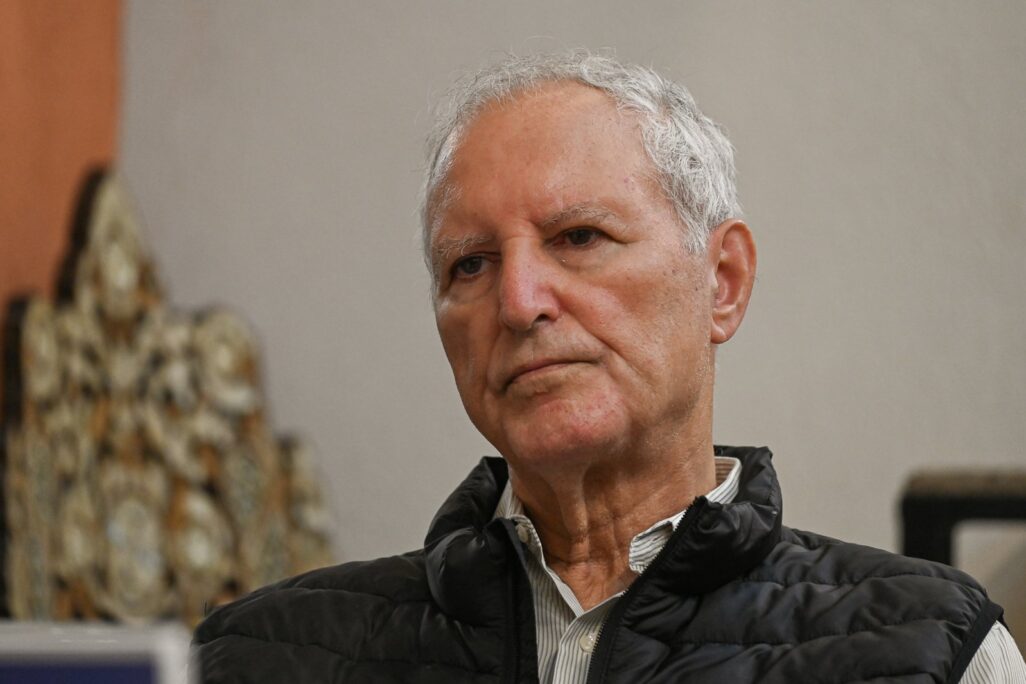
Professor Mohammed Dajani Daoudi sits at the Imperial Hotel, near Jaffa Gate in Jerusalem's Old City. Though he has reached the age of 80, he remembers his childhood within the hotel's walls—the starting point of physical and intellectual wanderings that eventually brought him back home. For decades he has worked to promote reconciliation between Israelis and Palestinians—"moderation within the conflict," as he puts it. Even at 80, and despite the current security and political situation, he says, "I believe in hope. My hope is that one day our children will be able to play together."
Daoudi, founder of the Palestinian movement for moderate Islam, Wasatia, belongs to a prominent lineage in Palestinian society. "The name Daoudi comes from the name given to the Dajani family because they were the custodians of King David's Tomb," he explains with pride. "They were appointed by Sultan Suleiman the Magnificent in 1525. And from then until 1948, we were the guardians of King David's Tomb."
He was born in the Baka neighborhood of Jerusalem. "In 1947, when the conflict began to turn violent, my grandfather sent the family to Egypt to stay with his brother. My grandfather was an entrepreneur; he owned many shops in the Old City and in West Jerusalem. He was forced to leave everything behind and move to the Old City."
When the fighting subsided, the family returned to Jerusalem. "We could not return to our home in Baka, so we came to the Old City and lived in the place that is today the 'Swedish Hostel.' My grandfather did not let any obstacle or loss crush him or turn him into a refugee. On the advice of her neighbors, his wife went to the UNRWA office and registered her family as refugees. When my grandfather returned from work and saw what she had done, he took the registration papers and said, 'I am not a refugee.' That was the lesson he taught us. Being a refugee is a state of mind. If you want to be a refugee, you want to be dependent on others; if you do not want to be a refugee, you rely on yourself and must build yourself up."
Daoudi relates that his grandfather saw the "Grand Hotel", built in 1884, in ruins and inhabited by refugees. He leased it from the Greek Orthodox Patriarchate, renovated it, and established the Imperial Hotel. The hotel became a prominent institution in the Old City: "People who wanted to hold festivals and weddings would come here; it was the only venue that did that in the 1950s. My grandfather persuaded the municipality to ask King Hussein for funding for a road connecting the Dung Gate with Jaffa Gate." The grandfather's businesses flourished, and he represented various European companies.
Today, Daoudi is locked in a legal battle over his right to reside in the hotel, which was purchased through a shell company in 2005 by the Ateret Cohanim organization. Following a years of litigation aimed at annulling the sale, the court gave its final approval in 2022, and the Jewish organization, which acquires properties in East Jerusalem, took possession of part of the building.
"I grew up in this hotel. I attended the Friends School in Ramallah, which was a Quaker school. I learned there to think in terms of compromise. They taught us empathy and cooperation. The headmaster, Farid Tabari, who was Christian, used to read in the assembly hall one day from the New Testament, one day from the Hebrew Bible, and one day from the Quran. And so we grew up steeped in interfaith values."
Fatah Activity, a Decade in the US
His political involvement began during his studies at the American University of Beirut. "Beirut marked the beginning of my year of radicalization. There were very active political parties there. Everyone was anti-Israel, calling for the destruction of Israel and the liberation of Palestine.
After the 1967 defeat, which was not just a military defeat, but also a psychological and social defeat, defeating Israel became tied to people's honor. They lost their pride in the 1967 defeat. As a result, Palestinians shifted from supporting Arab armies to attack Israel or liberate Palestine, to supporting Palestinian liberation movements that would liberate Palestine themselves."
Daoudi joined Fatah in 1967. "I was an idealist, and the liberation of Palestine was the ultimate goal." He relates that after a while, people began joining Fatah for money, status, and prestige. "During that period, I started seeing a lot of corruption. I used to raise money for Fatah by selling tickets door-to-door for five Lebanese pounds. I saw people taking 5,000 pounds just to throw a wedding. I said to myself, 'Wait a second, this is money that took me two months to collect, and they're throwing a wedding with it?' That affected me deeply."
")
At the end of his studies he received permission to return to Jordan, at the request of his family from King Hussein. In Jordan he founded the Department of Political Science and Diplomacy at the University of Applied Sciences. In 1993 he received residency and returned to Jerusalem.
He served as a consultant for the United Nations Development Programme (UNDP) and later for the Palestinian Authority. "Over two years, I succeeded in helping establish the Palestinian Authority's ministries. I established two institutions for public administration, one in Ramallah and one in Gaza. We trained more than 30,000 Palestinians to become civil servants in the Palestinian Authority."
Daoudi pushes back against the sweeping accusations leveled against the Palestinian civil service. "The corruption is at the top; it is not deeply ingrained. The civil servants want to do their job. Some are good, some are not. There is indeed a lot of nepotism and a lot of tribalism, and the problem is that the corrupt give everyone a bad name." He explains that in 1996, the Palestinian public voted for Fatah, but "Arafat encouraged corruption, and things did not go well."
According to him, "In 2006, people voted for Hamas as a vote against Fatah, but it turned out that Hamas used religion as a ladder to reach power. The masses believed them and followed them, and in order to consolidate their power, Hamas radicalized their religion. I think the young members of Hamas took part in the October 7 massacre because they believed they were carrying out God's will. They were taught that Jews provoked God's wrath, and that to appease God, one must kill Jews."
"Hamas Divides Us, Wasatia Unites Us"
Daoudi accuses Hamas of distorting verses from the Quran. "Many verses in the Quran are being changed. In Wasatia, we teach that everyone is entitled to their own faith. We teach tolerance, interfaith dialogue, and empathy for the other. There are values we share, and things on which we disagree; the Quran tells us that God will ultimately judge between us. He is a forgiving God, and He will forgive those who were misled."
He quotes a phrase considered the encapsulation of Wasatia's core principles: "Wars divide us, peace unites us," and connects it to present-day reality: "Hamas divides us, Wasatia unites us."
“The Middle Way”
"I went to Ein Kerem Hospital with my father so he could undergo chemotherapy. I saw Jewish doctors helping to heal Palestinians and Arabs, Muslims and Christians. I started to see the human side of the Other. Instead of 'us or them,' my vision became 'us and them.'"
He recalls one of the events that led him to establish the Wasatia movement. "It was in 2007, and I was secular then; I had no connection to religion," he remembers. "One Friday morning, I was watching an Israeli checkpoint from my home balcony. There were hundreds of Palestinians surging toward the checkpoint to get to Jerusalem for prayers. The soldiers were pushing them back because they didn't have permits. The soldiers fired tear gas at them, and I thought that eventually they would shoot them. The people were determined. Despite the tear gas, they didn't give up.
"In the end, the soldiers at the checkpoint brought buses, allowed the people to cross the checkpoint, searched them, took their ID cards, and then the buses took them to Jerusalem to pray. The buses brought them back to the checkpoint after prayers. The people got their ID cards back and went home."
"For me, it was a win-win situation. The Palestinians wanted to go pray so as not to miss the Friday prayers during Ramadan, and the Israelis were worried about these people coming in, entering Israel, and making bombs. The people prayed and there were no bombs or violence. I wanted to establish a party or movement that would create win-win situations, and that is how I started Wasatia."
The word Wasatia means "center" or "the middle way." "In the second chapter of the Quran, Surah Al-Baqarah, there are 286 verses. The middle verse says, 'Thus We have made you a middle nation.' This means there is a middle path in Islam. So we adopted that concept from there and started our movement. Initially, we focused on Islam because it is the language of the Palestinian religious community, and later, in order to appeal to secular audiences, we also spoke about moderation in various religions and among different philosophers."
“Education for Reconciliation and Empathy”
"We used to hold a conference every year where about 200 imams and sheikhs would come to learn about Wasatia. We worked on changing the Palestinian curriculum, but the problem is that even if you change it, if you don't change the mindset of the teachers, nothing can be taught. A teacher can walk into a classroom and teach hatred instead of peace.
"That is why in 2020 we established the European Wasatia Graduate School for Peace and Conflict Resolution at the European University Flensburg in Germany. About 25 students study there, including Israelis, rabbis, Palestinians, and one student from Gaza." He tried to set up a similar institution with joint programs at Tel Aviv University and Al-Istiqlal University in Jericho, but "PA President Abbas and the president of the Jericho university rejected it."
Daoudi places his trust in education and draws inspiration from Plato. "When he was disappointed by Athenian democracy, which condemned his teacher Socrates to drink poison, he looked beyond the Athenian community and beyond democracy. He was not against democracy, but he pondered what was wrong with it, and concluded that when people lack education, democracy devolves into demagoguery. He launched his academic journey to enrich the community through education. I want to enrich the Palestinian and Israeli communities through education for reconciliation and empathy. My dream is to see a graduate school in the spirit of Wasatia in Israel and Palestine."
The Need for Moderation
"Hamas's radical Islamic ideology can only be countered by a moderate Islamic ideology. You can defeat Hamas militarily, but if you don't defeat it ideologically, you lose. Hamas members want an Islamic state from the river to the sea, and Zionist extremists want a Jewish state from the river to the sea—I believe neither will happen; it is a fantasy on both sides. There are seven or eight million Israelis on one side, Jews, and seven or eight million Christians and Muslims on the other. What do you plan to do with them?
"The language of force used by the current Israeli government, designed to rally Israeli voters, empowers the radicals on the other side. They feed off each other. Moderation, on the other hand, paves the way for good-faith negotiations, which will open the path to peace."
His Office Was Ransacked, His Colleagues Stayed Silent
To educate for empathy, Daoudi, as a university professor, initiated a trip for Palestinian students to Auschwitz. "The reason I took my students to Auschwitz was to practice empathy—so they could go and see the suffering of the Other. We also took Israeli students to the Dheisheh refugee camp to hear the Nakba stories of the 1948 refugees, so that they, too, could feel empathy in their hearts. We want to turn hearts of stone into hearts of flesh."
Twenty-seven students joined the trip to Auschwitz in 2014. "These people came from such negative backgrounds. Before we started, I told them to leave the baggage of the past behind and come with an open mind. On our last day there, the newspaper Haaretz published an article about the trip. I had asked them to publish it only after we returned, but they published it while we were still there. The Palestinian newspaper Al-Quds translated the article into Arabic. There were several flaws in the translation. For example, it stated that Tel Aviv University funded the trip instead of Friedrich Schiller University in Germany, which actually funded it.
"People started telling the students, 'This is normalization, and normalization is betrayal.' I argue that normalization intended to reinforce the occupation is betrayal, but normalization intended to end the occupation and build bridges of peace with the peace camp on the other side is not betrayal."
Daoudi believes the error in translation was not made in good faith. The controversy spread beyond Jerusalem and the Palestinian Authority, reverberating throughout the Arab world. Daoudi came under attack in the media, and unidentified individuals ransacked his university office. Facing overwhelming pressure, he resigned from his post at the university.
"I met with the university president and submitted my resignation. He asked me why, and I replied: 'You have protests outside. My office was destroyed. People are threatening me.' I showed him threat letters, which he took and refused to return. I asked him to issue an updated statement on behalf of the university clarifying that what I did fell within the scope of academic freedom. He said, 'I can't do that.' There was heavy external pressure—for instance, Ahmed Qurei (one of the architects of the Oslo Accords), who served as chairman of the board of trustees, called him and demanded my dismissal."
"What affected me most negatively was the silence of my colleagues. Some of them even began attacking me to appease the university, claiming that the students who participated were forced to go. That was untrue, as 70 people had applied and we selected 30 of them."
The Big Dream and the Small Hope
Daoudi invokes the concept of "the big dream and the small hope," taken from a 1996 New Yorker interview with Mahmoud Darwish, the Palestinian national poet, following the signing of the Oslo Accords. Darwish said at the time that Arafat chose a small hope over a big dream. Daoudi recalls introducing this concept in 1997, at a gathering of Jewish and Palestinian religious leaders in Antalya, Turkey.
"The meeting played out as a series of monologues: people talked at each other, but didn't listen to each other. I recalled Darwish's words and asked, 'What is more important: a big dream or a small hope?' The big dream is to wake up one morning and find that the Other is no longer around. But when you wake up, there are eight million of the Other. What do you want to do with them? Do you want to throw them into the sea? They answered, 'No.' So we moved on to the small hope: to wake up one morning and discover that we are living together as neighbors—helping each other, teaching each other, learning from each other. That is how we can lead our children to peace."
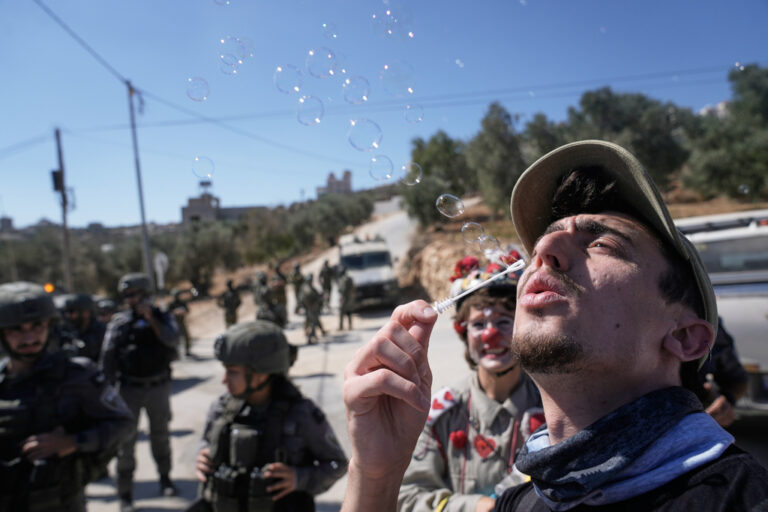
The starting point, according to Daoudi, is mutual recognition between the State of Israel and the State of Palestine. "What needs to happen is for both states to recognize each other as states and as UN member nations. This will grant legitimacy to the State of Israel from the Palestinians, and to the Palestinians from the Israelis. In doing so, we can move forward—living in the future rather than in the past."
Regarding Arab citizens of Israel, he says that "they should not view Islam as a barrier separating them from the Jewish community. They should use Christianity and Islam to serve as bridges between the two communities. And I believe they can adopt the concept of Wasatia within this group, emphasizing the vision of both communities living in peace and harmony."
"Elections Under Occupation Will Lead to Votes for Radicals"
Although he has criticisms of him, Daoudi believes that Palestinian Authority President Mahmoud Abbas can still sign a historic peace agreement between the two peoples. "Palestinians don't believe there is an Israeli partner for peace, and Israelis don't believe there is a Palestinian partner for peace. They don't hear each other. Israelis need to make peace with Abbas; signing a peace agreement will give him legitimacy."
According to him, "Ultimately, recognition of a Palestinian state will happen, and even though I don't support Abu Mazen [Mahmoud Abbas] and his entourage, if he gets the credit for it, people won't care about the corruption. Corruption exists in democratic countries as well. If people feel he delivered on what he promised—recognition of a Palestinian state—his path will be seen as the right one."
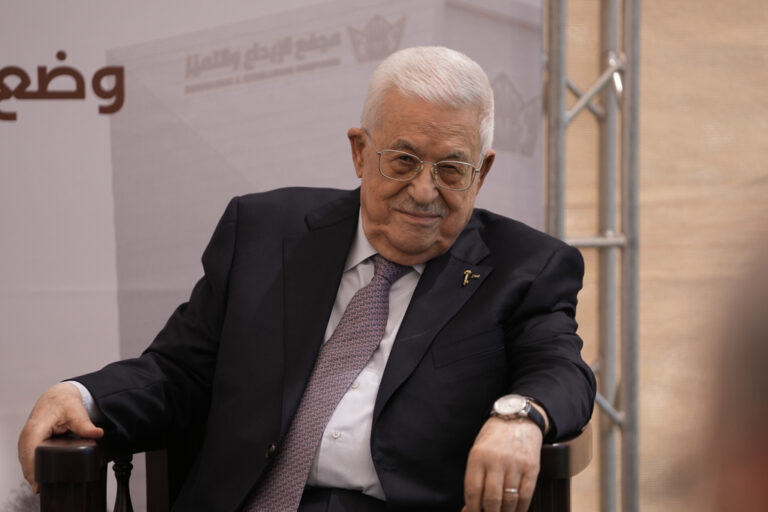
He recognizes the limitations of Abu Mazen's leadership, but sees no better alternative on the horizon. "Abbas is certainly not particularly open to the two-state solution, or even to Holocaust education. But if he is given the authority before his death to recognize the State of Israel and to become the President of the State of Palestine, he will lead the way for others to follow. Israelis want a courageous leader like Nelson Mandela, but someone like [Marwan] Barghouti, for instance, is no Nelson Mandela—none of the other leaders possess the courage to lead."
The Planned Palestinian Authority Elections
"I believe Abbas is using [the elections] as morphine for the people, because the situation is very grim—especially with the Israeli incursions into the West Bank, the siege imposed by Israel, the poverty, and the lack of salaries. I also believe these elections will not take place. In the past, elections were canceled because Israel did not permit them in East Jerusalem. Now, we don't just have the Jerusalem issue; we have the Gaza issue."
According to him, "I do not believe elections are a good thing under occupation. It isn't democratic. People under pressure and occupation will not vote like free people; they will vote for the radicals. Hamas will take over, and the Israelis encourage this so they have a pretext to annex the West Bank. Elections held under a sovereign Palestinian state would bring entirely different people into power—people who believe in democracy, negotiation, and diplomacy."
Is there a solution to the situation in Gaza?
"Israel needs to empower Gaza residents who oppose extremism—the moderates. Israel needs to bolster education and the Wasatia curriculum. In the next elections, Israelis need to decide what they want: the future or the past. If they want the future, that means peace. And if they want the past, that means war."
Dajani addresses Israelis directly: "You built a great country; do not destroy it. Do not make people hate it and place it under siege. Citizens of Israel today are better off than citizens in Britain. Instead of wasting money on wars and conflict, build bridges with people."