
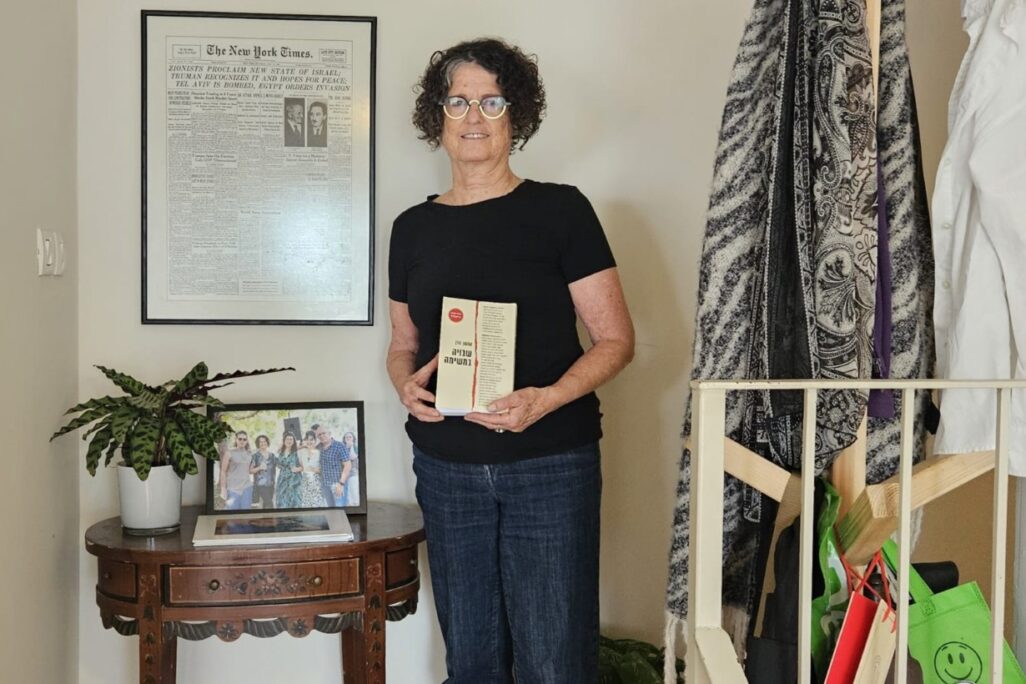
From the window of Shoshan Haran’s (70) home in Kibbutz Ma'ayan Zvi, the green slopes of the Mount Carmel foothills are visible. Laden with typical Carmel-coast vegetation of olive trees, pine trees, and agricultural groves, sloping down toward the plain. The fishponds look like giant patches, mirrors of water glistening in the sun alongside the coastal highway. In the distance, the wild coastline of Dor Beach emerges, and beyond the strip of white sand stretch the vast expanses of the Mediterranean Sea in shades of blue and turquoise. Migrating birds stop on an autumn morning, at a waystation between an approaching winter in Europe and warm Africa.
After decades in Be'eri, Haran is still getting used to the new landscape that replaced the paths of the western Negev. "I am unable to return to Be'eri," she says in an interview with Davar, "I saw things that no one should ever see." Haran's home in the kibbutz, where she was born and raised, was burned to the ground. The sight of the heavily armed terrorists who occupied the kibbutz for many hours and robbed her of everything most precious gives her no rest.
")
Haran was abducted from her home together with her daughter Adi Shoham, her grandchildren Naveh Shoham and Yahel Shoham, her sister-in-law Sharon Avigdori, and her sister-in-law's daughter Noam Avigdori. The terrorists pulled the family members through the safe room window, which they breached using a bulldozer. They led them along the familiar and beloved paths of the kibbutz, which had been overrun and turned instantly into a burning hell.
She was released from captivity in Gaza after 50 days, as part of the first hostage release deal. Only after her return did she discover that her beloved husband, Avshalom (Avshal) Haran, her sister Lilach Kipnis, her brother-in-law Evyatar Kipnis, and caregiver Paul Vincent Castelvi were murdered in the massacre at the kibbutz. Adi's husband, Tal Shoham, who was held separately from the family, remained in captivity and was released only after 505 days.
Since then, Haran hasn't really stopped. She fought for the return of the hostages, traveled the world, met with leaders and elected officials, and established a non-profit organization that assists families who cannot return to the Gaza Envelope. She tries to understand how Israel arrived at October 7, and what can be done to prevent the next disaster.
In January 2026, her book Mission in Captivity was published by Yedioth Ahronoth. The Hebrew title שבויה במשימה carries a double meaning—both "held captive on a mission" and "captive to the mission. "The credit for the book's title goes to my brother, Aviv (Leshem), who edited the book," she says. "I haven't released myself from the mission, even today. Now the mission is to tell the world what really happened."
Life in Be'eri: "They Said It Was the Safest Border in the World"
Haran was born in Be'eri, a daughter of the kibbutz founders who grew up on a combination of agriculture, mutual responsibility, and a belief that people deserve an opportunity for a good life. "In my life before, I engaged in natural sciences and plant sciences, seed breeding, and assistance to farmers in Africa. My sister Lilach Kipnis, who was murdered on October 7, was a social worker and trauma expert, a member of 'Women Wage Peace'. Avshal, my partner, was the CEO of 'Mashkei HaKibbutzim'. We were all oriented toward building an infrastructure for a good life."
Her parents, among the founders of the kibbutz, arrived in Be'eri fully aware of the danger. "When my parents went there, they knew where they were living," she says. "My mother was a radio operator. It started from '46 with dealing with many raids, and in '48, during the war, they lived in trenches. They went there out of very clear awareness. As far as they were concerned, they were determining the borders of the state. We grew up into that."
But she, according to her, grew up with a sense of security. "The founders started in a very difficult situation, and gradually reached very impressive success. We were born into something that might have been modest economically, but in our consciousness, our lives were secured. They started from a tough war and lost many friends, but came prepared for it. That was their mission."
That trust also seeped into her perception of the state. "We assumed there were authorities responsible for guarding the border, which we were told was the safest border in the world. We weren't naive, but we thought the state had the tools, capability, and power to protect us, so we didn't deal with it. We didn't think it was our job to know what was happening in Gaza."
"After the first tunnels were identified, there was a caricature in Be'eri showing a terrorist emerging from the dining hall floor, looking at the meals, and saying, 'Ugh, schnitzel again, I'm going back.' Meaning, we knew there were tunnels; it came up occasionally in conversations. We didn't know the tunnel system was more developed than the New York subway system. We focused mainly on cross-border tunnels. We knew they were constantly improving their rocketry and offensive capabilities, but we didn't know to what extent. We didn't know about the entire apparatus that was there. Where were we?"
Agricultural Work in Africa: "We Disproved Prejudices"
Haran's mission before October 7 was clear, and was tied to her profession as an agronomist. She worked for 11 years in senior roles at an international agricultural seed-breeding company. At a certain point, she felt that the industry's direction did not align with what she saw as the world's real need. "On the development maps of seed companies, similar to airline maps, you can see the home base and which places in the world they target. When examining these maps, which the company's senior management presented to us every year, you see they target the well-fed world. That didn't make sense to me."
To her, seeds are much more than a commercial product. "The traits of the variety determine food production. They determine disease resistance, fertility, the ability to cope with soil and water scarcity, shelf life." She refused to accept a reality in which vital improvements do not reach the people who need them most.
Together with a colleague from France, she tried for years to persuade management to direct more resources to Africa. The answer was always similar: in the future. Ultimately, Haran decided to leave and establish the non-profit organization Fair Planet, which connects farmers in Africa to advanced seed technologies and agriculture. "It comes from a concept of the need to give equal opportunities to people. I think it's also connected to the kibbutz upbringing," she says.
The organization sought to bring existing solutions to poor countries. "When we turned to seed companies, we didn't demand that they save Africa or Asia. We didn't demand that they run a breeding program or invest millions of dollars from R&D budgets into developing varieties for farmers in Africa. We said, you have all the solutions, you just need to bring them there, test what fits, and train them—that's all."
The seed companies rallied behind the idea, and soon the organization's activity reaped dizzying success. According to her, in the first location where the organization operated, farmers managed to increase yield threefold and income sixfold. After six years, the organization's presence was no longer needed.
"The people we worked with, Muslims and Christians in Ethiopia and Tanzania, really wanted to work so that their lives and their children's lives would be better. I had to fight all kinds of prejudices claiming that if they earned more they would get drunk, chew more khat, etc. The results disproved the prejudices. They sent their children to school, because suddenly the children were no longer essential to the family's livelihood. Their nutrition improved, and they continue without us to advance their economic development."
According to her, the success of the activity clarified the marketing potential to the seed companies. "The success expanded commercial activity in those countries," she says with pride, "it just needed that bridge."
Captivity: "The Danger Is Losing a Grip on Reality"
The ability to identify a problem, understand that a solution exists, and choose not to stand by is a thread connecting Haran's life before and after October 7. "It probably comes from a feeling deeply rooted in the education I received, that it makes no sense to have the solution and not bring it to the people who need it most."
In the Hamas attack, this trait took on an entirely different meaning. When the terrorists handcuffed her and pushed the six family members into a vehicle on the way to Gaza, Haran understood that even in the nightmare into which she was cast, she had a role. Under conditions where she had almost no control over anything, for 50 days, Haran tried to create a sense of order for herself and her family.
"Very quickly I realized that the terrorists' goal was to receive something from Israel in exchange for us, and therefore we had a shared goal: we needed to return safely to Israel. They wouldn't get anything from Israel as long as they didn't return women and children in a reasonable manner to the country. Therefore, I immediately understood that I needed to work with them."
She compares the captivity experience to "being in some spaceship in hostile space." She found ways to keep the children and herself grounded in reality. She calculated the days: "One of the dangers in captivity is losing a grip on reality. You need to know what day today is and what the date is, and stay connected to time." She also remembered a conference in Rwanda she was supposed to attend, and used it to create an imaginary story for the children.
She created an entire world in her imagination. The captors were "guards" whose job was to protect them from the hostile environment. "I was so much on a mission that it's probably part of what sustained me. In such a situation you do what you can, which is quite little; mostly imagination remains. It's almost the only thing you have control over, so you can fly with it."
On one occasion when they were permitted to shower using bottled water, Adi combed three-year-old Yahel's hair while Shoshan hugged her in a towel. "Yula was so small and thin, wrapped in the towel that served us all, which was already like a rag. I would teach her to count while combing out the tangles in her hair."
The Encounter with the Captors: "They Truly Intend the Destruction of Israel"
One of the things Haran realized very quickly in captivity was the complexity of relations with the people holding her. She spoke with them, listened, and while fully understanding that she was in their hands, tried to understand who they were. "It's not Stockholm syndrome; it's a strategy. You know exactly where you are and what you're facing, but within that, you speak as human beings. They are human beings, simply brainwashed."
She talks about one of the captors, named Muhammad. A young man of 24 or 25, educated, English-speaking, and possessing high emotional intelligence, with whom she conducted deep conversations. "From the conversations with him in Gaza, I understood the result of raising people under Hamas education. It's an extreme, jihadist education that educates for religious war starting from kindergarten," she shares.
"When I already had conversations with Muhammad and felt more confident facing him, I told him what I saw on the day they conquered Be'eri," she relates. "The IDF wasn't there, the state wasn't there, we drove through open fields to Gaza. I saw and knew that they had conquered Be'eri. It was clear from their body language and smugness that they too knew the IDF wasn't there."
"I told him that his friends did terrible things there. Without blinking, he answered me, 'We are the captors and they are the murderers, We are the same.' He was essentially telling me that had he been in their place, he would have murdered, abducted, and burned cruelly, just like them. It was only by chance that he was taking care of us, because that was the assignment he received and now we, the hostages, were a valuable asset for Hamas. He also told me, 'I recommend that you leave the country, because next time we come it will be much worse. This time we sent out only ten percent of the forces. Next time we'll come with much more. This was only a promo.'"
According to her, understanding the captors' motives shattered a basic assumption for her that was part of the world she came from. "I, and I think many people around me, lived under an assumption we never talked about—that all people want to live safe and good lives for themselves and their children." According to her, in conversations with the captors she understood that this baseline assumption was not shared. "When they talk about jihad, about the destruction of Israel, and about an Islamic world, they truly mean what they say. I understood that it's a mistake to assume that if we think differently, it's impossible that they really mean it."
"We were blind to their goals," she says, "even though they are very coherent and hide nothing." But the blindness, according to her, was mutual. "As far as our captors were concerned, Jews in Israel are similar to the French in Algeria, who had no business being there other than classic colonialism. They had no idea what we are doing here. They don't know about the Jews who were here 3,000 years ago, and don't know there was a Holocaust."
"It's not a matter of Holocaust denial," she refines. "Holocaust denial is Sinwar and Abu Mazen—people who studied and deny it. But you can't deny something you don't even know happened, and our captors simply didn't know it happened. Therefore, they didn't correctly identify the strength of sumud [steadfastness] that we have, and miscalculated the Israeli response. We always attribute sumud to them, but we have our own sumud, and maybe even stronger, because we have nowhere else."
Turning to the World: "To Tell How We Reached This Situation"
After 50 days, on November 25, 2023, Haran was released and returned to Israel. Returned with her were Adi, Naveh, Yahel, Sharon, and Noam. But the mission was not complete: 138 hostages remained in Gaza, among them Tal Shoham, her son-in-law. "The first thing I did when I was released from captivity was fight for the release of all the hostages. Tal was in captivity for a very long time, and we did not relent until they were released." Tal Shoham was released on February 22, 2025.
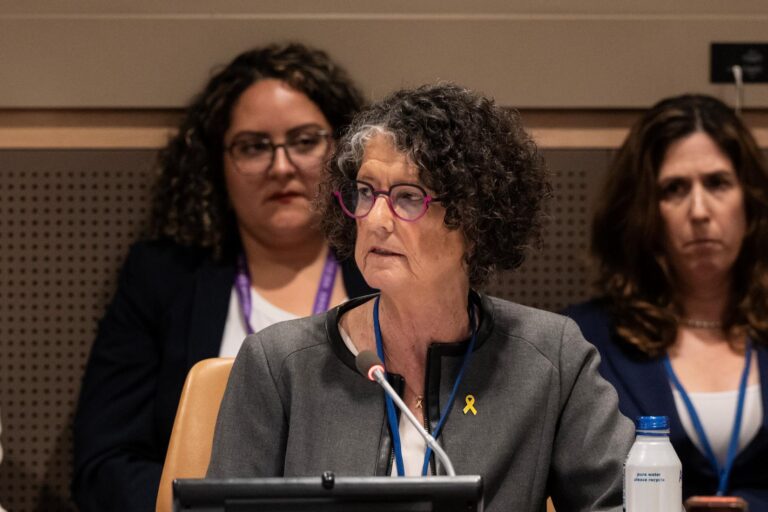
Ten days after her release, she already traveled to the United States and met with the Attorney General, senators, and members of Congress. "To me, these were business meetings. They are curious people who wanted to meet someone who was in the heart of the hell and hear what exactly happened. In return, I wanted them to act for the release of the hostages." In May 2024, she addressed the UN Security Council.
She began writing the book Mission in Captivity, which won the Bernstein Prize for original Hebrew non-fiction, about a year after returning. She shares that exposure is uncomfortable for her, but she sees value in it. "The most important thing to me is that people read the book and understand the complexity, that they know what happened."
Although Haran returned from captivity in late November 2023, according to her, she is to a large extent still there. "I haven't been released from Gaza," she says. "It's true that the 'Gaza' level in my thoughts dropped thanks to the book, which has a transfer effect, but it hasn't dropped completely. We are there a lot. All of us. One doesn't get released from that."
She currently devotes her days to family, building the new home, and endeavors related to the book. "It's not that I am emotionally free to do other things." She has not returned to her previous professional life: "My mission now is to tell the world what happened and how we reached this situation."
This mission continues to take her away from home. On the eve of the third anniversary of the October 7 massacre, her book will be distributed in the US in an English translation. She accompanies the book's release with a series of lectures and meetings with readers across the US. Later, the book is expected to be published in Swedish as well, and recently she received an inquiry from a publisher in France.
The book presents her experiences and those of her family in Gaza broadly and candidly, but it is not merely a record of captivity. In its final part, she details the processes that led to October 7, and the deep undercurrents that continue to generate hatred and destruction. "If I can bring people to know not only my story, but also the broader context, I have fulfilled my mission."
Haran describes at length an anti-Israel influence system targeting education systems and universities abroad, a ramified system for funding terrorism, and the use by jihadist and antisemitic forces of a long-term awareness campaign. "October 7th was like a spark," she says, "it ignited something that was prepared in a very sophisticated way against us for 20–25 years."
The interpretation she offers in the book is based on reading hundreds of studies, journalistic investigations, and economic and intelligence reports, along with insights gained from direct and unmediated interaction with her captors in Gaza, Hamas terrorists. In her book she wrote: "I learned from him (from the captor Muhammad) that Hamas is an organized, well-funded organization that pays monthly salaries to its operatives and assigns them tasks. Murderers. Abductors. Captors. Designated journalists. Social media influencers… all serve the jihadist mission of our destruction and strive for an Islamist world."
Haran points to two key areas for change: funding and education. "Without funding there is no terror," she says. "With all due distinctions, Avshal used to tell me regarding Fair Planet that every idea needs funding to be carried out. Beautiful ideas aren't enough; you also need the ability to realize them." Regarding the need for change in the education system in the Palestinian Authority territories and Gaza, this reflects her core belief in systemic change. "Our captors grew up in the Hamas education system. The central narrative is hatred and demonization, destruction of Israel, jihad, glorification of death for the purpose of achieving the mission, and belief in reward that will come after death."
According to her, these are the two most important elements for solving the situation. "Easy to say, not simple to execute, but it's important to at least point a finger at it," she adds sorrowfully, though not in despair. "I know there are people trying to do this, at least in terms of restoring education."
She cites as a positive example the Palestinian-American physician Dr. David Hassan, who established a network of schools and educational tents in the Gaza Strip. His schools use an updated version of the Palestinian curriculum from which inciting, violent, antisemitic, and jihadist content has been removed. Instead, the curriculum emphasizes conflict resolution, tolerance, empathy, and familiarity with different religions. "They teach thousands of children and do so in cooperation with Israeli and Jewish entrepreneurs and donors. He operates the same power of funding and education that was deployed against us by Qatar and terror supporters, but instead of education for religious bigotry for an Islamic takeover, he takes it in a positive direction."
The Distance: "The State Has Not Provided a Solution That Allows Rebuilding Lives"
During the struggle for the release of the remaining hostages, Haran realized that the state was not taking care of those who could not return home after the massacre. "Since the events of October 7th, many families have been dealing with severe trauma that prevents them from returning to their homes. These are the people who were hardest hit, who need to establish a home from scratch."
Together with Dalia Black, she founded ReHome, a non-profit organization that assists families unable to return to the Gaza Envelope communities in purchasing a home and rebuilding their lives. The organization provides bridge loans for self-funding a home purchase, along with a support package of lawyers, real estate consultants, and professionals.
"I will not return to Be'eri, and like me, there are many families," says Haran. "In psychology this is called 'place-based trauma'. Unfortunately, there is no state body addressing this issue. Economically, whoever returns receives rehabilitation, and whoever doesn't, can go in peace but receives nothing." The organization currently assists about 90 families, and she estimates the number will grow in the coming years. "It amazes me that three years later, the state still hasn't provided a concrete solution that allows starting to rebuild lives."
Starting Anew: "I Am in Touch with Friends, But the Distance Has an Effect"
In Ma'ayan Zvi she found a place where one could begin. "It's a very major move, from the western Negev to a kibbutz on the mountain overlooking the sea," she says. The search for a place to begin rebuilding her life started about a year after her return from captivity. In Ma'ayan Zvi, she says, she felt comfortable for the first time. "They helped us very much. They were fully mobilized. Here they opened their arms, heart, and soul."
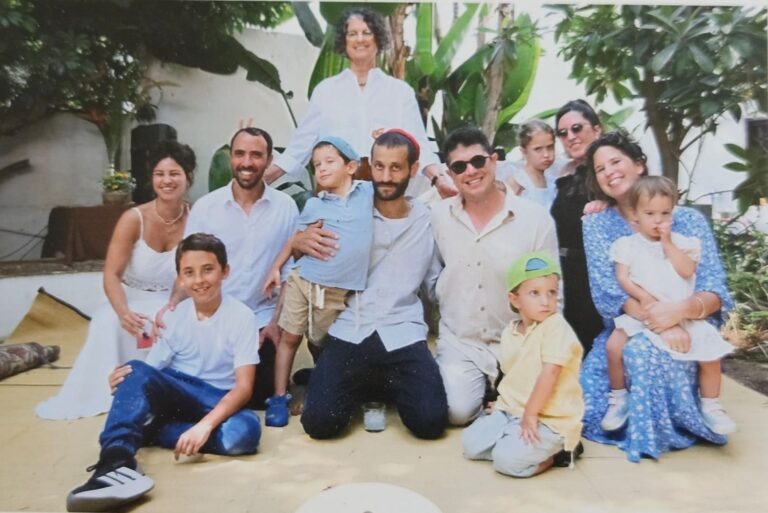
She is currently building a home in the expansion neighborhood of Ma'ayan Zvi, alongside her daughter Adi, her son-in-law Tal, their children, and her son Yuval Haran. Yuval married his partner Anna Lee in September 2025, following Tal's return. The younger daughter, Shaked Haran, is expected to move nearby.
To her, the move is not an erasure of life in Be'eri. In her book she writes: "With immense pain I understand that I will not be able to live in the community established by my parents, in the place where I was born, grew up, married, raised a family, and lived for 67 happy years. I saw with my own eyes Be'eri conquered, looted, and trampled. Its earth soaked with the blood of the people most precious to me. The trauma is present in every clod of earth, in every stone, bush, and tree."
Nevertheless, she says in the interview, the connection with Be'eri remains. "I am in good touch with friends in Be'eri, but the distance has an effect. It's a traumatic detachment in every respect. After all, my entire house was burned down, but there are things that cannot be burned." According to her, Be'eri is preserved in the family, in good memories, and in loss.
So too is the difficulty of continuing life without Avshal, her beloved, friend, and true partner. "The loneliness is very difficult, after decades of living in Be'eri and living with Avshal. The separation from him and from Lilach, my sister, is the hardest." After a moment of reflection, she adds: "On the one hand, I was left alone. On the other hand, the children and their partners, the granddaughters and grandsons give meaning to life. I am a woman on a mission."
As she wrote in her book: "With renewed strength and a deep recognition of the need to act for a better world, I stand before my future."