
Seventy-five years separate the battle for Yad Mordechai during Israel’s War of Independence from the October 7, 2023 assault on communities near the Gaza border. Yet over the past three years, the legacy of that battle — particularly the ways the kibbutz has commemorated its fallen over the decades — has taken on renewed relevance.
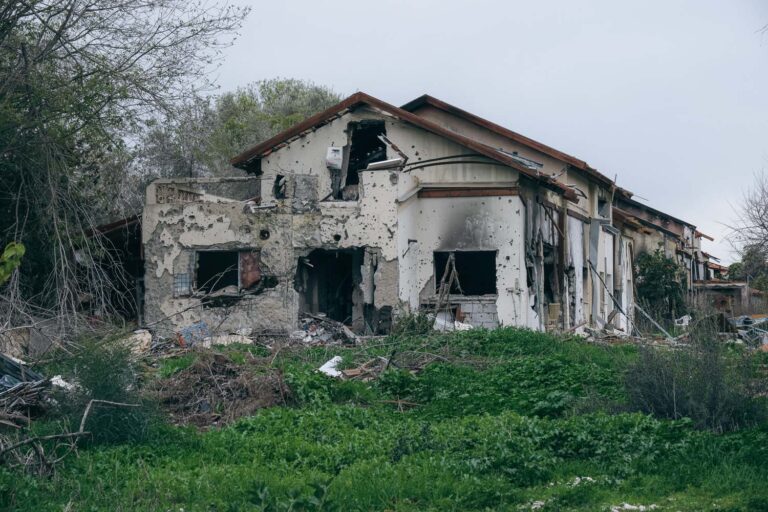
Kibbutzim near Gaza that lost hundreds of their members, and whose homes and fields became the sites of hundreds of soldiers’ deaths, must now decide how those losses will be remembered for decades to come. As they work through that painful process, they are turning to the only kibbutz in the area to have established a communal tradition of remembrance and institutions dedicated to preserving it.
“Choosing Between Different Paths Opens Up the Possibility of Healing”
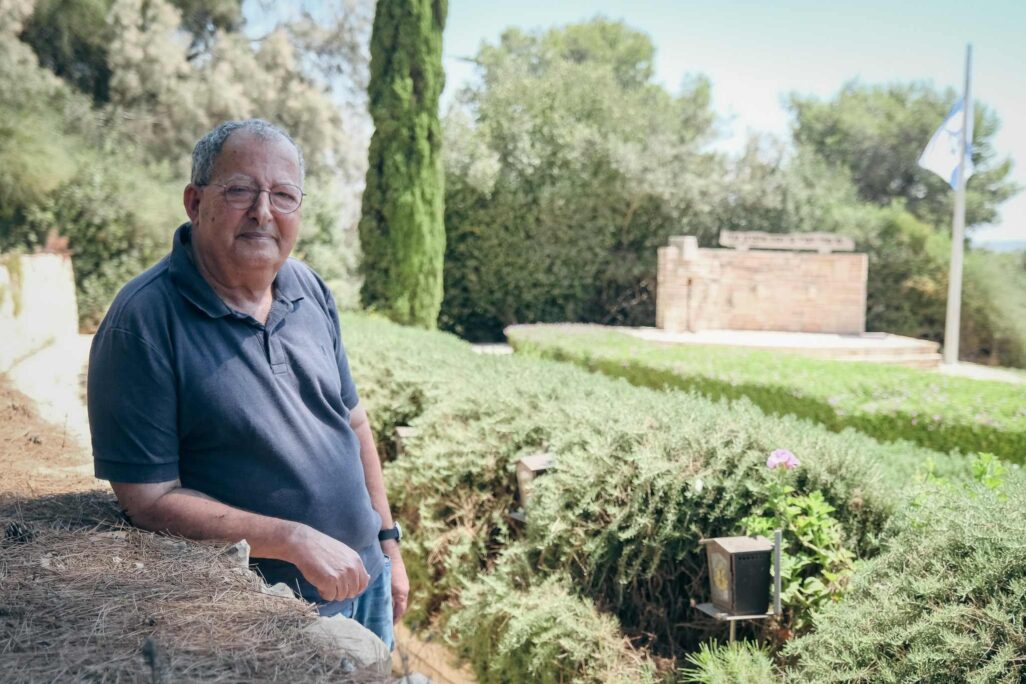
“Preserving memory and telling its story are central to rebuilding, commemoration and healing. That holds true for individuals and communities alike,” says Alon Dagan, 71, a lifelong member of the kibbutz and a clinical social worker by training, whose work addresses his community’s remembrance and bereavement, past and present.
Dagan has become a source of guidance for neighboring communities as they seek, in the aftermath of the catastrophe, forms of commemoration and remembrance that feel right for them.
What do you tell the kibbutzim you meet with about how to commemorate the catastrophe?
“I don’t give answers to the kibbutzim that come to me today. Wrestling with the question of how to remember is a central part of processing grief and trauma. Every kibbutz and every community will have to weigh the possibilities, choose among them and decide how to put that choice into practice. Choosing between different paths opens up the possibility of healing.
“That is what makes the situation in Kfar Aza so difficult. The state bypassed those dilemmas and that process, and tried to impose an answer,” he says, referring to the state’s attempt to influence the decision to demolish the kibbutz’s Young Generation neighborhood and relocate part of it to a memorial site outside the kibbutz.
“Above all, the communities that suffered need to be heard — not just in therapy, but by the nation and the military as well. Bereaved families don’t need to be told what to do; they need to be listened to. In a community like Be’eri, where more than a hundred people were killed, you cannot tell every person’s story at every ceremony. But you can work with the families to decide what feels right.”
“In 1948, We Were Not Caught Off Guard as We Were on October 7”
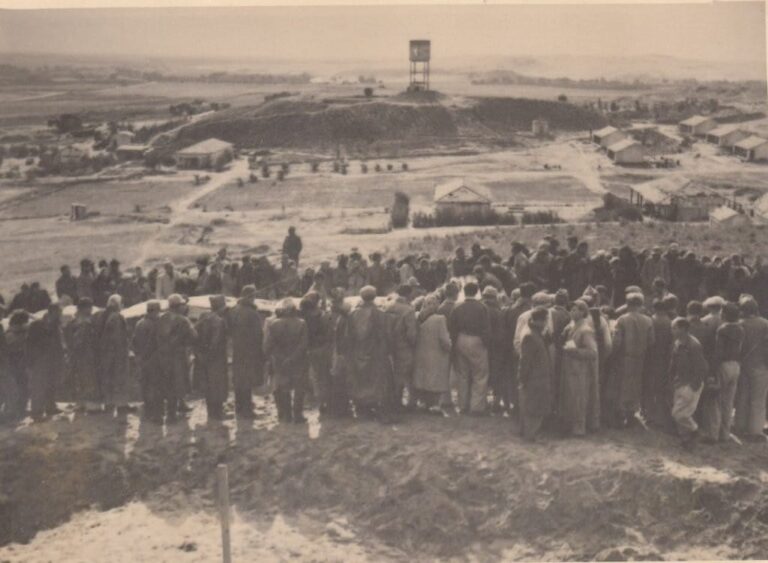
Over six days of fighting in late May 1948, Kibbutz Yad Mordechai lost 26 members, along with Palmach fighters who helped defend it against the Egyptian army. More than 30 people were wounded, and the defenders eventually decided to retreat. When the evacuated community returned that December, it included 18 children who had lost a parent and 11 widows. Three people remained missing.
“The return was marked by profound, painful grief and bereavement,” Dagan says. “But the trauma was not like that of October 7. The reason is that in 1948, we were not caught off guard as we were in 2023. The founders had a clear-eyed understanding of what lay ahead. The conflict with the Arabs was intensifying by the day, and they had been preparing for that attack ever since they established the kibbutz in 1943.”
As a therapist specializing in post-traumatic stress, Dagan brings a psychological perspective to the complex processes his community has undergone across three generations. He was in Yad Mordechai on October 7. His son, who was in Nahal Oz, narrowly escaped being abducted. The kibbutz was spared an incursion by terrorists, and its residents were evacuated to Hadera for six months. Many members, he says, continue to struggle with survivor’s guilt.
“Trauma erases words, tears at the soul and leaves those who experience it trapped in a fearful, constricted mode of survival,” he says. “Telling the story of what happened, again and again, gives meaning to a loss that can leave people paralyzed, and gives them new words to describe the traumatic experience. And when there is an audience willing to listen, it eases the loneliness so characteristic of these situations.”
Nearly 80 Years of Remembrance: “They Gave Meaning to a Terrible Loss”
Almost from the outset, Yad Mordechai chose to tell its story of suffering and courage. Its members returned to live on the hills where they had fought, and new homes rose in place of those destroyed. The fallen were buried in the heart of the kibbutz, beside the kindergartens — so that, as one longtime member put it, “they could hear the children’s laughter and remain among us.”
In 1951, a statue of Mordechai Anielewicz — the Warsaw Ghetto Uprising leader and Hashomer Hatzair member for whom the kibbutz was named — was installed on Water Tower Hill. The sculptor, Nathan Rapoport, whose reputation was already international, met with kibbutz members and involved them in the creative process. The Jewish American writer Margaret Larkin came to the kibbutz, interviewed its members and gathered their accounts in her book The Sun Stood Still.
In 1968, the From Holocaust to Revival Museum and a reconstruction of the battlefield opened. Together, they weave a narrative of destruction, bereavement and renewal. The annual ceremonies held there draw tens of thousands of people.
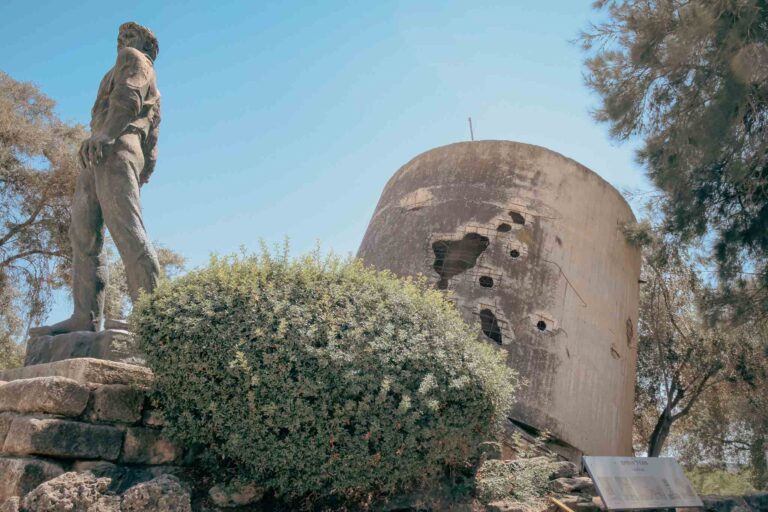
Dagan explains that Rapoport and Larkin, whether they realized it or not, did more than commemorate the dead. “They played a therapeutic role,” he says. “They encouraged people to speak. They gave meaning to the kibbutz’s collective sacrifice, which made us a national symbol of holding on to the land — a story that drew large audiences to our heritage sites. They gave meaning to a terrible loss through a story of profound sorrow and sacrifice, but also of courage and the choice to embrace life. Above all, they gave meaning to the contribution of one small kibbutz in the south to the Zionist ethos as a whole.”
For roughly 50 years, until the death of the last widow, the kibbutz’s distinctive tradition of remembrance included a ceremony at the communal grave every May 23, the final day of the battle, separate from Israel’s national Memorial Day.
“The entire kibbutz would climb the hill,” Dagan recalls. “As a child, I was asked to fill oil lamps and place them beside the graves. When I was older, I was given all 26 names to read aloud. Each child who had lost a father stood beside his memorial torch.”
Years later, during a series of group sessions with those who had lost parents in the battle, each participant was asked to bring a meaningful object from home. Without consulting one another, they all brought a box of matches.
“One woman said she used to light three matches to make sure her father’s torch would be lit on time,” Dagan says. “That small act held the whole weight of keeping his memory alive.”
National Grief, Communal Grief, Personal Grief
Yad Mordechai became a site of collective remembrance, yet it offered little room for private grief. “Grief was understood as something national and communal. The children had no space to express the pain of losing their own fathers, and the widows had no space to talk about losing their partners,” he explains. “Psychologists from the kibbutz movement came here in 1948 and instructed the teachers, mothers and caregivers not to talk to the children about those who had died. Why? Because it was too painful.”
Looking back, Dagan recognizes those failings while showing understanding for the decisions of those who came before him.
“It was a mistake, but one we can understand today in the context of the time. My mother, who lost members of her group in the War of Independence, received a similar message: ‘You must not cry. You must not show emotion.’”
Today, he says, attitudes have changed. “Men can now cry in daylight, not only at night. Working through grief demands words, music, writing, the body and emotion.”
Can addressing trauma prevent post-traumatic stress?
“Trauma cannot be prevented, but it can be treated, and its effects eased. There are many varied and accessible tools available today. Preserving memory, commemorating and documenting help both with treating trauma and with working through grief, which is far more complex. If you go on living, you risk forgetting; if you remember every moment, you may struggle to rejoin the flow of life.
“After any traumatic event involving loss, individuals and communities face questions about how to go on living in the shadow of that pain. Widows in the kibbutz asked themselves whether they had the right to remarry. In 1948, they initially decided against it; later, some chose differently. The widows of Kfar Aza’s local defense team face the same dilemma today.
“Loss always brings survivor’s guilt with it — questions such as, ‘Am I allowed to go on living?’ This is not unique to Yad Mordechai. These are universal human responses that occur everywhere.”
How does the memory of 1948 carry forward into the present?
“There are families here in which the grandfather was killed in 1948, the son was killed in the Yom Kippur War, and the grandson was severely wounded on October 7 or in the war that followed. The Masada dilemma — whether to sacrifice yourself heroically, be taken captive or bring about your own death — arose both at Yad Mordechai and in the kibbutzim near Gaza on October 7.”
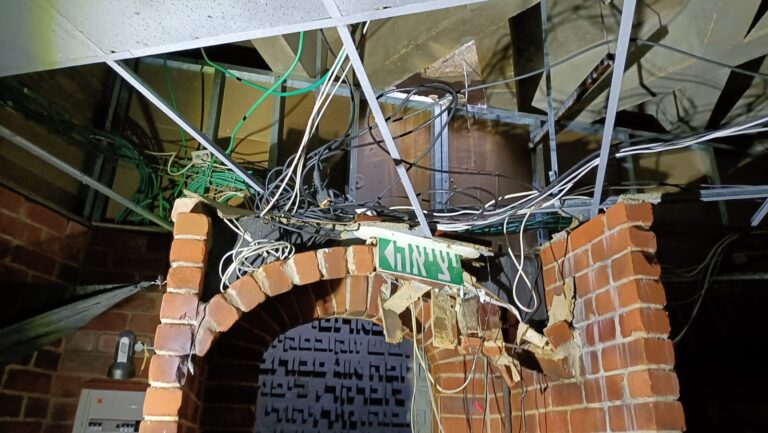
The war, he says, has also damaged the preservation and commemoration of the past. “During the war, a missile struck the From Holocaust to Revival Museum, ruptured a water pipe and destroyed all the displays,” Dagan says. “Missiles and trauma harm not only people, but the preservation of memory itself.”
“Trauma Exposes the Truth and Forces a Choice”
The story of neighboring Kibbutz Nitzanim illustrates how different approaches to remembrance can shape communities for generations. The partisan and Hashomer Hatzair leader Abba Kovner wrote a harsh letter to Nitzanim’s members after they decided to surrender when the kibbutz was overrun, suggesting they should have fought to the last bullet.
“For years, they bore an unjustified stigma of cowardice and betrayal that hurt them deeply, even though they, too, had fought a fierce battle marked by acts of courage, much like the battle at Yad Mordechai,” Dagan says. “They surrendered; we retreated. Both communities faced a military ordeal that ended in defeat, with acts of heroism by a small number of defenders facing a larger, stronger force.
“Eventually, after 75 years, Yad Mordechai’s missing were found buried in Nitzanim’s cemetery, allowing the stories of the two kibbutzim to come full circle through a shared fate. All that remains is to choose which story to tell.
“Trauma has one advantage: at its core, it searches for the truth. It exposes the truth. It forces a choice: confront it and do something with it, or surrender to fear, allowing the trauma to become chronic. Rebuild yourself and your kibbutz, or leave.”
Kfar Aza: “What Matters Is Recognizing Their Right to Decide”
In the third year since the massacre, the question of how to shape its remembrance continues to preoccupy communities near Gaza, bereaved families and the nation as a whole. Memorials at roadside shelters along Route 232, the memorial site for those murdered at the Nova music festival and the vehicle memorial at Tkuma emerged immediately after the catastrophe. They gave direct expression to grief and trauma at the places where events unfolded.
The creation of a national memorial to October 7, along with the composition and powers of a remembrance authority, featured in debates over the Remembrance Law passed this past July. These issues remain contested, and reaching agreement on their final form appears likely to take time.
One dispute that has now been resolved — and has become emblematic of the broader debate — concerns the future of Kfar Aza’s Young Generation neighborhood. The kibbutz voted by a decisive majority to demolish the neighborhood and relocate several houses outside its boundaries. Even after the vote, the state continued trying to reverse the decision, recognizing that it would shape how the catastrophe is commemorated.

“When the Kfar Aza community petitioned the High Court of Justice, the state was finally forced to accept its position. In my view, the kibbutz emerged stronger from the process,” Dagan says.
Despite the bitterness left by the state’s opposition, he believes the kibbutz’s communal, democratic decision-making fostered resilience and healing by restoring the community’s control over how its losses would be remembered.
“The court told them: this is the only right outcome because it was your choice. What matters is recognizing their right to decide. When a community debates whether to leave the ruined homes in the heart of the kibbutz or place the memorial elsewhere, the outcome matters less than the process itself.”
A School for Leadership in Emergencies: “Hope Where Leadership Was Absent”
Dagan points to another initiative in Kfar Aza: a school for leadership in emergencies being established by kibbutz member Mira Shoshani in memory of her daughter, Ofir Shoshani, an Israeli military commander murdered in the Young Generation neighborhood.
“Building the school where the trauma occurred draws on the leadership qualities of both mother and daughter. It commemorates a hope of repair at the site of the massacre, where the state’s leadership was absent that day and afterward,” Dagan explains. “The statue of Mordechai Anielewicz served a similar purpose for Yad Mordechai’s founding generation. It offered a way to honor his courage amid their profound bereavement.”
Dagan says it takes courage to confront pain in the place where it occurred and across the years that follow — and to recognize that the work of coming to terms with it is long, ongoing and never finished. He offers two contrasting examples of how remembrance unfolds over time.
“Look at the Nova memorial, which emerged immediately at the site of the massacre and gave immediate expression to the killings. At Yad Mordechai, it took no fewer than 20 years of communal dialogue to shape the memorial and remembrance sites. That work continues today. One example is the establishment, three years after October 7, of a home for lone soldiers in memory of Arnon Zamora, who saved the kibbutz.”
Zamora, a team commander in Israel’s Yamam police counterterrorism unit, fought terrorists at the Yad Mordechai junction on October 7. He was killed in June 2024 during Operation Arnon, the mission to rescue hostages from the Nuseirat refugee camp.
“Living Alongside Painful Memories Is an Ongoing Task”
Dagan emphasizes that choosing among different forms of commemoration can empower a community grappling with trauma.
“Every kibbutz and every community needs to choose its own path and work through that process internally, with advisers suited to its needs,” he explains. “That takes time: time to give expression to emotions, to the place and its landscape, to the story people want to tell, and to the memories of individuals and communities. Commemoration and remembrance encompass more than monuments and ceremonies. Memory should also find expression in songs, books, performances and commemorative projects — in whatever forms the human spirit can create.”
“The catastrophe of October 2023 was more devastating than that of 1948, and it poses an enormous challenge for those who choose to return to the Gaza border communities and rebuild what was destroyed,” Dagan says. “Living alongside those painful memories is an ongoing task, one that gives meaning to the traumatic experience and will probably last forever.
“Trauma, loss and bereavement remain present in all our lives, but always alongside life itself. Life continues, renews itself and ultimately prevails. The Yad Mordechai community shows that this is possible, as do the communities near Gaza that are beginning to return home, rebuild and commemorate October 7, so they can go on living alongside its memory.”