
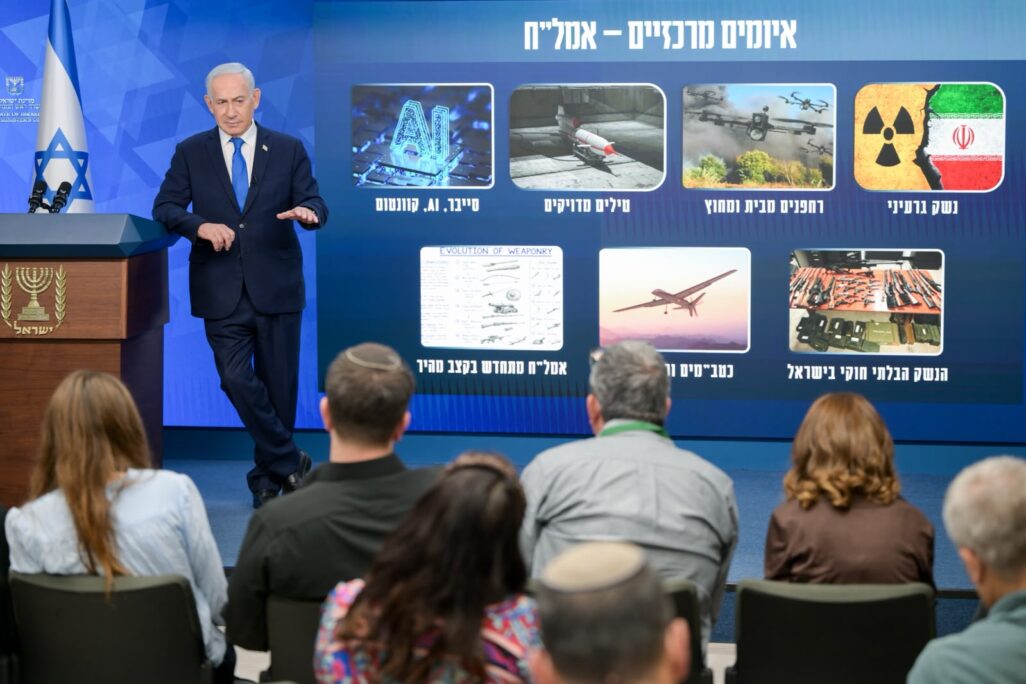
One of Prime Minister Benjamin Netanyahu’s favorite roles is that of the explainer: standing on a stage with a presentation behind him. In this campaign, too, the monitor was among the tools at his disposal, and on Sunday he put it to use on one of the most critical issues: Israel’s security doctrine.
On the face of it, the statement to the press appeared to be an impressive performance by the prime minister, revealing a coherent, forceful and clear worldview. But a closer look beyond the presentation reveals a different picture.
The strategic “prompt”? The concept of a security doctrine is difficult to define, but in the spirit of the times, it can be described as the “prompt” — the most fundamental instruction from which all of Israel’s security and strategic conduct should be derived. Such a document should contain the most basic elements of reality, such as the main risks and opportunities, and the appropriate ways of addressing them. It is difficult to say that the two-page document presented by Netanyahu, whose primary purpose is campaigning, met these standards.
An Admission of Guilt: The question of Netanyahu’s evasion of responsibility for the October 7 massacre has remained unresolved since that day, as he has refused to investigate the events or admit his own direct or contributory culpability. That is, until yesterday, in effect. At the beginning of his remarks, Netanyahu described the importance of presenting a security doctrine to guide the security forces, and said:
“More or less 10 years ago, I formulated a security doctrine and presented it to the heads of the organizations. It has changed since then; things have been added, things happened during the War of Revival (Iron Swords war). At its beginning, a fundamental shift in the security doctrine began, and I will present it here.”
In other words:
- 1. Recognition of the importance of a security doctrine.
- 2. An admission that the dominant security doctrine of the past decade was formulated by him and was problematic.
- 3. Recognition that the shift began in the wake of the war.
In short, Netanyahu is admitting for the first time that the security doctrine he established was problematic and changed only in the wake of the war.
In principle, this could be seen as an indirect and unintended moment of acknowledging a mistake and admitting guilt. Had this acknowledgment led to a process of soul-searching and a reassessment of course, one could have chosen to look at the glass as half full. But the document Netanyahu presented at the start of the week tells a different story.
Beyond the embellishments, there is nothing new: Despite the introduction, which speaks of refreshing the basic principles and also mentions “prevention,” this concept is absent from the principles themselves. So too are “preemption,” “disruption,” or any other concept that might indicate a new direction. Instead of developing a new regional outlook, taking continuous action beyond Israel’s borders, or reestablishing Israel’s position in the Middle East, the document offers the airy principle of “initiative, ingenuity and a critical approach” — a formulation that is always appropriate and never binding. All in all, beyond the embellishments, what emerges is something quite similar to Israel’s classic security doctrine: a qualitative edge, early warning, deterrence and defense.
It is possible to identify what appear to be expressions of a suspicious outlook in the document, and particularly in the way the prime minister spoke, suggesting a more “clear-eyed” and realistic approach. But this is merely a cosmetic change as long as it is not grounded in a new strategic vision. In the long term, suspicion is not a plan of action. It fades, becomes confused, and can also lead to mistakes. Encouraging critical thinking and initiative is always welcome; no one wants to encourage conformity and passivity. Nevertheless, deeper ideas must be presented to ensure change.
October 7 is not a threat: The list of threats includes drones, illegal weapons in Israel, and even quantum computing (mentioned without context). What is missing is the possibility of a ground invasion of Israel by a terrorist army — Hamas, Hezbollah, or any militia that might yet emerge near Israel’s long borders. In other words, October 7.
The disappearance of the threat of an incursion could perhaps be attributed to the temporary success in neutralizing the threat from Hamas and Hezbollah, but this mainly demonstrates the document’s short-sightedness. It is inconceivable that a ground incursion into Israel should be removed from the reference scenario for threats to Israel. With all due respect to quantum computing.
The reform that never happened: One could downplay the document’s significance and say that Netanyahu simply wanted to run an election campaign. But that is precisely the problem – the profound blurring of the line between campaigning and reform, between the fate of the prime minister and the fate of the country. One can give Netanyahu higher or lower marks for his performance over the past three years, but the truth must be acknowledged; meaningful systemic learning is impossible until this Gordian knot is untied. There can be no genuine review conducted in the service of such a personal political interest. Changes in behavior, yes, but not profound change.
The extensive focus on October 7 may create the illusion that lessons have been learned. Offense instead of defense, vigilance instead of complacency, investment instead of depletion, initiative instead of passivity. But this is only an illusion, one that will fade with time. A genuine overhaul of the system requires a different kind of breathing room, one that cannot be achieved in such a poisoned political atmosphere.