
I don't apologise for seeing the world through the eyes of a Jewish Israeli. So, watching what is unfolding in France right now, I find myself asking how much of it, if any, is connected to Jews and Israel.
"Not at all", you might say. "Anton, it's a bit of a stretch."
And perhaps it is. The unrest in France has its own causes, rooted in social and economic grievances that deserve to be understood on their own terms. I'm not suggesting that Jews or Israel are at the centre of what is happening there. But watching events unfold has led me back to questions that have troubled me for years: about antisemitism, the radical left, political Islam, and what happens when political movements abandon the principles they claim to defend.
I recently came across the term islamo-gauchisme – literally, Islamo-leftism. I'm nearly 25 years late to the party, although the phenomenon it describes is one I'm all too familiar with.
The term was developed by French sociologist Pierre-André Taguieff in the early 2000s to describe the convergence, and sometimes outright alliance, between sections of the radical left and Islamist movements, particularly around anti-Zionism and the Palestinian cause. Dave Rich explored much the same phenomenon in his book The Left's Jewish Problem, including a chapter entitled "The New Alliance: Islamists and the Left".
Islamo-gauchisme is contested, particularly in France, where it has sometimes been used to discredit Muslim political participation, anti-racist activism and legitimate criticism of Israel. Muslims participating in politics are not necessarily Islamists, and supporting Palestinian rights does not make someone an ally of radical Islamism. Nor am I suggesting there is one coherent Islamo-leftist movement. I'm interested in particular alliances: why they form, what holds them together, and what they mean for Jews and society more broadly.
The ideological contradiction is striking. People who identify as progressive, secular, feminist and pro-LGBTQ rights sometimes make common cause with movements that oppose these values. Some Islamist movements seek to subordinate women, criminalise homosexuality and impose religious law, leaving secular liberals with few of the freedoms they defend at home.
Of course, Islamist movements are not all alike. Some participate in electoral politics, while others are authoritarian or explicitly violent. Nor does cooperation over a particular issue necessarily mean agreement about everything else. Political movements have always formed tactical alliances with people whose wider beliefs they reject.
What concerns me is that Israel, Zionism and sometimes Jews themselves appear to have become a point of convergence for movements that otherwise have remarkably little in common. For some, this comes from placing opposition to Zionism within an erroneous anti-imperialist framework, or from genuine solidarity with Palestinians. For others, it may be opportunism, or hostility towards Israel that slips into hostility towards Jews. Sometimes antisemitism is not merely something these movements tolerate, but part of what brings them together.
Opposition to Israeli government policies, opposition to Zionism and antisemitism are not automatically the same thing. But neither are they always separate in practice. When Jewish communities are held responsible for Israel's actions, Jewish institutions become targets of anger about the Middle East, or old conspiracy theories reappear dressed in anti-imperialist language, the boundaries have clearly been crossed.
And parts of the left deserve particular scrutiny. It isn't simply that some are prepared to overlook antisemitism. They can actively produce, legitimise and lead hostility towards Jews. Antisemitism doesn't always arrive wearing a far-right uniform. It can come wrapped in the language of liberation and social justice, making it particularly difficult for progressives to recognise. As a Jewish socialist, I find that especially difficult to accept.
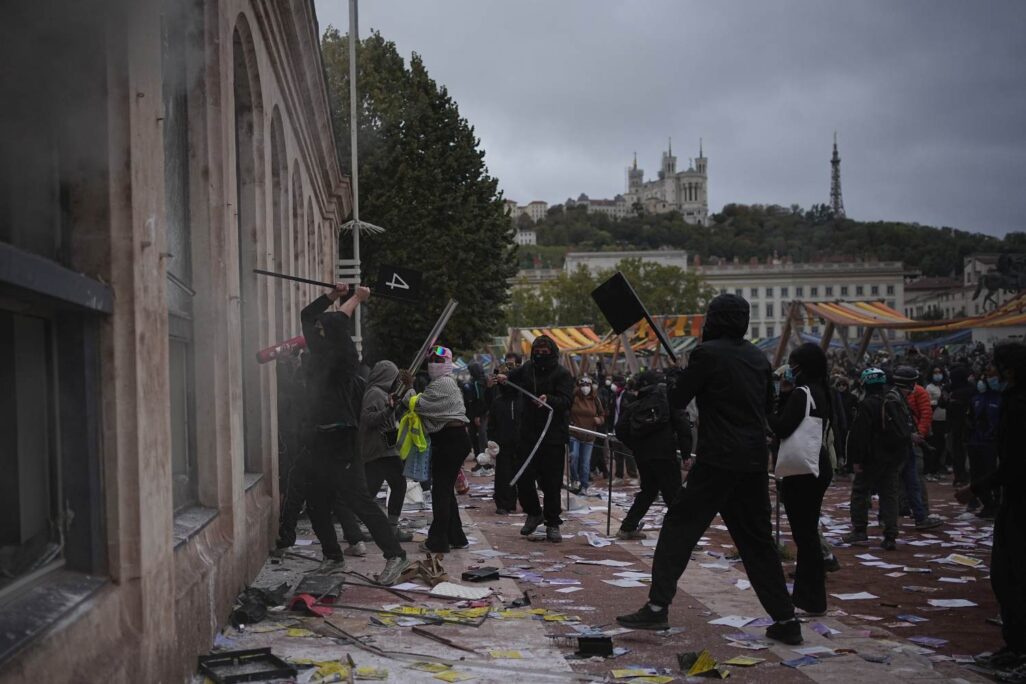
The current demonstrations in France are certainly not primarily about Israel or Palestine. They have involved anger over educational conditions, underfunded public services, living costs, wages and inequality. Large numbers of students, teachers, workers and trade unionists have demonstrated peacefully, demanding improvements to their lives. These are precisely the issues around which socialists have historically organised.
Alongside these protests, however, there has been violence, destruction and looting. The French government has blamed radical far-left groups and opportunistic criminals, although responsibility remains disputed. There have also been serious concerns about police violence and excessive force.
We shouldn't confuse peaceful demonstrators with those responsible for violence, or dismiss all anger towards the police as extremism. France has a long history of confrontational protest and policing. The right to protest must be protected, and both violent protesters and the police held accountable.
But who is responsible for the violence? Are organised political groups exploiting legitimate social struggles? And are the attitudes associated with the alliances described by Taguieff and Rich part of a wider problem facing European democracy?
To explore that question, we have to look at class.
There is a real economic struggle taking place in France. Some people feel excluded and abandoned, while others feel their traditional privileges and social standing slipping away. These aren't necessarily the same people, and their interests may differ. But deteriorating public services, insecure employment, rising costs and widening inequality are genuine problems.
From a socialist perspective, these demand collective organisation around wages, housing, education and the distribution of wealth. Yet economic insecurity doesn't automatically produce class solidarity. It can produce resentment, nationalism, religious fundamentalism, conspiracy theories and the search for someone to blame.
Antisemitism has historically been effective at turning complicated economic relationships into stories about hidden enemies. Instead of examining who owns wealth, who exercises power and how inequality is produced, people are told that Jews secretly control finance, politics, the media or society itself. Genuine anger about inequality is redirected towards an imagined Jewish conspiracy, leaving the actual structures of wealth and power largely untouched.
The left can reproduce these ideas too. When criticism of capitalism becomes a story about Jewish financial power, or criticism of imperialism becomes an accusation that Zionists secretly control governments, the language may sound radical, but the underlying ideas are disturbingly familiar.
I've seen a video circulating amid the French unrest in which a rioter apparently blames Israel for the French police response. One recording tells us little about how representative that sentiment is. But why does Israel become an explanation for an unrelated domestic confrontation?
If disaffected populations find common cause in hostility towards Jews and Israel rather than organising around shared material interests, something has gone badly wrong. Worse, parts of the left may be contributing to that shift.
The purpose of socialism, as I understand it, isn't simply to identify an enemy. It's to understand the structures producing inequality and exploitation, and organise people around their shared interests in changing them. An alliance built around hostility towards a common enemy isn't the same as solidarity built around shared principles.
This brings me to another phrase that troubles me: "Globalise the intifada."
I've generally understood it as a call to extend the struggle against Israel beyond the Middle East, with worrying implications for Jewish communities worldwide. But perhaps its implications for European societies could go further.
The phrase means different things to different people. For some, it means peaceful international solidarity with Palestinians through demonstrations, boycotts and political campaigns. Intifada means an uprising, and its meaning cannot be reduced to violence. But it also carries the history of attacks on civilians during the Second Intifada, making it understandable that many Jews hear it as threatening.
What if, for some, globalising the intifada also means spreading an approach to politics in which confrontation is celebrated, compromise is betrayal and democratic institutions are obstacles rather than instruments of change? One in which violence is justified by the righteousness of the cause, and the struggle becomes more important than the society one hopes to create?
I'm not suggesting everyone using the slogan believes this, or that it has any demonstrated connection with the violence in France. French protesters have their own grievances. But political methods and attitudes can travel between struggles. If violence becomes acceptable against one perceived enemy, does it become easier to justify against another? If democratic compromise is dismissed as weakness in one context, why should it suddenly be valued in another?
This isn't unique to the Palestinian movement or the left. Far-right nationalism and religious extremism can display the same contempt for democratic institutions. France also has its own traditions of confrontational politics, independent of the Middle East.
As a socialist, I believe in demonstrations, strikes, civil disobedience and collective struggle. Many rights were won through precisely these methods. Public order isn't an absolute good, and disrupting it can be necessary to challenge injustice. Nor does the state automatically defend democracy simply because it possesses legal authority.
But there's a difference between collective action for political change and treating democratic breakdown as desirable. Violence doesn't become progressive simply because its perpetrators claim to fight oppression.
And this brings us back to the contradictions between parts of the radical left and political Islam. What happens to feminism when sexual violence against women is excused because the perpetrators are considered anti-imperialist allies? What happens to LGBTQ rights when those responsible for persecution are fighting a supposedly more important enemy? And what happens to anti-racism when antisemitism is treated as an inconvenient complication rather than something to be confronted?
These aren't arguments against Palestinian solidarity or cooperation between different religious and political communities. Such cooperation can be principled and necessary. But it cannot require abandoning the values that brought us into politics.
I want a left that supports Palestinian freedom while unequivocally opposing antisemitism; that protects Jewish communities without demonising Muslims; that opposes Islamist authoritarianism without treating Islam itself as a threat; and that recognises abuses of power, including Israel's, regardless of who commits them. Human rights cannot depend on which side we support.
There's an idea I keep returning to: a society that fails to protect its Jews will ultimately fail to protect everyone else.
Perhaps that's too absolute. Antisemitism doesn't always precede democratic collapse, and sometimes it's a symptom rather than a cause. But protecting Jewish citizens is an important test of a society's commitment to pluralism, equal citizenship and the rule of law.
When attacks on Jews become acceptable, Jewish institutions need extraordinary protection, or Jewish citizens feel their belonging is conditional, something is going badly wrong. The normalisation of intimidation, conspiracy theories and political violence weakens protections on which everyone depends. Methods used against one minority can later be turned against others.
The far right cannot be excluded from this discussion. Antisemitism has a long history on the nationalist right, including among movements now presenting themselves as defenders of Jews against Islamism. Some demonise Muslims and immigrants, simply replacing one scapegoat with another. Others exploit disorder to portray entire communities as dangerous and demand restrictions on democratic freedoms. None offers a serious answer to France's social and economic grievances.
I'm not claiming antisemitism caused the unrest, that Islamist movements are organising the violence, or that calls to globalise the intifada explain why French streets are burning. The grievances are real, and many demonstrators are doing exactly what socialists have always advocated: organising collectively to improve their lives.
But I worry about the political movements competing to shape that anger. Are they offering serious programmes for change, or simply another enemy to hate? Can they build solidarity across communities? And will they condemn violence even when its perpetrators claim to be on their side?
For me, these questions lead back to the argument that first troubled me: what starts with the Jews never ends with the Jews.
Not every threat to democracy begins with antisemitism. The treatment of Muslims, immigrants, refugees and other minorities is equally revealing. But antisemitism has a particular history of bringing otherwise incompatible political forces together through conspiracy theories, resentment and a common enemy. The danger is that the attitudes and methods normalised through such hostility persist even when the target changes.
I'm a Jewish Israeli socialist. I want to live in a world in which Palestinians are free, Jews are safe, Muslims are not demonised and workers can organise for their rights. I want a left that recognises antisemitism within its own ranks, and a democratic society strong enough to accommodate radical dissent without surrendering to political violence or authoritarian responses.
If antisemitism, ideological opportunism and the willingness to excuse violence are weakening the democratic principles on which everyone depends, then this isn't just a Jewish problem. It's a problem for French democracy, for the left, and for anyone who believes in a pluralistic, secular and genuinely egalitarian society.