
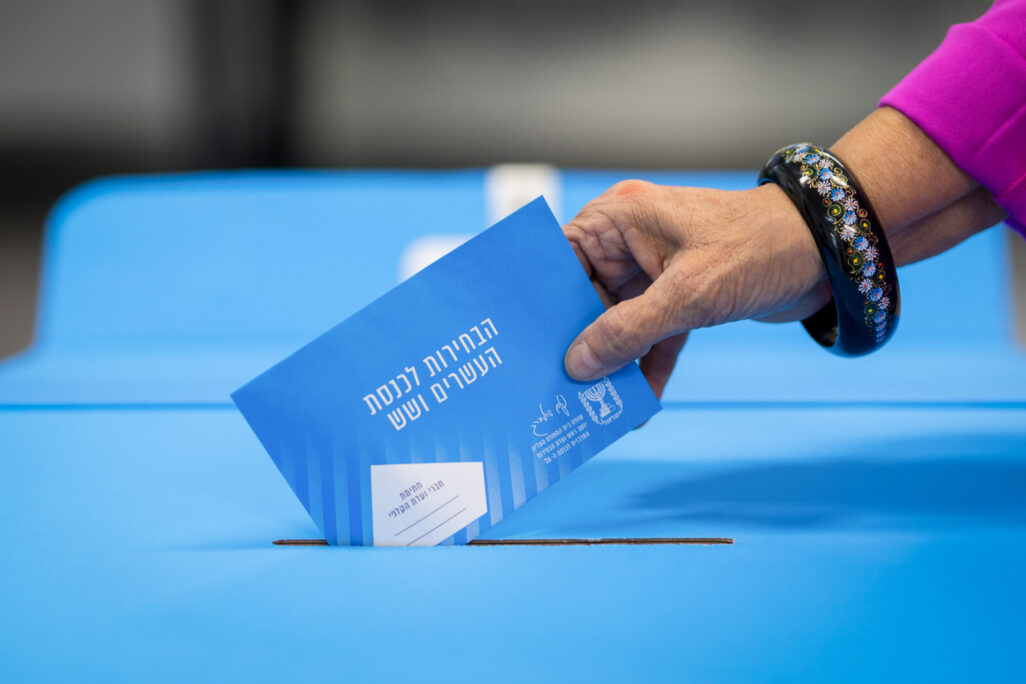
7,331,981 eligible voters will be able to vote in the upcoming election, an increase of 543,177 people, who will vote at 12,018 regular polling stations, alongside hundreds of special polling stations in the military, hospitals and other locations. In the previous election, 4,794,593 people actually voted, representing a turnout of 70.63%.
The electoral threshold (3.25%) stood at 154,855 votes, and the general quota (i.e. one Knesset seat) was approximately 36,000 votes. A total of 417,400 votes, around 8.76% of valid votes, were cast for lists that failed to cross the threshold. In the previous election, 29,851 votes were disqualified, around 0.62% of all votes cast.
In the previous election, around 460,000 votes (approximately 9.8% of all votes) were cast in double envelopes, which were placed in ballot boxes at accessible polling stations, Israeli diplomatic missions around the world, IDF bases, prisons and other locations. This year, with a significant increase in the number of eligible voters and, apparently, in the number of people who will actually vote, as well as tens of thousands of regular-service soldiers and reservists voting at military polling stations, the number of double envelopes is expected to increase significantly. This means that the difference between the initial results, which will come in on Tuesday night, and the results after the double envelopes have been counted may be greater than in the past. In the previous election, in 2022, around 710 polling stations operated in the IDF, but now, due to fighting on several fronts and the high number of reservists serving, more than 800 polling stations will be opened.
How Many Votes Are Needed to Cross the Electoral Threshold?
The electoral threshold is 3.25% of all valid votes, and the number of votes required varies in each election depending on voter turnout. In the last election, the threshold stood at approximately 154,854 votes, but the figure is expected to rise this time due to the increase in the number of eligible voters and expectations of higher turnout than in the previous election. However, even if turnout falls to 70%, the electoral threshold will stand at 165,800 votes.
Even if turnout reaches 72% (compared with 70.63% in the previous election) and invalid votes account for 0.6%, in line with the average of the last two elections, the electoral threshold is expected to stand at approximately 170,500 votes. At 75% turnout, it will stand at approximately 177,600 votes, and in a scenario of 80% turnout, it will reach approximately 189,400 votes.
How Many Votes Are Worth One Seat, and How Is It Calculated?
The Bader–Ofer Law is the name given to the amendment that established the method for distributing the seats remaining after the initial allocation. The arrangement is now set out in Sections 81–82 of the Knesset Elections Law. Only parties that cross the electoral threshold, meaning they receive at least 3.25% of the valid votes, take part in the allocation of seats. Votes cast for lists that fail to cross the threshold go to waste.
This is where the calculation of the “general quota” for seats begins: the votes received by all lists that crossed the electoral threshold are added together and divided by 120. The result, excluding the digits after the decimal point, is the “general quota”. For example, if these lists receive a combined total of 4.8 million votes, the quota is 40,000. A list that receives 430,000 votes will be allocated 10 seats in the initial distribution.
Since only whole seats are allocated at this stage, there are usually several seats left to distribute. To determine which list receives the next seat, the average number of votes each list would have per seat if it received that additional seat is calculated. This is known as the “list quota”. For example, for a list that received 430,000 votes (10 seats), the list quota is calculated by dividing the number of votes by 11, giving approximately 39,091. By contrast, for a list that received 650,000 votes (16 seats), the list quota would be approximately 38,235. The list with the highest average among all the lists wins the seat.
Lists that have surplus-vote agreements increase the chances of one of them winning a seat, because their combined average in this calculation is higher. For example, two parties that each received 430,000 votes would together have 860,000 votes and 20 seats. Adding one seat for the purposes of the calculation gives them an average of 40,952 votes per seat, increasing their chances of receiving an additional seat for one of them — the party with the higher list quota.
After a list or pair of lists receives an additional seat, the average number of votes per seat is recalculated to determine what it would be if it received yet another seat. The average for the list that has just received a seat decreases, while the calculations for the remaining lists stay unchanged. The lists are compared again, and the next seat is awarded to the one with the highest average, until all 120 seats have been allocated.
How Are Surplus-Vote Agreements Calculated?
Surplus-vote agreements are valid only if both lists that signed an agreement with each other cross the electoral threshold. In the current election campaign, among those that may cross the electoral threshold, the agreements are between Likud and Religious Zionism and Zehut; Yashar! and the Democrats; Shas and United Torah Judaism; Together and Yisrael Beiteinu; and Ra’am and the Joint List. Otzma Yehudit, Amcha Israel, the Reservists’ Party and the Economic Party have not signed surplus-vote agreements, which may reduce their chances of gaining additional seats.
Surplus-vote agreements are calculated using the list quota of each of the two lists that signed an agreement, but only if they jointly win an additional seat because their combined list quota is higher.
Timeline
After the polling stations close at 10 p.m., the counting of votes will begin. Members of each polling station committee will record, one by one, the number of votes received by each party, conduct a recount and thread the ballot papers onto designated skewers to ensure that no ballot is counted twice as a valid vote. All of this will take place under the supervision of election integrity observers.
Once counting at local polling stations is complete, each ballot box will be sealed and packed in special packaging, then transported by several representatives to the regional elections committee. There, the ballot box will undergo a verification process to confirm its authenticity and check that the recorded data matches the figures from the ballot box. It will then be sealed again and transferred to the Central Elections Committee’s logistics centre in Modi’in. Every vote that passes verification will be entered into the system and published, with the official results expected to begin appearing around midnight.
During the first hours of the night, all regular ballot envelopes are expected to be counted. Once counting is complete, partial official results will be published, excluding the double envelopes. Counting of the double envelopes will begin on Wednesday at the Knesset and is expected to be completed by Thursday morning, when the final results will be published. As in every election, the Arab parties may be disappointed by the results after the double envelopes are counted, as they traditionally receive a lower percentage of votes in double envelopes than in regular envelopes.
On 4 November, one week after the election, the final results will be published. The period for submitting appeals against the election results will then open, with a hearing scheduled for 18 November at the Jerusalem Administrative Affairs Court.