
The outgoing government changed its approach to three key issues affecting Arab citizens in Israel: economic development, the fight against crime and violence, and policy towards Bedouin society in the Negev. Alongside these changes, the government advanced legislation that affected the status of Arab citizens and relations between Jewish and Arab citizens.
The government began its term while the five-year plan for Arab society was already underway. However, May Golan’s appointment as Minister for Social Equality was accompanied by a significant slowdown in the implementation of Government Resolution 550, the multi-year economic development plan for reducing gaps between Arab citizens and Jewish citizens. The failure to convene the standing committee responsible for approving budgets, together with the decision not to appoint a replacement for Hassan Tuafer, who resigned as head of the Authority for Economic Development of the Arab Sector, undermined the ability to advance the plan and the willingness to implement it.
This was compounded by a series of cuts to the program’s budget and transfers of funds to other purposes, promoted by Golan. As part of the fiscal restraint measures during the war, the government also decided on an across-the-board cut of 5% and a 15% cut to the budgets allocated under government resolutions. Following these cuts, 23.302 billion shekels remained in the program, out of an original budget of 30 billion shekel.
During the government’s term, there was a sharp decline in the annual allocation rate for the budgets under Resolution 550: from 92% under the Bennett–Lapid government to 70.6% in 2022 and 26.1% in 2025.

One of the justifications for the cuts promoted by Minister Golan, in cooperation with National Security Minister Itamar Ben-Gvir, was the need to strengthen the fight against organized crime and violence. Government Resolution 549, intended to tackle crime and violence in Arab society, was approved alongside Resolution 550 and allocated a budget of 1.5 billion shekels over five years.
According to data from the Ministry of National Security, by the end of 2025, only around 748 million shekels had been spent, out of approximately 825.7 million shakes earmarked for implementation, representing around 55% of the total budget. Implementation at the Ministry of National Security was also accompanied by personnel changes and shifts in policy. When Ben-Gvir took office, Yoav Segalovitz was removed from his position as head of the task force combating crime in Arab society, and attorney Ro’i Kahlon was appointed to the role only eight months later.
A Dramatic Surge in the Number of Homicide Victims in Arab Society
In March 2023, the “Stopping the Bleeding” program, which set out a comprehensive approach to tackling crime and violence in seven localities, was frozen. Its suspension marked a shift away from an approach that viewed crime as a problem requiring a multi-system response, including social welfare and education services, towards an approach focused on enforcement through dedicated units and police task forces.
That year, the number of homicide victims in Arab society surged to 245, compared with 116 the previous year. In 2024, 230 people were murdered, and in 2025 the figure rose again, reaching a record 252 victims. Meanwhile, there was no comparable increase in the number of murder cases solved.
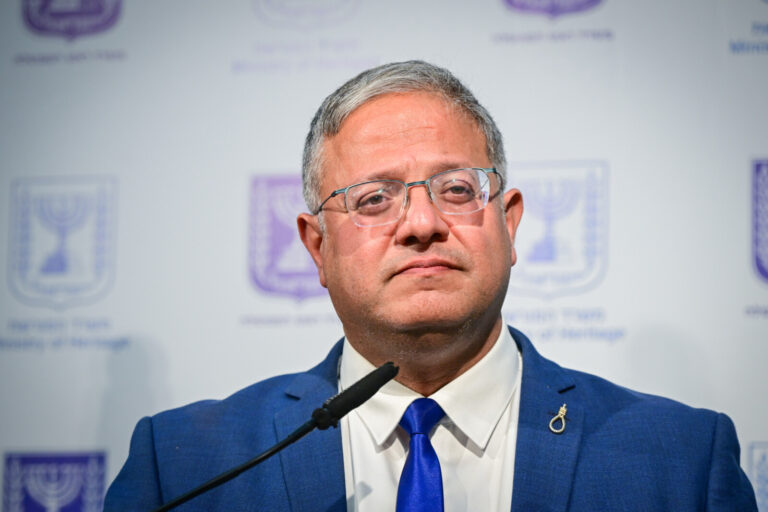
Another program frozen when Ben-Gvir took office was “Safe Track”, which focused on a multi-dimensional fight against criminal organizations. In April 2024, the program was relaunched under the minister’s leadership, this time under the name “Green Safe Track”. Ben-Gvir takes pride in the number of weapons seized and police raids on compounds belonging to criminal organisations, some of which he even joined as an observer. However, one of the key achievements he highlights is the number of illegal structures demolished during his tenure.
Between 2023 and 2025, approximately 14,280 structures were demolished in Bedouin localities in the Negev, around 5,750 of them in 2025 alone. This year, the estimated number of demolitions stands at around 5,000 structures. But the change is not merely quantitative: in recent years, there has been a growing trend towards demolishing entire residential compounds rather than individual houses and structures. During this period, around 2,500 Bedouin families lost their homes, leaving approximately 20,000 people without a roof over their heads.
At the same time, Diaspora Affairs Minister Amichai Chikli, who is responsible for the Authority for the Regulation of Bedouin Settlement in the Negev, advanced several plans to regulate Bedouin settlement: the Addressing Plan, the Blue Lines Initiative, and the Alignment Plan. The guiding principle behind these plans is to relinquish land ownership claims in exchange for plots for construction in recognized localities, while concentrating the Bedouin population in large, recognized settlements. Chikli pledged to regularize the settlement of 729 families by 2026.

Social organisazions, led by the Council of Unrecognized Villages, criticized the plans for their unilateral and coercive nature, and argued that they had also failed to deliver the expected results. Alongside the economic and enforcement policies, legislative initiatives relating to the fight against terrorism were accelerated during the “Iron Swords” war and in the aftermath of the events of 7 October.
Among other measures, bills were advanced to prevent the employment of teaching staff who had studied at institutions in the Palestinian Authority and to deny recognition to academic degrees from those institutions. Another law expanded the Director General of the Ministry of Education’s authority to dismiss teachers for expressions of support for terrorism. These measures were driven by a hostile public atmosphere towards Arab citizens of Israel, while simultaneously deepening it. Alongside the legislation, arrests were made following social media posts, on suspicion of supporting acts of terrorism.
Additional legislation targeted criminal organizations. This included defining criminal organizations in law, introducing measures to combat protection racketeering, and attempting to extend anti-terrorism powers to the fight against organized crime. These measures were also intended to make it easier for the Shin Bet to become involved in tackling criminal organizations.
Overall, two main trends shaped the government’s policy towards Arab citizens of Israel: cuts to public services and efforts to marginalize Arab citizens in public life, or at the very least, to widen the divide between Arab and Jewish society. Together, these trends defined the government’s approach over the past four years.