
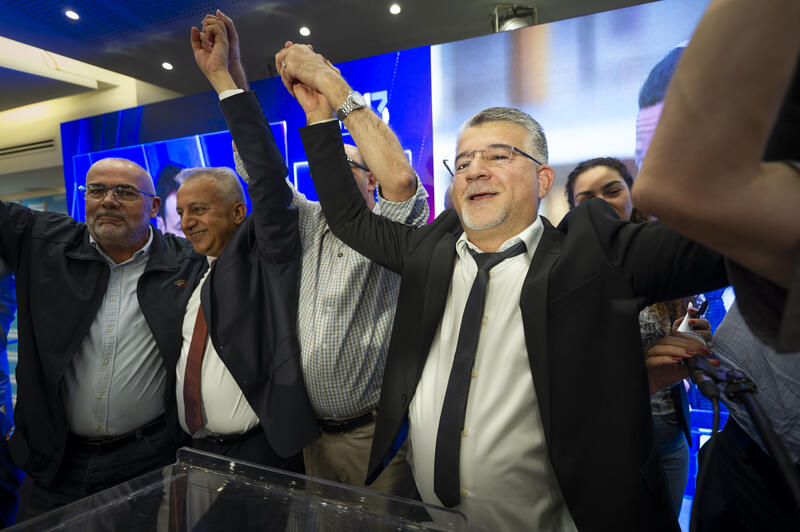
Arab citizens of Israel decided that this time would be different: the major achievement of the 26th Knesset election was the 19 seats won by the Joint List and Ra’am, thanks to an unprecedented turnout of 80.3%. By comparison, in the previous election in 2022, turnout among Arab citizens stood at just 53.9%.
“Arab citizens flocked to the polling stations, and the majority voted for the two Arab lists,” Professor Nohad Ali, a lecturer in the Department of Sociology, the Multidisciplinary Department and the Department of Criminology at the Western Galilee Academic College, told Davar. “The main reason is the right-wing parties and their attack on Arab society. Arab citizens turned out in large numbers to protest against their delegitimisation.”
The vote was “a protest against the situation of Arab citizens in every area,” added Professor Ali, who heads the field of education for the promotion of freedom, equality and fraternity at the Samuel Neaman Institute. “The Arab leadership succeeded in combining the protest against racism with its fundamental demands on issues of violence in Arab society and housing.”
The protest translated into an electoral achievement: the Joint List will likely be the third- or fourth-largest party in the next Knesset, with 11 seats, while Ra’am is likely to win eight (as of the time of publication).
According to Professor Ali, the difference between the two lies in their willingness to integrate into the political system. “‘The Joint List’ supports integration. Although it does not support joining the government, it wants to act as a safety net for a change government. In the eyes of most Arab citizens, Mansour Abbas’s approach is probably ‘too much’. Arab citizens have certain limits when it comes to integration, and most still find it difficult to cross them.”
Following the selection of candidates for the Arab lists, criticism was voiced over the absence of young people and women. Professor Ali believes that voter turnout is the key to change.
“In recent elections, turnout among young people was particularly low. In 2022, 47% of young Arab citizens voted, compared with around 74% of young Jewish citizens. The same was true of women. However, thanks to the high turnout this time, the Joint List will have two or three Arab women in the Knesset. It is not enough, but it is not bad representation. We heard the leaders of the Joint List offer full-throated apologies for the underrepresentation of women on the list, but Arab citizens were willing to forgive them on this issue. There are also young candidates on the Joint List who will enter the Knesset.”
Bedouin Voted for Ra’am, While Druze Found No Place in Jewish Parties
A significant increase in voter turnout was also recorded among Bedouin citizens in the Negev: in 2022, around 51% of eligible Bedouin voters cast their ballots. This time, turnout ranged from 60% in unrecognised villages to 82% in Rahat. Although Bedouin localities in the Negev have long been known as a stronghold of support for Ra’am, the Joint List also received votes in the region. According to Professor Ali, placing Bedouin candidates in realistic positions on the Joint List contributed to this, but “Ra’am’s advantage lies in its more traditional, more religious line. This is more in keeping with the Bedouins’ worldview.”
The Druze community also exercised its right to vote in greater numbers, with turnout reaching 61.9%, compared with just 48.4% in 2022. Nevertheless, this figure remains significantly lower than turnout among Arab citizens overall.
“Disappointment among the Druze has been deepening since the passage of the Nation-State Law,” Professor Ali says. “As they put it, ‘We are Jews when it comes to obligations, and Arabs when it comes to rights.’ In the weeks leading up to the election, there were several incidents of racism against young Druze men and women simply because they were speaking Arabic.”
Professor Ali also argues that the Druze community was disappointed with the right wing because of its exclusionary approach—not only towards Arab voters, but also towards the Arabic language. At the same time, they found no place in the centre and left-wing parties. As a result, a large proportion of Druze voters supported the Arab parties.
“Ra’am Joining Netanyahu Would Be Political Suicide”
Regarding the expected coalition negotiations, Professor Ali believes that Arab citizens will not allow the Arab parties to join Likud and Benjamin Netanyahu. “Ra’am joining Netanyahu,” he explains, “would amount to political suicide for Ra’am in Arab society, after everything this government has done to Arab citizens.”
“Arab society wants political integration, but the question is what scope there is for this partnership. We have three approaches. The first, led by Mansour Abbas, is to be not only in the coalition but in the government itself. But the Jewish parties do not want that. The second approach is to be in the coalition but not in the government. The third—and this seems to me to be the leading option in the eyes of Arab citizens—is to act as a safety net for a change government.”
Professor Ali’s proposal to the Arab parties is to conduct joint negotiations with Yashar chairman Gadi Eisenkot. “They should form something like a single technical list of 19 Knesset members and engage with Eisenkot from a position of strength on the major civic issues affecting Arab citizens: violence and crime, housing, unemployment, and the rampant terrorism perpetrated by Jews.”
Professor Ali allows himself to step away from the position of an outside observer for a moment and speak his mind: “It is a disgrace to democracy, to the state and to the public to say that Arabs are not worthy partners, not because of their ideology, but simply because they are Arabs.”