
It is difficult to find a community in Israeli society that is not frustrated by the election results. And yet, it is precisely within this shared frustration that we can find one and a half reasons for optimism.
Israeli society is more polarized and divided than ever. And yet, the latest election reveals two shared phenomena, cutting across sectors and groups, which remind us that despite differences in culture, outlook, language and religion, Israelis share a common reality.
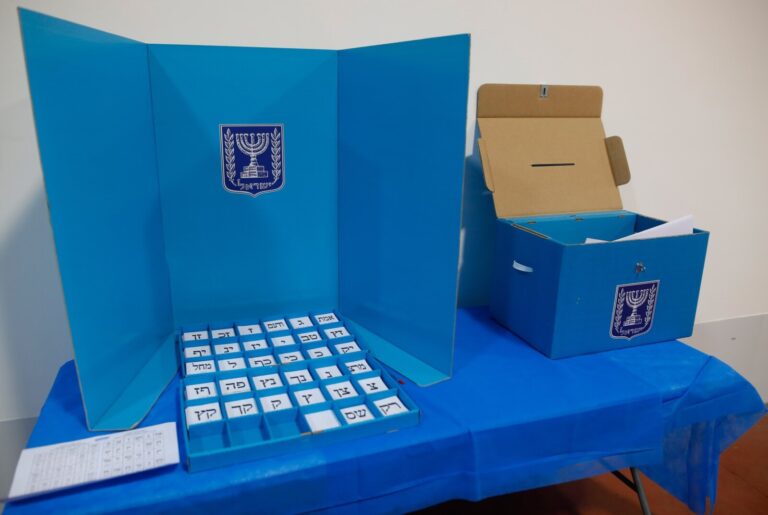
The first phenomenon is the high voter turnout, which crossed sectoral lines and reached 77.7%. The Israeli public cares! A great many citizens, from all parts of society, want to influence the country's future. And this is a reason for optimism that requires very little interpretation to appreciate.
The second phenomenon is that nobody has a majority. So many Israelis turned out to vote in an election seen as decisive, and yet the result is a political deadlock.
Every group in Israel holds rigid ideological, political and cultural positions – a kind of set of existential assumptions – which sometimes exist like parallel lines that never meet. Not with one another, and sometimes not even with reality. These elections have shown that, at least for now, none of these underlying assumptions has an unequivocal majority among the public, and that no group can fully realize its worldview and get everything it wants.
The “full-right” government did not receive the public mandate needed to continue governing in its current composition. But the coalition parties led by Netanyahu remain the largest cohesive political bloc, despite having served as the government of Israel during the greatest disaster in its history.
On the other hand, the Change Bloc is discovering that it cannot deliver the long-awaited “change”: it cannot form a government on its own, and its positions represent a group that may be the largest in Israeli society, but is still far from constituting a majority by itself.
The Haredi parties have collectively lost five seats, and public support for them is declining in the face of the deepening crisis surrounding the social contract between Haredi society and the state, particularly on the issue of military conscription. The assumption that the existing arrangements can be maintained without holding a fundamental discussion about the Haredi public’s place in the State of Israel is likely to push the Haredi parties away from power.
Arab citizens of Israel are showing, once again, that they want and need to be part of the Israeli political system. We are witnessing a positive political awakening calling for integration into Israeli society and pragmatic solutions to problems – something that is very important to encourage. At the same time, the State of Israel cannot establish a governing partnership with elements within the Arab leadership that do not recognize Israel’s right to defend itself against terrorism and work to deny its legitimacy to exist. Unfortunately, there are quite a few forces within the Arab leadership that hold these positions.
The next government in Israel must find a way to engage with moderate forces in Arab society and create a situation in which the political system offers hope for integration and belonging, while guaranteeing Israel’s security as a Jewish and democratic state. The debate framed as two sides of the same coin – “We must sit with Arabs” or “We will not sit with Arabs” – does not allow for such progress. The sweeping and racist approach from both the left and the right, which views Arab citizens solely through the lens of their origins (whether or not they are Arabs), rather than as a public organised into different parties and holding different beliefs, will continue to push us towards impossible situations.
Beneath the underlying structure of Israeli politics, as we have described it, lie deeply held worldviews: a state governed by Jewish religious law, “Peace Now!”, a state of all its citizens, a society devoted to Torah study, the separation of religion and state, population transfer and more. These are worldviews whose hold on the realities of Israeli and Middle Eastern life is tenuous, and the Israeli political deadlock demonstrates that none of them has a majority in Israeli society.
So where is the half-reason for optimism hiding?
In the Book of Genesis, after Adam and Eve eat from the Tree of Knowledge, it is written: “Then the eyes of both of them were opened.” The moment they realize they are naked is also the moment when the possibility opens up before them to make choices and confront their situation.
Perhaps we, too, are facing such a moment? A moment in which we must recognize that some of the assumptions we have insisted upon simply cannot exist in the reality as we imagined it. This does not mean abandoning our values, but rather rethinking how we can give expression to as many of our values as possible in the Israel of 2026, a country we all love so much.
It is clear to any reasonable person that if today’s political leaders were to set about writing the Declaration of Independence, no such document would be written. And that means there is no framework of agreements organising Israeli society and the State of Israel and enabling them to function.
Rabbi Tamir Granot has proposed, in this context, the idea of a “national annulment of vows”. There is a profound logic to his proposal: when it becomes clear that the price of keeping promises is prolonging Israel’s entrapment in an ongoing political crisis, the responsibility is not necessarily to uphold them at all costs, but to courageously examine how they can be released, while preserving as much as possible of the values underlying them. Such an annulment of vows could, and should, also allow for a new and different arrangement of the various groups in Israeli society within the political system, and the creation of new alliances.
Keeping promises to voters is a democratic value of enormous importance, but the continued existence and flourishing of the State of Israel are even more important.
Looking beyond the profound deadlock and the disappointment felt by all groups makes it possible to see a significant opportunity to break free from an ongoing crisis.
We appeal to Israel’s public leaders and the heads of all political parties: rise to the occasion, reconsider the rigid assumptions you have clung to, and act to bring us out of this crisis!
From the left, centre and right; Jews and Arabs; Haredim, religious and secular – do everything in your power to create the broadest, Zionist, functioning and best possible government, committed to the future and security of the State of Israel and the wellbeing of all its citizens.
We, the citizens, will find it in our hearts to forgive broken election promises. But we will not forgive leadership that failed to rise to the occasion and deepened Israel’s severe crisis at the most difficult moment in its history.
The authors are coordinators of the Noar HaOved VeHaLomed youth movement.