

Central Elections Committee chair Justice Noam Sohlberg plans to submit the official election results to President Isaac Herzog on Wednesday, November 4, as required by law. The handover comes as work continues to verify the results and investigate suspected electoral irregularities, alongside a Shin Bet inquiry into an alleged attempt by a foreign state to influence the election outcome.
Once the results are published, appeals may be filed with the Jerusalem Court for Administrative Affairs within 14 days.
Publication of the official results will also set in motion a round of consultations at the President’s Residence. Herzog must determine who can form a government—and which lawmakers and parties would support it.
November 10
The Knesset is currently in recess, and its committees will not meet without special authorization from the Knesset speaker until November 10, when the new parliament is sworn in. In the meantime, sitting lawmakers remain in office.
November 11
On Wednesday, November 11, President Herzog will task the Knesset member he considers most likely to succeed with forming a government. The nominee will then have 28 days to assemble a coalition, with a possible 14-day extension at the president’s discretion.
The party tasked with forming the government will be able to appoint one of its members to chair the Arrangements Committee, which will determine the membership of two key parliamentary committees: Finance, and Foreign Affairs and Defense. The Arrangements Committee will include representatives of all parliamentary factions in proportion to their share of Knesset seats.
In principle, the Arrangements Committee can establish special committees to handle legislation, but passing those bills would require a coalition majority.
Caretaker Government
Until a new government is sworn in, the current administration remains in office as a caretaker government, retaining its existing powers, though subject to certain limits. Under the law, it must exercise “restraint in exercising its powers in all matters where there is no particular necessity or urgency to act during the transition period.”
Knesset Speaker
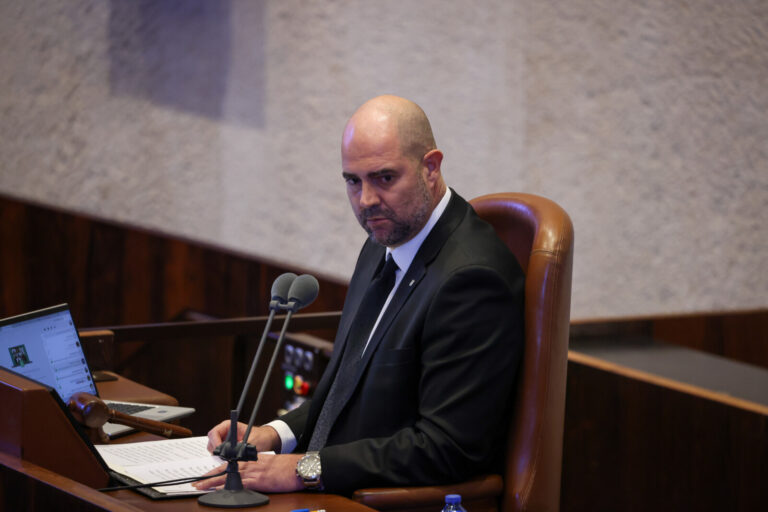
The Knesset must elect a new speaker between the swearing-in of the new parliament and that of the new government. Until then, the current speaker, Amir Ohana, remains in office. As long as no decision has been made to swear in a new government, no law requires him to step down.
This situation led to a standoff in 2020, when then-speaker Yuli Edelstein refused to convene a plenary session to elect a new speaker, despite a request from 61 lawmakers to replace him. His refusal prompted a petition to the High Court of Justice, which ruled that “under the circumstances”—three consecutive elections and the coronavirus pandemic—the vote must go ahead as requested by a majority of Knesset members. Edelstein refused to comply with the ruling and announced his resignation. The court then authorized Amir Peretz, the longest-serving Knesset member at the time, to convene the plenary to elect a new speaker before Edelstein’s resignation took effect.
Under the current circumstances, the party that forms the government will not be the same party that nominates the next Knesset speaker. This reflects the political pressure on prospective coalition partners to secure gains for their parties—even if they ultimately fail to form a government.
Several lawmakers have been discussed as potential candidates within the “change bloc.” The leading name is Oded Forer of Yisrael Beiteinu, alongside Yair Lapid of Beyachad–Yesh Atid and Yaakov Asher of United Torah Judaism. Asher has already denied any suggestion that he is involved in coalition talks.

The Knesset speaker wields considerable influence, setting the rules for plenary debates and exercising authority over the work of parliamentary committees.

However, contrary to reports before the election, passing legislation to establish a state commission of inquiry, or the so-called “Defendant Law,” which would bar anyone facing criminal charges from forming a government, is not realistic. Until a new government is formed, the Knesset’s temporary committees lack the authority to advance these bills. Even attempts to establish ad hoc committees to handle the two measures would likely be struck down by the High Court of Justice.
Passing the Mandate
If the first attempt to form a government fails, the president must decide within three days whether to entrust the task to another Knesset member willing to accept it. The second candidate would have 28 days to assemble a coalition, with no possibility of an extension.
If the second attempt also fails and the president announces that efforts to form a government have been unsuccessful, a 21-day period begins. During that time, any group of 61 lawmakers, regardless of party affiliation, may submit a written request to assign the task to a Knesset member who has agreed to accept it. The president must then appoint that lawmaker within two days, giving them 14 days to form a government. If no such request is submitted, the Knesset will dissolve and another election will be held in April or May 2027.

The Knesset member tasked with forming a government must notify the president and the Knesset speaker, within the allotted time, that they have succeeded. The speaker will then inform the Knesset and schedule a session to approve and swear in the government within seven days of that announcement. The new government will take office only after winning a vote of confidence in the Knesset.
If the third attempt to form a government also fails, the Knesset will dissolve and another election will be held in April or May 2027.