
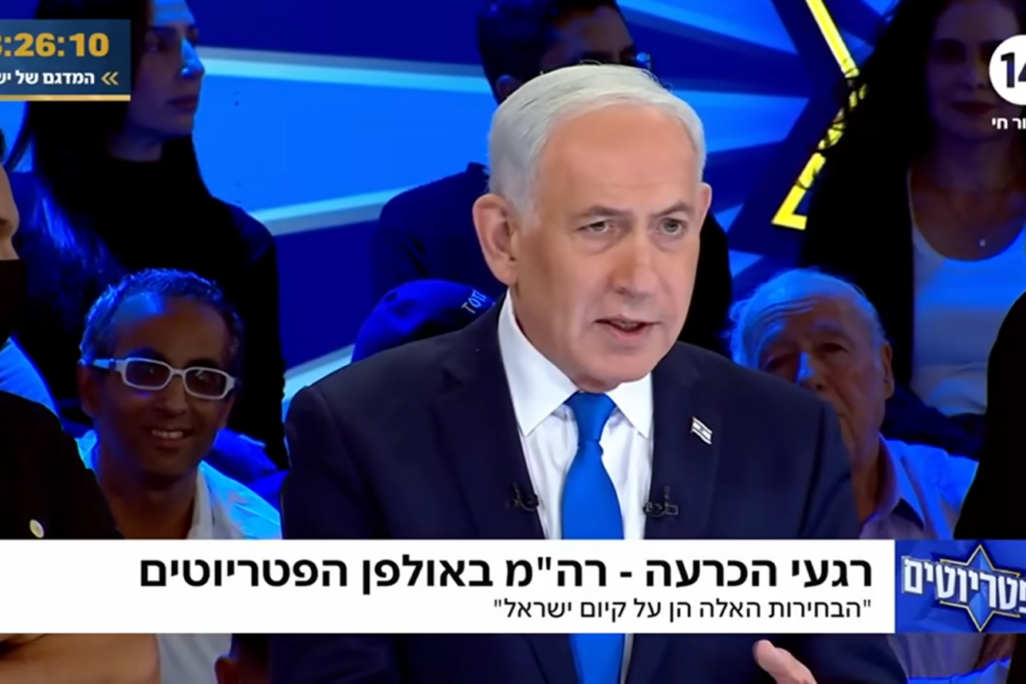
In the days before the election, Prime Minister Benjamin Netanyahu gave a series of interviews to media outlets identified with the right, chiefly Channel 14 and Galey Israel radio. Alongside calls to energize voters, attempts to persuade people not to vote for the small right-wing parties and a repeat of his messages against the media, Netanyahu addressed a video that he claimed the Iranian regime had published.
“I say to my brothers and sisters, citizens of Israel, I know you are busy with day-to-day matters or with the baseless affairs that the panic channels are trying to feed you. But there is one fundamental question here: existence,” the Prime Minister said on the Channel 14 program The Patriots on Sunday evening, two days before the election. “Today, this morning, Iran’s news agency published the video in which you saw the directive from Mojtaba [Khamenei] to drop nuclear bombs on Israel. They have renewed the nuclear program.”
A day later, in an interview with host Boaz Golan, the Prime Minister repeated the claim that the Iranian news agency had published a video threatening Israel with nuclear weapons. Netanyahu referred to the warnings he had sounded over the years about Iran’s nuclear program and claimed that the media used to dismiss them as “another Netanyahu spin.” He said that Israel was on the brink of annihilation a year ago, and that only his actions, along with those of the army and the resilience of the people, prevented it. “It takes one atom bomb. They call Israel a one-bomb country. But just to be safe, they want to prepare many bombs. Nuclear bombs like these destroy the State of Israel,” he said.
Netanyahu then returned to describing the video that he claimed was published in Iran: “Yesterday the Iranian news agency, an official agency of this dark regime, published a video in which they show how the dictator of the day, Mojtaba [Khamenei], orders the preparation of a nuclear bomb, and then they show the bomb on Israel.” He ended his remarks with a call to voters: “So what are you waiting for? Listen to me, our fate is in your hands.”
The Channel 14 hosts did not ask Netanyahu for a source for this information, did not ask to see the threatening video and did not take steps to bring it to air afterward.
Experts on Iran and Digital Verification: “We Couldn’t Find Such a Video”
In a check we conducted with an Iran expert and a digital literacy expert who specializes in debunking fakes on social media, we were unable to find such a video, a mention of it on news sites or a reference to it, or anything similar to it, on social media.
“My Iranian research assistant and I did not find such a video,” Dr. Tamar Eilam-Gindin, an author and Iran expert at the Ezri Center for Iran & Persian Gulf Studies at the University of Haifa, told Davar. “I assume that if it existed, it would have received a lot of echo. The regime has many users, some of them humans and some of them machines, and if there had been propaganda like this, it would have been echoed and would be easy to find.”
Tal Hagin (27), a digital verification expert and director at an international intelligence company who specializes in making digital literacy accessible, told Davar: “I checked all kinds of channels, official and supposedly official, and did not manage to find any AI video or anything similar to what the prime minister is talking about.” Hagin, who debunks fakes as a hobby on his X page, described his method: “I built a folder of links to Telegram, to X and to other places where the Iranians make statements, and ran a check there, and we used other means and researchers to look for such a video.”
Hagin also consulted several researchers who have contacts inside Iran. “No one knows what this is about,” he said. “The only thing I found was a written warning, allegedly from Mojtaba, that Iran would harm anyone who harms its interests, nothing connected to nuclear weapons.”
Nine Hours Before the Interview: Netanyahu Posted an Atom Bomb Simulation on Tel Aviv
At 11:35 a.m. on Sunday, October 25, Netanyahu published a post (in Hebrew) on social media with an AI-generated simulation of an atom bomb dropped on Tel Aviv, along with text written by Yuval Bloomberg. The warning in the post and the image is clear: If Netanyahu is not elected prime minister, our fate is sealed. The post ends with the following words: “Anyone who cares about their own physical survival, and that of their family and loved ones, should have their hand tremble before choosing someone who will not be able to complete the mission, thereby condemning themselves and their family to the danger of a second Holocaust, because of their political hatred or because of a foolish, unimportant sham storm.”
Nine hours after the post was published, Netanyahu arrived at the The Patriots studio on Channel 14, where he spoke about Mojtaba’s video without showing clips from it or evidence of its existence. In the hours between the post’s publication and the interview, Netanyahu was widely criticized for the fear-mongering messages in it and the apocalyptic scenario it presented. Times of Israel reported, citing a Channel 12 report, that “White House officials were alarmed by the post that Prime Minister Benjamin Netanyahu published today.”
“It’s not that there are no threatening videos,” Gindin said. “There are leaks attributing to Mojtaba statements about an atom bomb and that he would reverse his father’s ruling [the fatwa against nuclear weapons], but I haven’t seen any AI video, and certainly not a real video of him.”
“Maybe there’s a game of broken telephone here,” Hagin suggested. “Someone on Netanyahu’s staff saw something on TikTok, and it became ‘Iran declares.’ I’ve seen professors of mine make mistakes with fakes on social media; it can happen. That doesn’t absolve the Prime Minister of responsibility, if that’s the case, but the internet is not like covert intelligence. The information passes under far fewer eyes.”
Hagin said the difficulty in distinguishing between political messages and intelligence information puts the onus on the Prime Minister to present the sources he relies on. “One of the problems Netanyahu has as prime minister is that it isn’t clear when it’s a campaign and when it’s real intelligence, and he has to take into account that he needs to persuade the unconvinced, the suspicious. Every politician must internalize: If you have the ability, bring the source.”
Hagin stressed that he does not entirely rule out the possibility that such a video exists: “There could always be an official account or Telegram channel, a real one, that we haven’t found, which is why I’m telling Netanyahu: Show the video.”
The Prime Minister’s Office declined to respond to our inquiries.