
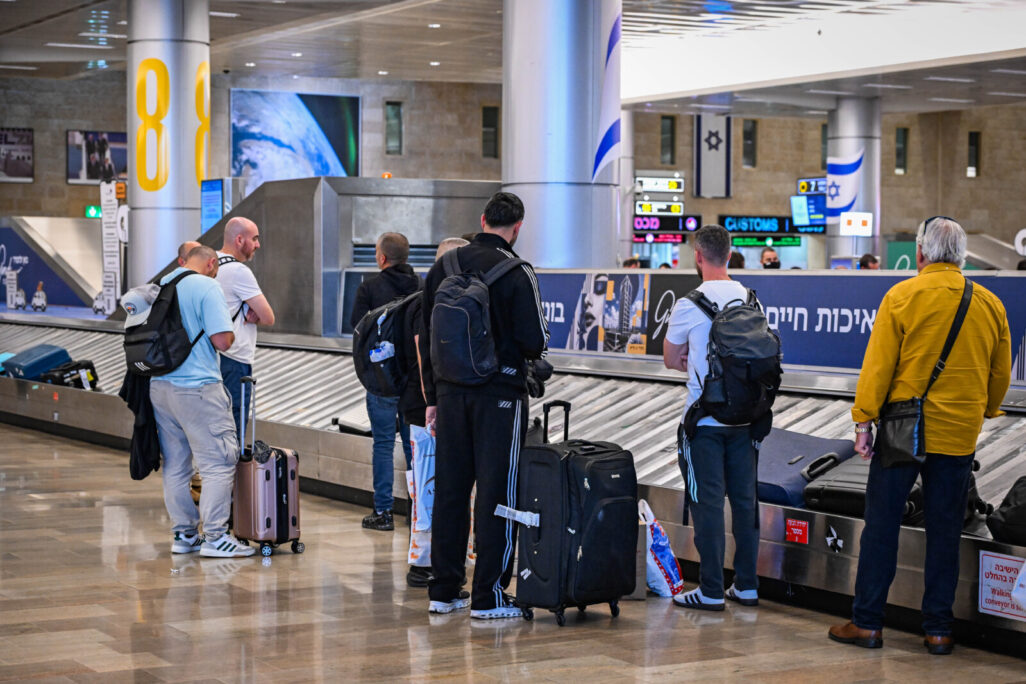
One of the figures that attracted considerable public attention was the number of people who came specifically to vote. Some have even viewed this as a strong disincentive for the Change Bloc to hold another election. However, according to preliminary data published by the Central Bureau of Statistics, it is difficult to find evidence of a decisive impact by Israelis who flew in specifically to vote.
In October 2026, there were 87,200 entries into Israel by Israelis living abroad. This figure is not equivalent to the number of Israelis who came to vote in the 26th Knesset elections: some of those who entered the country may have left before election day, others stayed in Israel but did not vote, and some came for visits that were unrelated to the elections. Nevertheless, the figure makes it possible to examine changes in the volume of arrivals in Israel compared with previous months.
The figure in its new format began to be published last June, with comparative data from the previous year added subsequently. In October 2025, there were 52,300 entries by Israelis living abroad, meaning that October 2026 saw an increase of 34,900 entries, or around 67%. Compared with September 2026, when there were 62,400 entries, this represents an increase of around 24,800. The October figure is also around 25,000 entries higher than the average for the months for which data are available, although this comparison is affected by seasonality, the summer months and the timing of the holidays.
There is no data on the reasons why Israelis entering the country came. It is reasonable to assume that some of the increase was related to the elections, but it is not possible to attribute all the additional entries to this purpose, or to determine from the data how many people came specifically to vote. It is also important to distinguish between the number of entries and the number of people: the data refer to movements across the border, and do not necessarily represent different individuals.
Before the elections, the Fly&Vote initiative, which worked to encourage Israelis living abroad to return to vote, estimated that around 67,000 Israelis would come to cast their ballots. The estimate was based on registration data and a survey conducted by the initiative, rather than an actual count of voters. The CBS data cannot confirm this estimate, but neither can they directly disprove it, since they do not identify the purpose of people’s arrival.
What about the electoral power of Israelis who came from abroad? In the most recent election, an average of around 45,000 votes was needed to secure one Knesset seat, after deducting votes cast for lists that did not pass the electoral threshold. If, for illustrative purposes only, we assume that around 25,000 additional people came specifically to vote, and that all of them were eligible voters who actually cast a ballot, this would amount to a number of votes equivalent to just over half a Knesset seat. However, this is purely a mathematical illustration, not a substantiated estimate of the number of voters who came from abroad. The data does not make it possible to determine how many of those entering the country were children, how many voted, or which lists received their votes.
The question of which parties Israelis who came from abroad voted for also remains open. Contrary to the common assumption that Israelis who have emigrated abroad necessarily lean towards certain political positions, studies conducted before the war did not point to significant or clear-cut differences in their political views. Since the beginning of the war, emigration from Israel has increased, but there is insufficient data on the political views of more recent emigrants. Even if their employment and educational profiles may point to certain trends, this is not enough to determine how they voted.
The Extent of the Impact Cannot Be Determined
According to CBS figures cited on the eve of the elections, around 810,000 eligible Israeli voters currently live abroad. Compared with this number, an additional 25,000–35,000 entries into Israel during October represents around 3%–4%. Here, too, the comparison is between two different sets of data: all eligible voters living abroad on the one hand, and the additional number of entries into Israel on the other. The comparison illustrates the scale of the figures, but does not indicate the actual voter turnout.
The arrival of Israelis from abroad was one of the issues discussed during the election campaign, and at one point the Likud even took action against an initiative that helped bring them to Israel. After the elections, the possibility was also raised that the participation of Israelis living abroad had affected the voting results and the balance between the blocs. However, the data published so far do not make it possible to determine the extent of the impact, and certainly do not prove that it decided the election

A more significant and clearer figure is the overall voter turnout. Turnout rose to around 77.9%, compared with approximately 70.6% in the previous election – an increase of around 7.3%. At the same time, the number of votes cast for lists that failed to pass the electoral threshold fell from around 417,000 to around 308,000. Taken together, this means that the share of eligible voters whose votes went to lists that passed the electoral threshold reached around 74%, compared with approximately 64% in the previous election. This means that the current results reflect a higher proportion of eligible voters whose votes were included in the allocation of Knesset seats.
Therefore, even if many Israelis came from abroad to vote, there is no basis for concluding that they alone changed the balance of the election. The clearer and more significant change is the overall level of voter participation and the reduction in the proportion of votes that were not translated into representation in the Knesset. This is also a key factor in the debate over the need to form a government based on the current election results.