
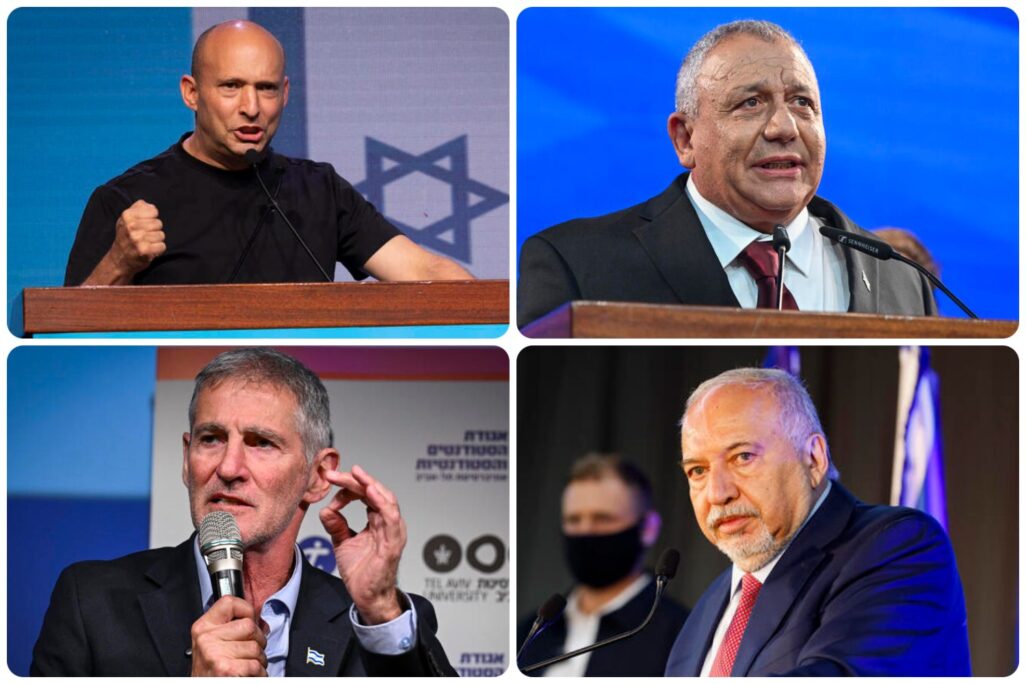
Yashar party leader Gadi Eisenkot announced on Friday that significant progress had been made in negotiations to form a new government, and that talks between the parties in the Change Bloc had also resulted in “breakthroughs”. In a post published on his Facebook account, Eisenkot presented his plan to form a national emergency government and warned those who might try to delay its formation for personal reasons. He said he hoped to receive the mandate to form the government from President Isaac Herzog early next week.
“Israel is facing a real, tangible and dangerous state of emergency,” Eisenkot wrote. He accused the Netanyahu government of harming Israeli democracy and conducting the war for political considerations, and claimed that Israel was also facing a severe diplomatic crisis. Under these circumstances, he said, a new government must be sworn in as quickly as possible, in order to prevent another election campaign and the continuation of Netanyahu’s tenure as head of a caretaker government.
Eisenkot explained that his plan is based on forming a government initially comprising four Zionist parties in the Change Bloc: Yashar, Beyachad, The Democrats and Yisrael Beiteinu. It would then be able to expand through the addition of other parties and Knesset members. “The logic behind it is to swear in a government as quickly as possible, based on the four Zionist parties of change and correction, with any party and any Knesset member who agrees to my four fundamental principles joining, immediately or gradually.”
The four principles presented by Eisenkot are recognition of Israel as a Jewish and democratic state; acceptance of the values of the Declaration of Independence; mandatory service for all, whether military, national or civilian; and recognition of Hamas as a terrorist organisation, alongside a commitment to dismantling its military and governing power. He said he intends to approach all Knesset factions and invite their members to join the government if they agree to sign the principles, even after it has been formed.
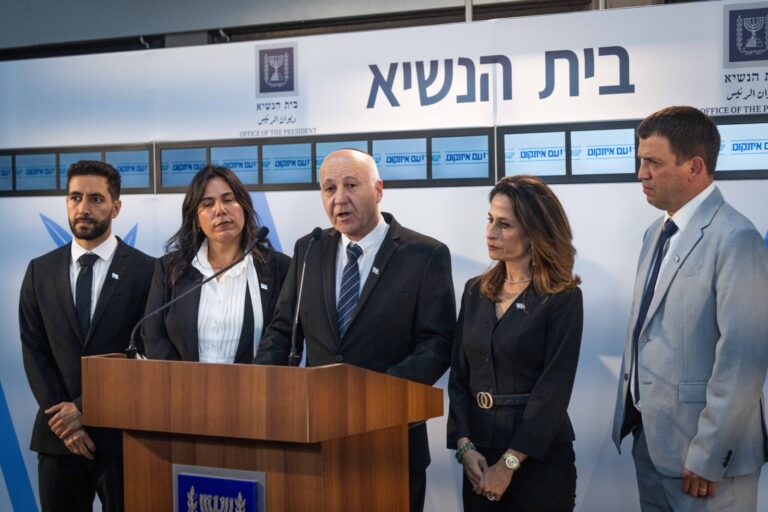
Referring to the negotiations taking place over the past few days, Eisenkot wrote that he and his team had been holding numerous meetings, some of which had not been made public. “I find my partners in the bloc to be people who understand the gravity of the moment. We have made significant progress and achieved breakthroughs as well – quietly and modestly, with much remaining behind the scenes.”
Eisenkot also addressed the results of the consultation round at the President’s Residence, in which 67 Knesset members recommended him, compared with 46 who recommended Netanyahu. He said this reflected the public’s desire to replace the government. “In practice, 74 Knesset members did not express confidence in Netanyahu continuing in office,” he wrote, including in his calculation the seven United Torah Judaism MKs who did not recommend any candidate.
At the end of his statement, Eisenkot warned against attempts to thwart the formation of the government. “I intend to carry out the mandate the people have given me, and the mandate the president is expected to give me, with the utmost reverence,” he wrote. “Anyone who tries to stall and sabotage the formation of the government for personal and irrelevant reasons will be remembered by history as someone who failed to rise to the occasion and did not act to save Israel in a time of emergency. This will not be forgiven.”
Lieberman Willing to Compromise on Conscription, but Opposes Relying on Arab Parties
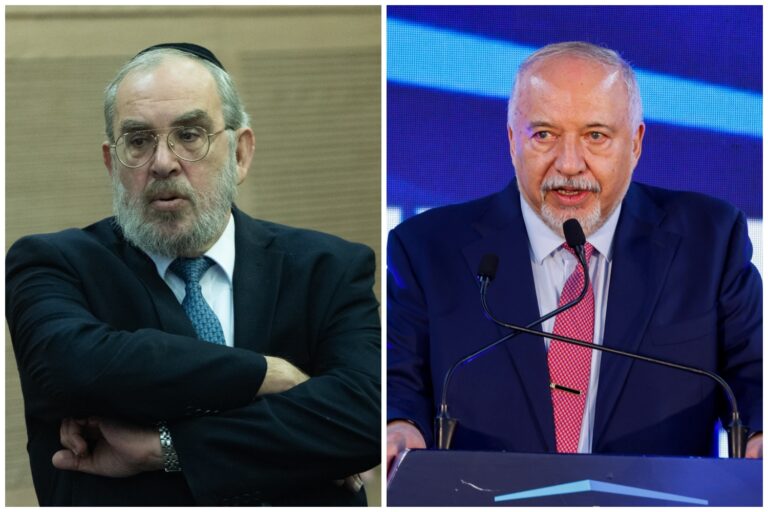
Eisenkot’s announcement came hours after Yisrael Beiteinu leader Avigdor Lieberman announced that he was also willing to compromise on the issue of the conscription law, in order to allow the formation of a government without Netanyahu. As reported earlier, Lieberman wrote that “the election results require all of us to reassess our course”, and that “national responsibility requires us to make difficult decisions and be prepared for painful compromises”. According to him, “on all other issues, it is permissible and desirable to show flexibility, compromise and understand that trying to get everything means getting nothing. This also includes the issue of the conscription law.”
However, Lieberman reiterated that he would not support a minority government that relied on Ra’am and the Joint List abstaining. “I strongly oppose the formation of a government that relies on the abstention of the Joint List and Ra’am, and Yisrael Beiteinu will vote against such a government.” He called for the formation of a 61-member coalition without the Arab parties, and estimated that, once it was established, three or four Likud MKs could join it. Lieberman also denied that he was holding negotiations over a rotation agreement for the position of prime minister.
The main difficulty in forming the government stems from the distribution of seats in the new Knesset. The four parties in the Change Bloc hold just 48 seats between them, while the parties supporting Netanyahu hold 53 seats, and Ra’am and the Joint List hold 19 seats. The two ultra-Orthodox parties, Shas and United Torah Judaism, hold a combined 13 seats. Their joining the Change Bloc could give it a majority of 61 Knesset members, but no agreement has been reached at this stage on their joining the government. Lieberman’s newly expressed willingness to compromise on the conscription law may help advance the negotiations, but does not guarantee their success.
The consultation round at the President’s Residence concluded with Eisenkot receiving the recommendations of 67 Knesset members and Netanyahu those of 46. The seven United Torah Judaism MKs abstained from making a recommendation. President Herzog announced that he intended to assign the mandate to form the government next Sunday, but emphasised that, despite the gap in the number of recommendations, it was still unclear which of the candidates would be able to form a coalition. He said he would hold further one-on-one talks with party leaders in an effort to clarify the possibilities for forming a stable government.