
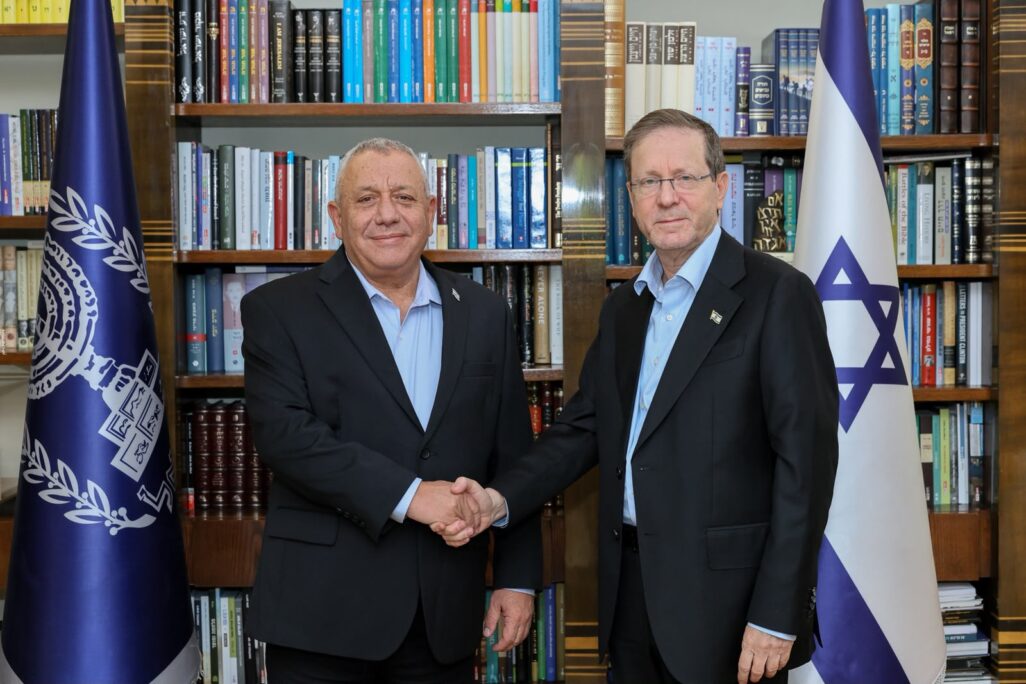
President Isaac Herzog will today (Sunday) task Gadi Eisenkot, leader of the Yashar party, with forming Israel’s 38th government. The ceremony is expected to take place at 17:00 at the President’s Residence in Jerusalem, after Herzog informed Eisenkot of his decision last night, following the round of consultations with Knesset factions and additional talks he held with party leaders.
Eisenkot responded to the president’s announcement in a post on X: “This is the time to form a national emergency government. I will do everything to ensure that we are worthy of this responsibility.” On Friday, he announced that talks between the parties in the Change Bloc had resulted in “significant progress” and “breakthroughs”, but did not elaborate on the agreements that had been reached.
According to a statement from the President’s Residence, 67 Knesset members recommended that Eisenkot be tasked with forming the government, compared with 46 who recommended Prime Minister Benjamin Netanyahu. The seven United Torah Judaism MKs did not recommend either candidate. Over the weekend, Herzog met separately with Eisenkot and Netanyahu and informed them of his intention.
Despite his lead in the number of recommendations, Eisenkot still does not have an agreed-upon coalition majority. The four parties in the Change Bloc – Yashar, Beyachad, The Democrats and Yisrael Beiteinu – hold a combined 48 seats. The other MKs who recommended him are from Ra’am and the Joint List, while Yisrael Beiteinu leader Avigdor Lieberman opposes forming a government that relies on their abstention.
Talks to Form the Government
On Friday, Lieberman announced that he was also willing to compromise on the issue of the conscription law in order to enable the formation of a government without Netanyahu. “National responsibility requires us to make difficult decisions and be prepared for painful compromises,” he wrote. However, he clarified that Yisrael Beiteinu would vote against a minority government that relied on the Arab parties. His shift in position on the conscription issue could open the door to dialogue with the ultra-Orthodox parties, but no agreements that would enable them to join the coalition have yet been reported.
Eisenkot presented four principles on which the government he seeks to form would be based: recognition of Israel as a Jewish and democratic state; acceptance of the values of the Declaration of Independence; mandatory service for all; and recognition of Hamas as a terrorist organisation, alongside a commitment to dismantling its military and governing power. According to Eisenkot, any party or Knesset member who agrees to these principles would be able to join the government, either when it is formed or later during its term.
On Saturday night, Netanyahu called for the formation of a unity government that would include the parties in the right-wing bloc and other Zionist parties, and warned against forming a government that relied on the support of the Arab parties. Eisenkot rejected the call, saying that Netanyahu was using the term “unity” only because he had realised that his days in office were numbered. According to Eisenkot, Netanyahu had previously acted against unity governments in which he himself had participated.
Once the president tasks Eisenkot with forming the government, he will have 28 days to complete the task, in accordance with the Basic Law: The Government. If additional time is needed, the president may grant him an extension of up to 14 days. The 26th Knesset is expected to be sworn in next Tuesday.