
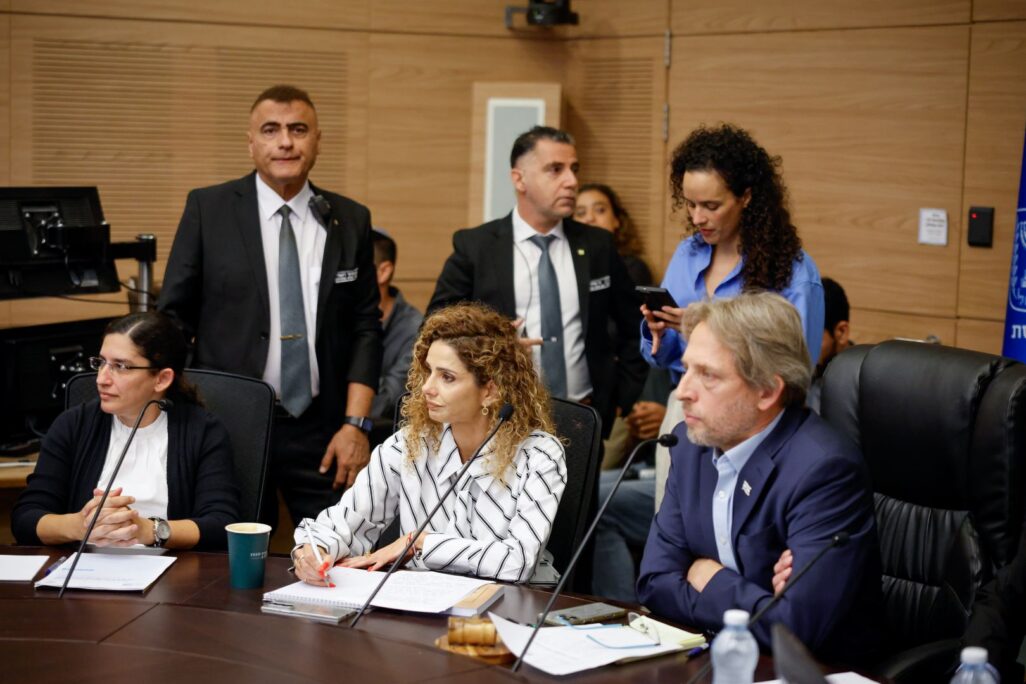
Israel’s defense establishment committed to future purchases totaling about US$31.5 billion, relying on the future aid agreements with the United States that were supposed to be signed and on the current agreement. Officials at the Finance and Defense ministries did not know about the understanding between Prime Minister Benjamin Netanyahu and U.S. President Donald Trump to immediately cancel the agreement in its entirety. This emerged at the first Knesset Finance Committee discussion, held yesterday, on the effects of ending the aid agreement with the U.S., which U.S. President Donald Trump announced last week.
The Memorandum of Understanding (MOU) between Israel and the U.S. was signed three times in the past 30 years. It is intended to regulate mutual purchases between the two countries and U.S. financial aid to Israel for defense procurement from the U.S., as well as additional agreements in principle concerning Israel’s qualitative military edge over its adversaries. The latest agreement went into effect in 2019 and is due to end during 2028, but last week Trump announced that the agreement would end immediately, in agreement with Netanyahu.
Government Ministries Don’t Know When the Aid Will End, or Whether a New Agreement Will Be Signed
During the discussion, it emerged that Israel had relied on the balance of funds in the current agreement, as well as on future aid funds, if agreed, in a total amount of more than US$31 billion. It also emerged that senior Finance Ministry officials were not aware of plans to end the aid agreement.
“It disturbs me, as a citizen, that senior Finance Ministry officials sit here and declare: We didn’t know, we woke up in the morning and heard an announcement by the president of the United States along with the rest of the world,” said Committee Chair MK Liran Avisar Ben Horin, who is a member of B'Yachad, the centrist Bennett-Lapid alliance. “We heard that they also don’t know whether this is an immediate stop or a stop at the end of 2028, when the agreement ends. This should disturb every citizen of the State of Israel. In the end the result is the same: This money comes back in the form of taxes on citizens who work and serve.”
Finance Ministry officials noted that at this stage there is no certainty about when the aid will end or the timing of it, and that staff work is under way, led by the Defense Ministry, to examine an alternative arrangement. It was also presented that ending the arrangement would mean a hit of about half a percent of GDP a year. Defense spending, the Finance Ministry said, has nearly doubled since the outbreak of the war, as have average deficit rates, which caused a significant rise in the state’s interest payments. To bridge defense costs, substantial changes were made “that raised the tax burden by a full percentage point of GDP,” a Finance Ministry representative said.
“It comes to US$3.8 billion a year. The budgetary aid is not only economic, it also establishes cooperation between Israel and the U.S.,” Avisar Ben Horin said, addressing the Finance Ministry representatives. “I’d like to understand whether there are alternatives to this aid, and whether an orderly work process was carried out. We would be glad to learn whatever the professional staff can teach us.”
“We did not know about the announcement,” said Shira Amiel Ben Abba, Deputy Director of the Budget Department and the official in charge of the defense budget, of the end of the aid. “There was no prior staff work on this matter. Ahead of the next aid agreement, there is a team led by the Defense Ministry that deals with the structure of the aid and with how to build the plan for the next round, for the next decade. We too are still trying to understand what the announcement means, where things are heading.”
In response to a question from MK Shaul Meridor, a member of Eisenkot's centrist Yashar party, the various government representatives noted that they, too, had not been familiar with the move. They also admitted that they had not dealt with an abrupt halt of a source of revenue of this kind. “One can cut from defense spending, cut civilian spending, raise taxes or increase the debt. If this sum doesn’t arrive, the government will have to decide what the mix among these things is. In the 2027 budget, the government will have to decide how to act.”
Increase in the Defense Budget, the Tax Burden and the Interest the State Will Pay
Tamar Levy Boneh, Deputy Director of the Budget Department at the Finance Ministry, noted that in recent years the defense budget has grown by tens of billions of shekels, to 8% of GDP in 2026, compared with 4.4% in 2022. The average deficit in the war years rose to 5.1%, and the debt-to-GDP ratio grew to about 69%, compared with 60% in 2022, she said. She also said there was a significant rise in the tax burden due to legislative changes in 2025, alongside the crowding out of part of civilian spending as a share of the budget.
Following that, Amiel showed that defense spending has nearly doubled since the outbreak of the war, as have average deficit rates, and that as a result there was a significant rise in the state’s interest payments.
Commitments of More Than $31 Billion, and No One Knows Where the Money Will Come From
Under the defense agreement with the U.S, the MOU, the current annual aid stands at $3.8 billion a year, and there are currently dollar commitments of about $24.8 billion beyond the framework of the existing agreement. Including the balance of funds remaining in the current agreement, Israel relied on more than $31 billion.
Finance Ministry officials noted that at this stage there is no certainty about the end of the aid or the timing of it, and that staff work is under way, led by the Defense Ministry, to examine an alternative arrangement, which may also bring new opportunities. It was also presented that ending the arrangement would mean a hit of about half a percent of GDP a year, and that the incoming government will be required to manage the balance between defense spending, the debt trajectory and the implications for the standard of living in the economy, and to factor American aid into the mix as well.
“There is now a budget of about 161 billion shekels (US $51 billion), while the Defense Ministry says it needs more than that,” Amiel said. “The defense establishment’s challenges in this period are many, both the budgetary challenges and the development of threats in general, the challenges of the reserves, the issue of returning to readiness, and a force buildup plan. There is today a force buildup plan that the prime minister agreed on, of about 350 billion shekels (US $111 billion), which will be spread over 13 years starting in 2027. Large parts of this plan have already been launched and other components are planned. All of these are significant challenges that will lead to a very high defense spending burden in the coming years, looking forward, with regard to the aid funds.”
A Worthy Discussion on Whether It’s Right to Wean Off Aid Money, and How
MK Hanamel Dorfman of the far-right Otzma Yehudit party argued that the security and diplomatic significance of the aid should be discussed. “Whether this is a unilateral announcement or whether there was some coordination at some level, I don’t think it’s our business as a committee to examine what coordination was done and at what level. In the end, this is a state-level event. Alongside that, I think that in the end, from a long-term perspective, this is welcome. This dependence of the State of Israel is not right. We are a sovereign state, and in the security sphere too we have our own priorities. I think it would surely be right, ahead of the next agreement, not to rush headlong into this, and to see how we set priorities at home, build them better, and not rely on outside actors.”
Meridor replied, using a verse from the Torah: “‘A people that dwells alone’ (Numbers 23:9) is not a work plan. To reach a state where we are preparing for the fact that we have no friends in the world and no ability to buy ammunition. That the government reached a situation in which Trump has to say that he will stop aid on the morning of [the U.S. midterm] elections is an unfathomable failure. Imagine the finance minister giving up a percent of the budget. Discussions were held over much less than that, over fuel. Here it seems the prime minister is giving up 24 billion shekels (US $7.6 billion) on his own, when the U.S. also gained from this agreement. It’s happening without staff work. All the ministries say they didn’t know about it. If the previous government’s policy continues, no one will sell us ammunition, maybe Iran. I don’t know where we’ll get these 12 billion shekels (US $3.8 billion), but it will come out of the citizens’ pockets every year.”
“This is a worthy discussion on whether it’s right to wean off the aid money, and how and with what it should be replaced,” the committee chair concluded, referring to the Finance and Defense ministry officials. “It disturbs me that they tell me even the next agreement is already committed. That is, we behaved as though we have money that, a week ago, we were told we don’t have. So even if you think it’s right to wean off, staff work must be done,” she said, announcing that she would summon more senior officials for the continuation of the discussion.