
Khader Washah was a fourth-grade student when he came across a sight he could not forget. On his way home from school, he saw his cousin emerge from the house with flames engulfing her body. He was just a child then, but that memory continued to haunt him into adulthood. When he was 25, his aunt was murdered alongside other family members. Alongside the pain and terror of the events themselves, the silence surrounding them was also etched into him: the things left unsaid, the questions left unasked, and the grief that was given no public expression.
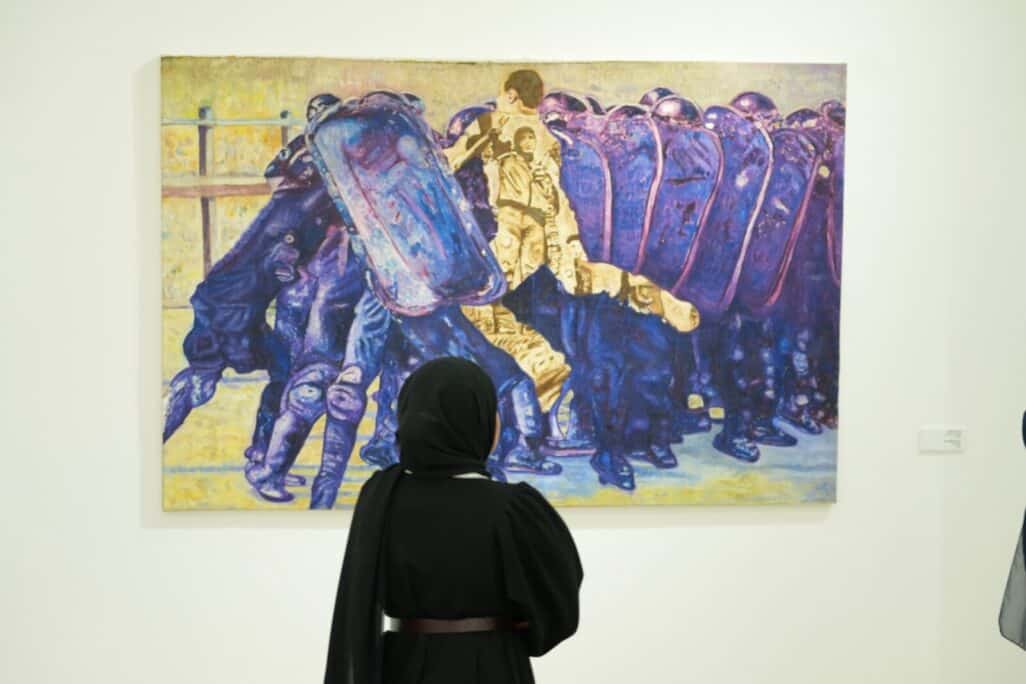
Decades later, Washah—an artist and educator living in Rahat—chooses to return to these memories specifically through art. In his solo exhibition, Hukm (حُكْم), presented at the Al-Qasuom Art Gallery in the Negev Bedouin village of Umm Batin, he tackles violence against women and femicide, examining the mechanisms of power and silence that allow these phenomena to persist.
")
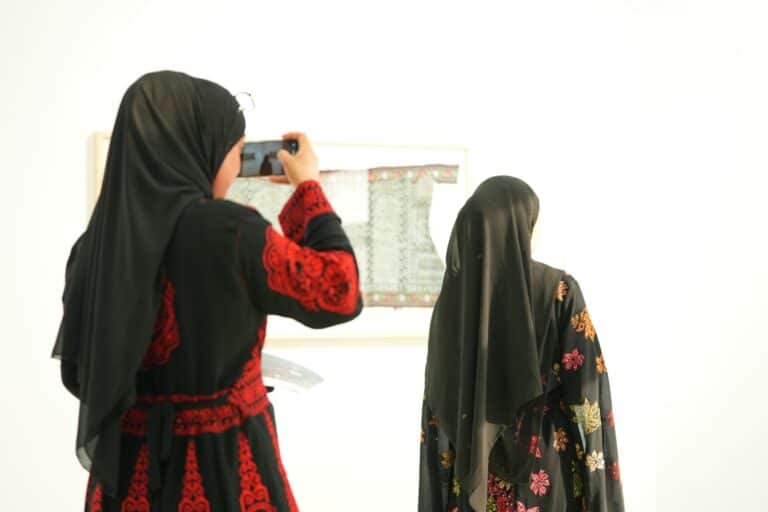
Among the works displayed in the exhibition are large-scale paintings alongside pieces incorporating traditional Palestinian dresses once worn by women. Washah unravels the fabrics, separates the embroidery, and integrates them into his works. The act of unraveling becomes an artistic gesture of disclosure in his hands: what was hidden within the family and society gains a tangible, colorful, and painful presence.
“In our society, as a man, this isn’t easy for me,” he says regarding the decision to address the issue publicly. “It isn’t even talked about inside the home; no condolences are accepted, and people act as if nothing happened. But the pain remains.”
“My extended family doesn’t want me to talk about it”
Washah was born in 1966 in the Al-Bureij refugee camp in the Gaza Strip to a family that fled the village of Beit 'Affa in 1948. In 1985, he went to study in the United States, and in 1989, he married Johar and moved to Rahat. His life story moves between Palestinian, Arab, Bedouin, and Israeli identities and spaces, and the complex relationships between them are also present in his work.
Tackling femicide is not new to his work, but exhibiting these pieces to the Arab-Bedouin community in the Negev represents a particularly significant step for him. For years, he kept some of the works stored away in his studio, in part due to concerns over how they would be received and the potential repercussions of such exposure for his family members.
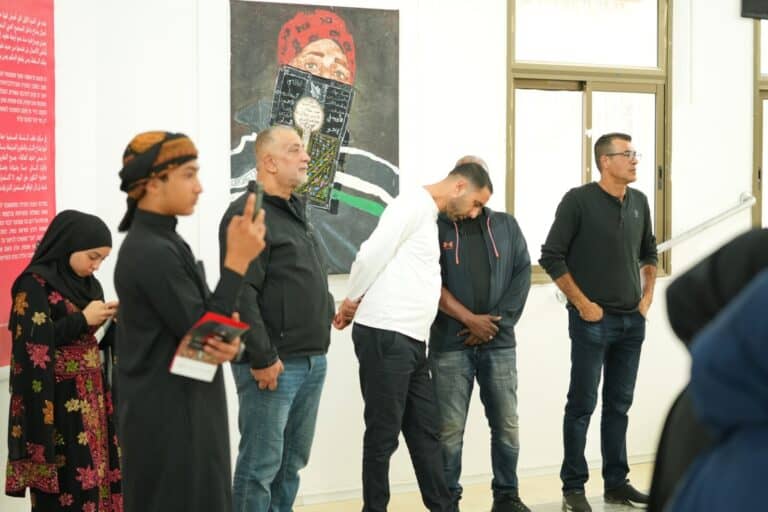
"For several years, the works stayed in the studio. I didn't want to exhibit them to Israeli society because it comes from a different perspective and framing, and I didn't want to hurt myself or the people close to me," he shares.
Even within his own family, not everyone accepts his decision to speak out. "It took me a long time to gather the courage to talk about this," he says. "The extended family doesn't want me to talk about it. It’s a topic people don't want to discuss or debate, and they don't want to open it up at all."
Yet according to him, it is precisely this silence that forms part of the problem. Washah seeks to challenge the prevailing social explanations for these murders and the use of the term "family honor," or "honor killings" which he contends sometimes conceals entirely different motives.
“People talk about ‘family honor,’ but from the cases I researched, the perpetrators murdered over inheritance, refusal to marry, and all kinds of things hidden under this umbrella to whitewash the issue,” he says, adding that he feels many of the murderers go unpunished. “It pains me to think about how I am supposed to feel safe regarding my daughters, my wife, my sisters, and my aunts.”
Despite his personal and community starting point, Washah refuses to confine the discussion of violence against women to the bounds of Arab society. For him, it is a phenomenon that crosses countries, cultures, and religions, and one that requires a broader confrontation.
“I am not only talking about femicide in Arab society, but about femicide all over the world. A woman is a woman and a mother is a mother, and you cannot view women solely through the definitions of race, religion, and nationality,” he says.“It happens in every society—Western, South Asian, African. This killing simply doesn’t stop. Everything we hear brings me right back to the things I experienced from a young age.”
An Unraveling Dress, A Revealed Memory
One of the most prominent expressions of Washah’s engagement with women and memory appears in his series of works titled "Hagar." To create these pieces, he utilizes old, traditional Palestinian dresses that he has collected over the years. Rather than preserving the garments in their entirety, he deconstructs them and incorporates their components into new works.
The dresses—which once held the bodies of women and bore the marks of their embroidery—thus take on a new life. The fabric and needlework serve not merely as raw material, but as evidence of a female presence, of tradition, and of memory. Through them, Washah seeks to give voice to women whose perspectives are absent from the discourse, and to the pain that lingers after their stories have been silenced.
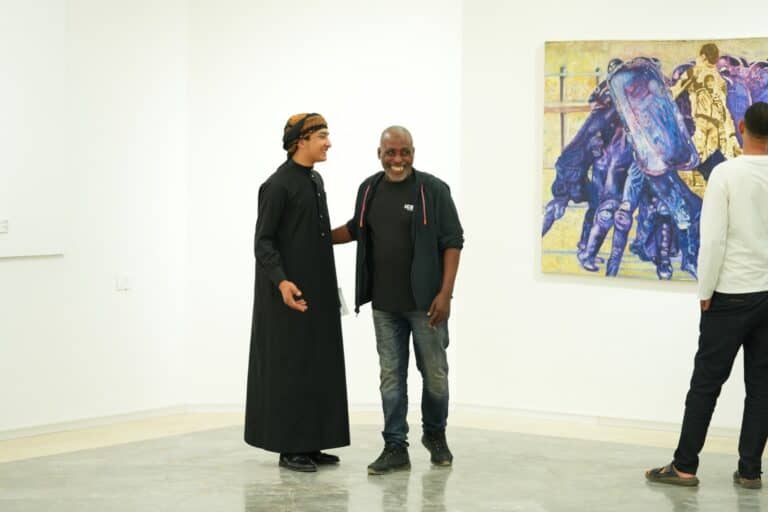
"As a collector of old Palestinian dresses, I unraveled them," he recounts. "I took the human element and the craftsmanship embedded in them to present this work. It was deeply fulfilling for me, both as an artist and as an individual, and it allows me to breathe a little. At the very least, I’ve managed to express what I had to say."
There is something particularly charged about the choice to unravel a traditional garment. The dress serves as an expression of cultural identity and a craft passed down through generations; yet, in Washah’s work, it also becomes a means to question the status of women within the society that preserves this tradition. He does not discard the beauty of the fabric and embroidery; rather, he employs them to bring to the surface what exists alongside them.
Who judges, who rules, and who pays the price
The title of the exhibition, Hukm, encapsulates the core questions that preoccupy Washah. The Arabic word carries several meanings, including rule, judgment, authority, decision, and verdict. This multiplicity of meanings is not accidental: it allows for an examination of who holds the power to make decisions about the lives of others, who grants them that authority, and who bears the consequences.
The exhibition's curator, Raz Gluzman, explains that selecting a word that cannot be unequivocally translated into Hebrew was intended to leave these questions open. In Washah’s works, these questions touch not only on the relations between men and women, but also on political power, governance, and oppression.
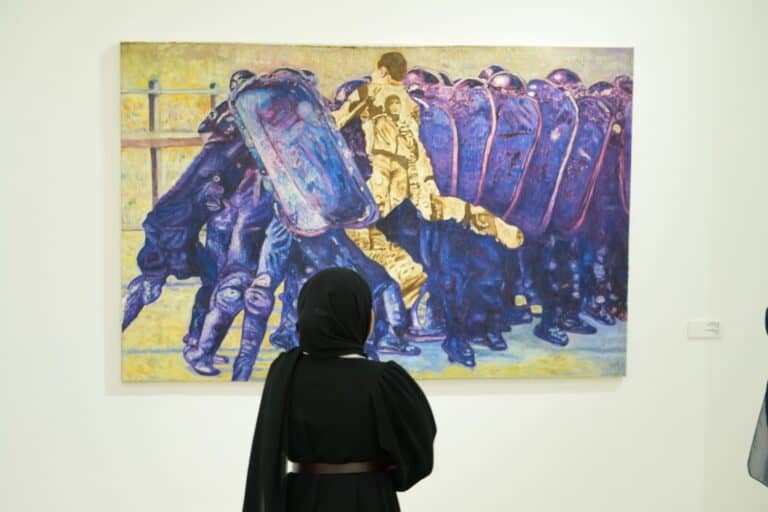
One of the central works in the exhibition is an oil painting measuring over three meters in length, created in the aftermath of the Arab Spring. At its center appears Mohamed Bouazizi, the Tunisian street vendor who set himself on fire to protest the humiliating treatment he suffered at the hands of authorities—an act that became one of the catalysts for the wave of protests across the Arab world.
In the painting, Bouazizi is depicted lying in a hospital bed after suffering severe burns. Beside him stands a woman dressed in traditional attire from head to toe, alongside a sign in Hebrew and English calling for freedom and peace. Gluzman views the current presentation of the work as a bridge connecting a political outcry voiced over a decade ago with present-day social and political reality.
Although the painting was inspired by a specific historical event, the questions it raises regarding humiliation, power, and freedom remain relevant today in his view. The interplay between the various works expands the exhibition's scope: moving from violence against women within the family and community to the power dynamics that shape individual life in society as a whole.
Art in the Heart of the Village
The location where the exhibition is presented also carries significance. Washah’s works have previously been exhibited in art institutions, including the Mishkan Museum of Art, Ein Harod, and the Umm al-Fahm Art Gallery. This time,however, they are arriving for the first time as a major display inside the Arab-Bedouin community in the Negev.
The Al-Qasuom Gallery operates within the community center building in Umm Batin, adjacent to public services such as a Tipat Halav (infant-care clinic) and the Employment Service. Its location creates an encounter between art and the daily lives of local residents, including those who do not typically visit museums and galleries.
")
"Many of the people who come to the gallery have never been to a gallery before, while others have never visited a Bedouin village," says Gluzman. According to him, the gallery also attracts visitors from outside the village and the regional council—including residents of Rahat, Kuseife, Be'er Sheva, and Mitzpe Ramon. Guided tours are conducted in both Arabic and Hebrew, and the community-based structure facilitates encounters with audiences different from those who typically frequent large art institutions.
For Washah, the exhibition in Umm Batin is more than just an opportunity to showcase his work to a new audience; it allows him to bring challenging questions into the social sphere in which he operates, inviting viewers to engage with them firsthand.
Art as a Catalyst for Social Change
Washah’s belief in the power of art to effect change extends beyond his own personal creative work. For nearly two decades, he has taught and directed the art program at the Segev Shalom Comprehensive High School—a program he established, which has been attended by hundreds of students over the years. In his view, teaching is not a pursuit separate from artistic creation, but rather an integral part of the same worldview. He sees art as a means to broaden the horizons of young people, stimulate independent thinking, and encourage them to re-examine the reality surrounding them.
Graduates of the program continue to engage with art, and some have even gone on to become teachers themselves. Washah notes with pride that, for many years, it was primarily female students who chose to join the program. In recent years, however, there has been a shift, with an increasing number of boys also seeking to participate. "Every year, about 17 to 21 of my graduates go on to pursue art," he says. "It’s a joy to see them, support them, and stay in touch regarding a wide range of topics."
.")
His students are also familiar with his work outside the classroom. They encounter his pieces in books and online, and sometimes ask him to take them to exhibitions in which he is participating. This engagement allows them to see how social and political issues can be transformed into artistic creations.
Washah does not claim that his work provides a solution to violence against women. Rather, his primary goal is to end the act of repression—to give space to the pain and to challenge the social conventions that allow the silence to persist. "The role of art is to serve as a mirror to the era in which we live—socially and politically. As artists, our duty is to present things directly; if we sugarcoat reality just to please society, then what is the purpose of art? Art must be powerful and righteous."
")
After carrying the memory of his cousin, and the trauma of a murder within his family for decades, Washah has chosen not to keep these stories confined to his studio or his home. He brings them before the public, even when doing so is met with resistance, aiming to transform the act of witnessing them into a conversation that can no longer be avoided.
"My role is not to provide solutions, but to pose questions," he says. Perhaps the most significant question of all is also the simplest—one he directs both at himself and at the society around him: "Why accept this in silence?"